👉 Web designer, video editor & AI content creator expert.
👉 Web designer, video editor & AI content creator expert.

🤖 AI-Generated Storytelling Videos That Create Emotional Impact
In today’s content landscape, attention is won through emotion — and storytelling is what keeps people watching.
This project showcases AI-generated visual content combined with strategic editing, voice integration, and message-driven storytelling to create highly engaging short-form videos.
Using tools like Grok for visual generation, CapCut for editing, AI voice processing (Audiofish), and ChatGPT for scripting, each piece is carefully crafted to deliver a cohesive and emotionally resonant experience.
These videos are designed to:
capture attention instantly
create emotional connection
increase viewer retention
This is not just AI content — it’s a storytelling system built to engage, connect, and stand out in crowded feeds.
0
100

🔥 Short-Form Video That Turns Emotion Into Engagement
In today’s digital world, attention is everything — but emotional connection is what truly drives engagement.
This short-form promotional video was created to showcase a content style focused on deep reflection, emotional impact, and audience connection, inspired by stoic philosophy and modern digital storytelling.
Developed using tools like CapCut, Canva, and Adobe Photoshop, this type of content is designed to capture attention quickly, keep viewers engaged, and build a strong personal or brand identity online.
These videos are not just visually appealing — they are strategically crafted to make people stop, think, and connect.
This is the kind of content that doesn’t just get views… it creates impact.
0
94

:Modern Website Design for Content & Service Businesses
I design clean, high-converting websites that showcase services clearly and help businesses attract and convert clients online. This project focuses on content structure, visual clarity, and user experience.
1
99

🎤 High-Impact Talking Head Reels That Capture Attention Instantly
Most people record videos… but very few know how to turn them into impactful content.
This short-form video showcases a full production process including on-camera performance, lighting setup, audio capture, and professional editing, designed to create a strong emotional connection with the audience.
Recorded using a personal studio setup and edited in CapCut, this type of content combines clear messaging, visual storytelling, and attention-focused editing to keep viewers engaged from start to finish.
The scripting process (assisted by AI tools like ChatGPT) ensures that every message is intentional, direct, and emotionally resonant.
This is not just a video — it’s a piece of content designed to make people stop, listen, and remember.
0
97

UGC Creator | Beauty, Self-Care & Home Videos | South Africa
New to Contra
UGC Creator | Beauty, Self-Care & Home Videos | South Africa





Senior AI Solutions Architect | Agentic AI & RAG



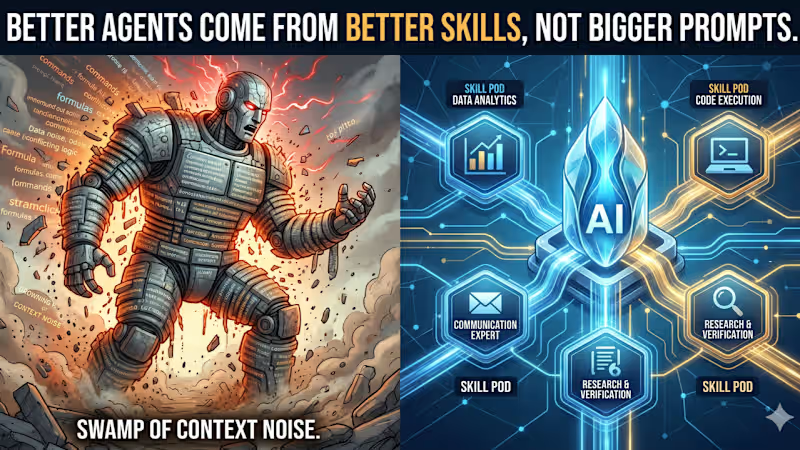
A lot of people building with Claude Code-style agents are still focused on prompt engineering.
I get why. It’s the most visible lever.
But I think the bigger opportunity is usually somewhere else: the reusable skills, workflows, or slash commands an agent relies on over and over again.
Those are what shape behavior over time. And in my experience, improving them is less about piling on new instructions and more about tightening the loop around failure.
Watch where the agent breaks. Figure out why. Fix the workflow. Repeat.
Sometimes that means adding a rule. Just as often, it means removing one.
Over the last couple of days, I rebuilt the /close-loop cycle in my framework, Rebar, and it clarified something I’ve been feeling for a while:
A lot of agent systems have evaluation. Fewer have a feedback loop that actually makes them simpler, cheaper, and more reliable over time.
That difference matters.
In the old version of my loop, a feature could be marked complete because the evaluator returned a PASS. The orchestrator would close the issue, everything looked fine, and only later would I realize something important was still missing — like a Prisma migration file.
So the feature wasn’t really done. It just had the appearance of being done.
The evaluator had often already pointed at the problem in its follow-up notes. But the system wasn’t treating that kind of language as blocking. “PASS with follow-ups” was getting interpreted too generously.
That was the real failure: not bad evaluation, but a weak handoff between evaluation and release.
So I rebuilt the loop around four gates, and all four have to pass before “done” means anything:
1 . Evaluator Checks code, scope, and completeness and writes structured findings.
2. Release gate Scans those findings for blocking language like “must generate,” “cannot ship,” or “before any live DB.” If that language shows up, the work is blocked.
3. Cycle-scoped improve step Promotes only the current cycle’s validated observations into the expertise file, instead of dragging in stale backlog noise.
4. Meta-improve Looks across evaluator logs for repeated failure patterns and proposes changes to the templates themselves, with a human review step before anything sensitive gets updated.
That last piece is where the compounding effect starts to show up.
Because the default instinct in agent systems is usually to add.
Add another reminder. Add another caveat. Add another paragraph to the template so the model doesn’t make that mistake again.
Sometimes that’s right. But it’s also how workflows slowly turn into bloated instruction stacks that cost more and work worse.
Every extra line gets paid for on every future run. And long prompts full of overlapping rules are often harder for models to follow consistently than a smaller number of clear ones.
So the better question is not “what else should we add?”
It’s “what actually belongs in the workflow?”
In the first real cycle of the rebuilt loop, I saw four patterns:
- schema changes without Prisma migrations
- dirty working tree bleeding across features
- orphan Vue refs that were declared but never rendered
- Hono context typing debt across multiple routes
Only the first two justified workflow changes.
The orphan refs were already being caught by the evaluator, so there was no reason to duplicate that logic in the template. The Hono typing issue was real, but it was cleanup work, not a process problem.
That distinction matters more than it sounds.
If every bug becomes a workflow rule, the system gets heavier every week. If you’re disciplined about separating repeatable process failures from one-off implementation issues, the workflow stays lean.
And that’s really the bigger point here.
There are two things improving at the same time:
First, context gets better. Validated observations get promoted into structured expertise, so the next run starts with better knowledge of the codebase and less repeated discovery.
Second, workflow gets sharper. The system looks at repeated failures and changes the reusable commands around the agent — ideally by adding only what consistently matters and cutting what doesn’t.
That combination is where the gains compound.
The agent starts with better context, but a lighter operating model.
That’s a much healthier direction than what a lot of systems drift toward, which is more and more prompt text, more accumulated edge-case handling, and rising cost without much improvement in reliability.
The artifact trail is what makes this workable.
Each cycle leaves behind evidence: evaluator logs, raw findings, expertise updates, queued template patches, wiki notes.
After enough cycles, you’re not just reacting to the last annoying failure. You can actually see what keeps recurring, what was already covered elsewhere, and which instructions are no longer doing useful work.
That makes subtraction much easier to justify.
And yes, there’s a token-cost argument here too.
A 2,000-token template invoked 50 times a day costs 100,000 tokens a day just to load. Trim 500 tokens of dead guardrails and the savings add up quickly.
But the bigger win is clarity.
In practice, models usually do better with fewer, more coherent rules than with long prompts full of defensive clutter. So shortening the workflow isn’t just cheaper. It often improves quality too.
To me, this is the more interesting layer of agent design: not just agentic coding, but skill engineering.
The reusable commands around an agent should themselves be under active improvement. Not based on vibes. Not based on one weird miss. Based on repeated observation and actual evidence.
If your setup doesn’t have:
- an evaluator producing structured findings
- a release gate that can interpret blockers
- a way to detect recurring failure patterns
- and a human review step for sensitive workflow changes
then there’s a good chance the system will get more expensive over time, not less.
Every miss turns into another sentence. Every edge case turns into another rule. Eventually you’re feeding the model more instructions and getting less leverage out of them.
The better path is a tighter loop:
less prompt where possible, more signal where it matters, and workflows that get sharper as the system learns.
That’s what I’m trying to build into Rebar.
Rebar is open-source. The close-loop command, the meta-improve queue, and the release gate are in the repo. Play with it, and if you see a dead instruction in my own templates, send me a pull request.
0
285





Fractional CMO driving growth for B2B startups & scaleups.
Fractional CMO driving growth for B2B startups & scaleups.


View more →

This is the Start of Something Memorable!
This is the Start of Something Memorable!




Content Creator, Writer, & Model
Content Creator, Writer, & Model


View more →

Creative Video & Photo Content for CPG Brands
Creative Video & Photo Content for CPG Brands