Freelancers using Python in MumbaiFreelancers using Python in Mumbai
I’m an AI & Machine Learning engineer with expertise in deve

Cover image for What your attention heatmap isn't
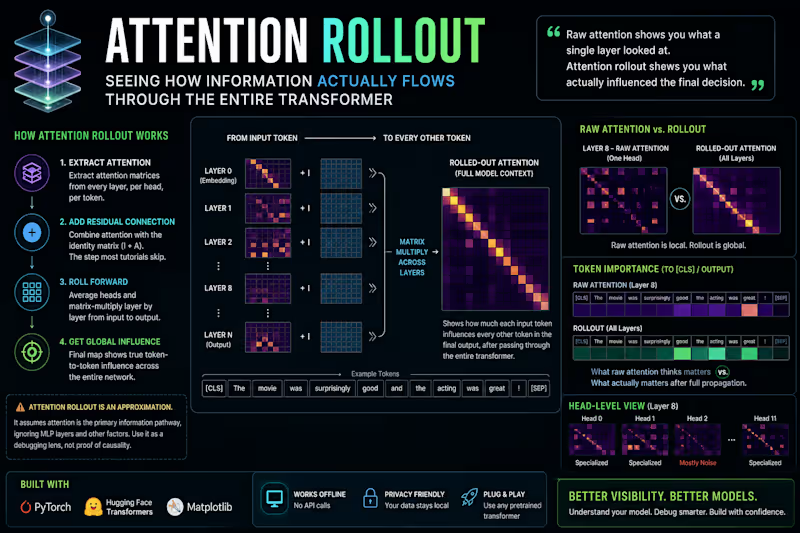
What your attention heatmap isn't telling you Everyone's staring at attention heatmaps and calling it "interpretability." Almost nobody's asking whether a single attention map actually tells you what the model used to make its decision. It doesn't. Not on its own. A raw attention map from layer 8 shows you what layer 8 attended to. It says nothing about how that signal got mixed, diluted, or overwritten by every layer before and after it. Attention rollout fixes this — and I built a walkthrough to show why it matters. Here's what makes it more than a "pretty heatmap" demo: Instead of visualizing one layer's attention, I traced how information actually flows through the full transformer stack. → Every layer's attention matrix is extracted, per head, per token → Multi-head attention is averaged, then combined with the residual connection (identity + attention) — this is the step most tutorials skip, and it's the one that actually matters → The combined matrices are matrix-multiplied layer by layer, rolling attention forward from input to output → The result: a single map showing genuine token-to-token influence across the entire network, not just one layer's snapshot The overlay shows you everything: → Per-layer attention vs. rolled-out attention, side by side → Token importance scores overlaid directly on the input text → A comparison view: which tokens raw attention says "matter" vs. which ones rollout says actually matter → Head-level breakdown so you can see which heads specialize vs. which are noise No black box. No "trust me, the model looked here." Just linear algebra, applied honestly across every layer instead of cherry-picking one. Built with PyTorch + HuggingFace Transformers + Matplotlib. Runs on any pretrained transformer, fully offline. ⚠️ Important: attention rollout is an approximation, not ground truth. It assumes attention is the primary information pathway, which ignores MLP layers and can still mislead for very deep models. Treat it as a debugging lens, not proof of causality.
0
69
I build AI agents & internal tools that act on data
13
Followers
I build AI agents & internal tools that act on data
Cover image for Project Overview This is a personal portfolio and services s...
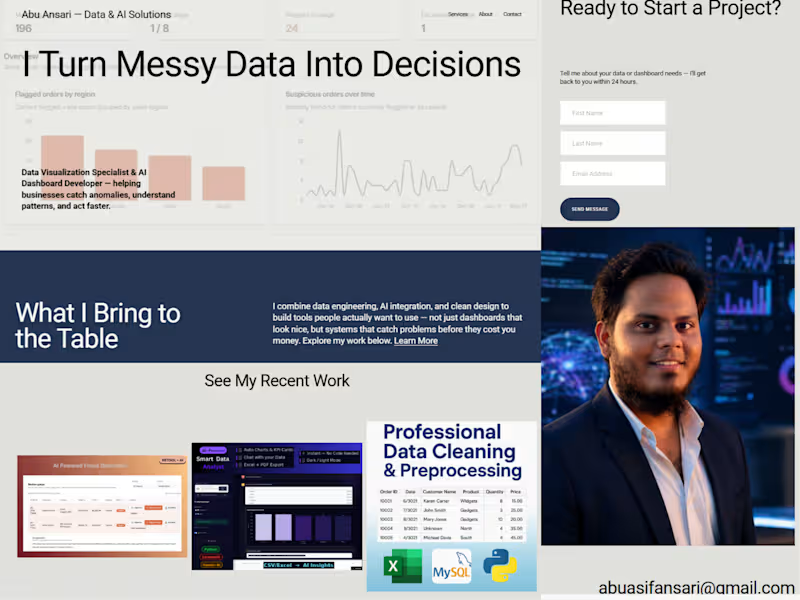
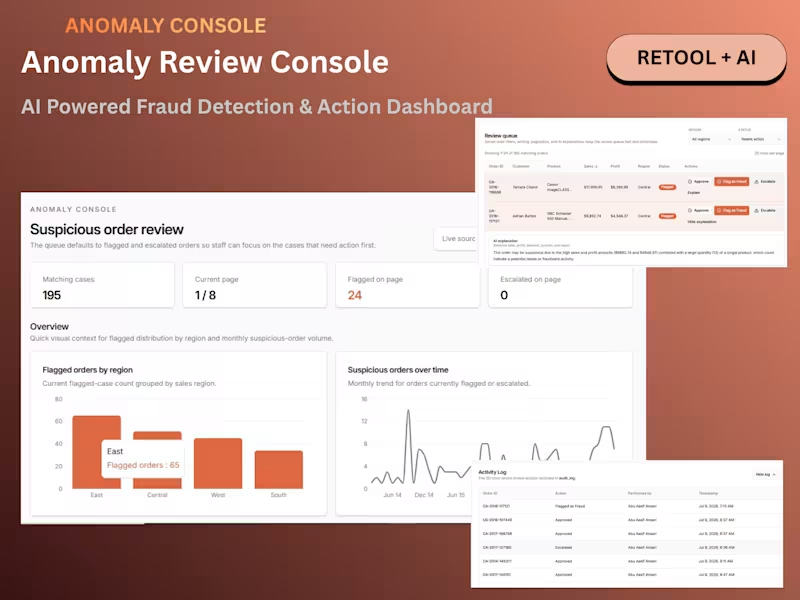
Project Overview This is a personal portfolio and services site built for a working freelancer — myself — as part of the Make It Real Challenge. I'm a data visualization specialist and AI dashboard developer, and I wanted the site itself to reflect that work rather than just describe it. So instead of stock photography and generic copy, every visual on the site is a real screenshot from a project I've actually shipped. The Concept Most freelance portfolio sites lean on polished lifestyle photography — laptops on wooden desks, people in blazers looking thoughtfully at monitors. I wanted to flip that: let the actual product screens do the talking. The site is built around a simple idea — "solutions built on data, not guesswork" — and that shows up literally in the visuals, not just the copy. What's on the site Homepage: A direct hero statement ("I Turn Messy Data Into Decisions") backed immediately by a real dashboard screenshot from my Anomaly Review & Action Console, followed by a "recent work" section pulling in three separate real projects. Services page: Four core offerings — Anomaly Detection Dashboards, Power BI & Data Analytics, AI-Integrated Internal Tools, and Custom Data Automation — each paired with an actual screenshot of that specific project (not a mockup). About page: A short, direct bio and a real photo, no filler. Contact page: A simple inquiry form paired with a data-visualization graphic that matches the site's overall theme. How I used Finish Layer Block Animations: I used on-appear and on-scroll triggers (Reveal and Slide styles) across the homepage, services, and contact pages. Section headings reveal as the page loads, and content blocks slide/fade in as the visitor scrolls — this turns what would be a static, all-at-once page into a guided, paced experience. Block Transform: Rather than a flat grid, I applied a subtle rotation to a couple of key visuals (a dashboard screenshot and the contact-page graphic) — just a few degrees, enough to break the rigidity of the layout without sacrificing readability. It gives the page an asymmetrical, more intentional feel instead of looking templated. Process I built this using Squarespace's Blueprint AI to get a fast base structure, then went through every page replacing AI-generated placeholder content (stock imagery, generic service descriptions, an accidental product/ecommerce section) with real project data, real screenshots, and copy that actually reflects how I work with clients. The site is password-protected rather than published on a paid plan, and is fully responsive across desktop and mobile. Access: 🔗 Site: https://pike-megalodon-4yb2.squarespace.com (https://pike-megalodon-4yb2.squarespace.com)🔑 Password: Omega
2
321
Data Guru. AI Solutions. ML Engineer.

🔍 Transforming Data into Business Insights

FastAPI, AI & RAG Engineer helping startups ship faster
New to Contra
FastAPI, AI & RAG Engineer helping startups ship faster
Versatile full-stack developer exploring Blockchain and AI.

5.0
Rating
Versatile full-stack developer exploring Blockchain and AI.
Data Analyst / Data Scientist
13
Followers
Data Analyst / Data Scientist