Freelance Software Engineers in MaharashtraFreelance Software Engineers in Maharashtra
AI-Native Creative Director: Brand, UI/UX & Motion
$1k+
Earned
1x
Hired
5.0
Rating
88
Followers
AI-Native Creative Director: Brand, UI/UX & Motion
I’m an AI & Machine Learning engineer with expertise in deve
Cover image for What your attention heatmap isn't
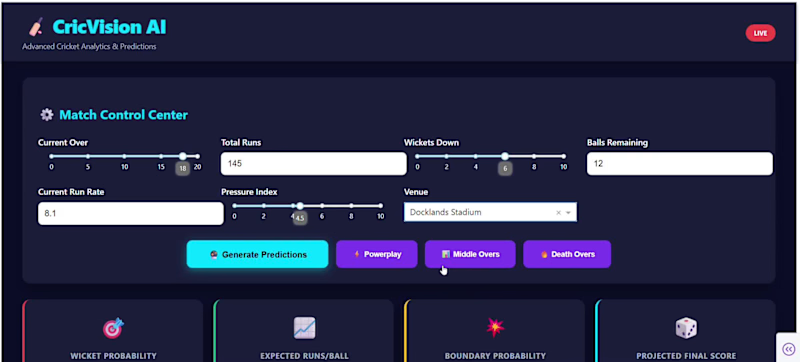
What your attention heatmap isn't telling you Everyone's staring at attention heatmaps and calling it "interpretability." Almost nobody's asking whether a single attention map actually tells you what the model used to make its decision. It doesn't. Not on its own. A raw attention map from layer 8 shows you what layer 8 attended to. It says nothing about how that signal got mixed, diluted, or overwritten by every layer before and after it. Attention rollout fixes this — and I built a walkthrough to show why it matters. Here's what makes it more than a "pretty heatmap" demo: Instead of visualizing one layer's attention, I traced how information actually flows through the full transformer stack. → Every layer's attention matrix is extracted, per head, per token → Multi-head attention is averaged, then combined with the residual connection (identity + attention) — this is the step most tutorials skip, and it's the one that actually matters → The combined matrices are matrix-multiplied layer by layer, rolling attention forward from input to output → The result: a single map showing genuine token-to-token influence across the entire network, not just one layer's snapshot The overlay shows you everything: → Per-layer attention vs. rolled-out attention, side by side → Token importance scores overlaid directly on the input text → A comparison view: which tokens raw attention says "matter" vs. which ones rollout says actually matter → Head-level breakdown so you can see which heads specialize vs. which are noise No black box. No "trust me, the model looked here." Just linear algebra, applied honestly across every layer instead of cherry-picking one. Built with PyTorch + HuggingFace Transformers + Matplotlib. Runs on any pretrained transformer, fully offline. ⚠️ Important: attention rollout is an approximation, not ground truth. It assumes attention is the primary information pathway, which ignores MLP layers and can still mislead for very deep models. Treat it as a debugging lens, not proof of causality.
0
53
Ariston IT: Elevate Your Business with Custom Software

Full Stack Developer | React.js, Node.js, Laravel, SaaS, AI
7
Followers
Full Stack Developer | React.js, Node.js, Laravel, SaaS, AI
AI-Native Full Stack Engineer
New to Contra
AI-Native Full Stack Engineer
Cover image for I shipped an open-source package
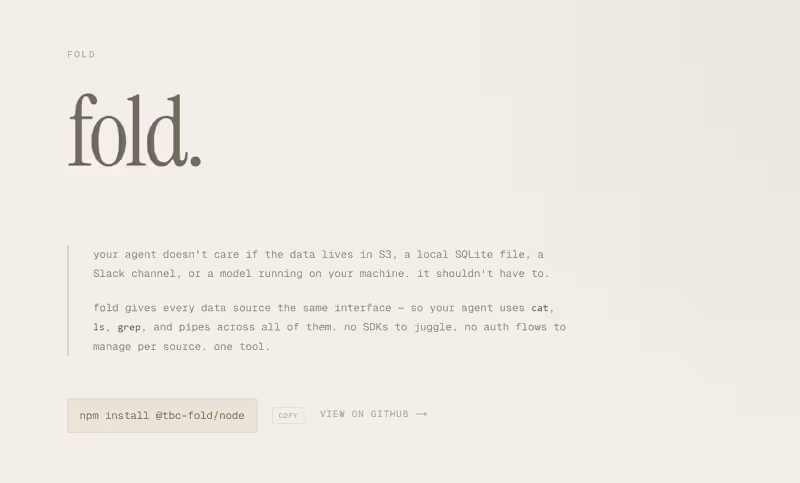
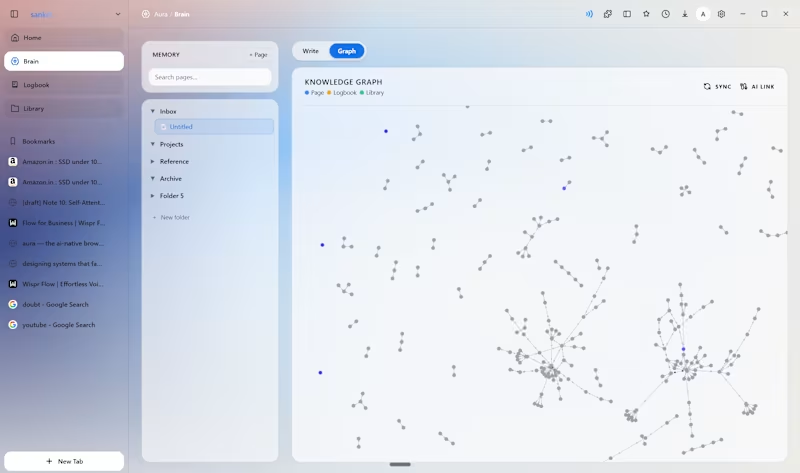
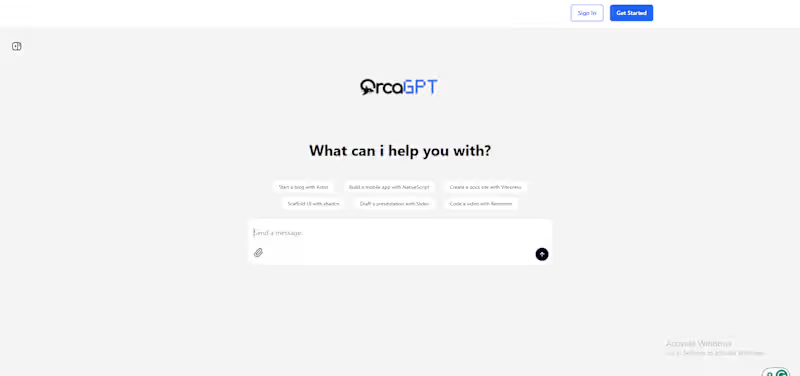
I shipped an open-source package called Fold. Here's the problem it solves: When you build an AI agent that touches more than one data source S3, Slack, a local database, your filesystem you end up managing three or four different SDKs, auth flows, and API shapes before writing a single line of actual agent logic. Then you give your LLM a list of 12 tools and hope it picks the right one. Fold takes a different approach. It's a virtual filesystem. You mount any backend under a path prefix: /notes → your local Documents folder /db → a SQLite database /s3 → an S3 bucket /slack → Slack channels as directories /model → a locally running Ollama model Your agent gets one tool: bash. cat, ls, grep, wc, head, pipe across all of them. LLMs were trained on bash. They know it cold. Fold exploits that instead of fighting it. Three things I built that Mirage (the main prior art) doesn't have: Local-first. SQLite, local files, and Ollama are first-class resources. Everything can run on-device with zero data egress and zero API keys. Reactive. ws.watch (http://ws.watch)() lets any resource push events when data changes. Your agent triggers automatically no polling, no cron. Rich listings. ls -c returns metadata alongside filenames row counts, schemas, member counts, last activity. The agent understands the environment in one call instead of five. It also ships as an MCP server out of the box. One file and it's available in Claude, Cursor, or any MCP client. Published under The Builder Company: npm install @tbc-fold/node Repo: https://lnkd.in/g6EdaYEx (https://lnkd.in/g6EdaYEx)Website: https://lnkd.in/g6WjxGGd Built this alongside Aura. The two are related Fold is the abstraction that lets Aura's local agent work across your data without sending anything to the cloud. If you're building agents and hitting the multi-SDK problem, try it.
1
56
Software Engineer building user friendly software