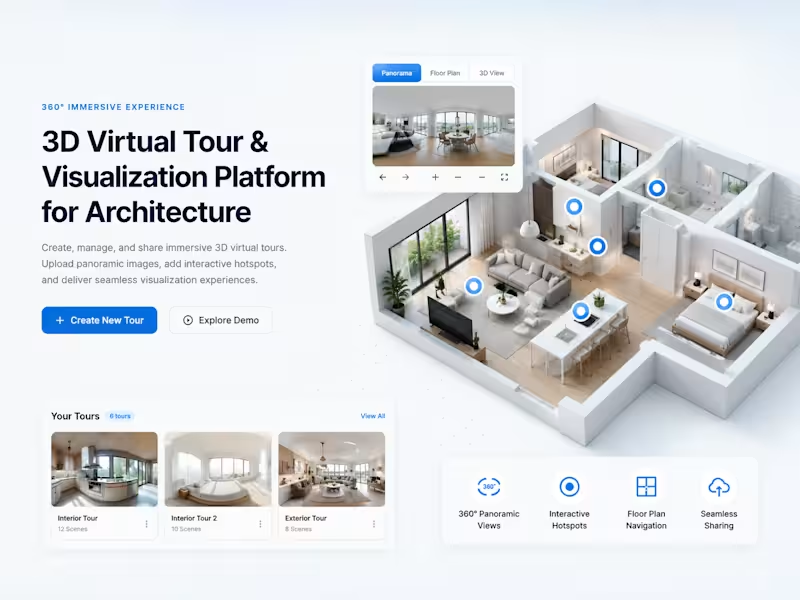
3D Virtual Tour & Visualization Platform for Architecture
Project Overview: A next-generation 3D visualization platform built for an architecture client, designed to solve the industry problem of imagination gaps, costly mistakes, and delays. The platform allows users to design, visualize, and present home and building layouts in stunning real-time 3D empowering architects and their clients to plan and build with confidence.
My Role: Full Stack Developer Built the complete platform including 3D engine integration, interactive UI, and backend.
Key Features Built:
Real-time 3D visualization see every change instantly
Interactive floor plans with 2D to 3D switching
360° walkthroughs & immersive virtual tours
Interior & exterior design customization (layouts, materials, furniture & finishes)
Share & collaborate features for team workflows
Tech Stack:
Three.js & WebGL (3D rendering)
React.js (Frontend)
Node.js / Express.js (Backend)
Outcome: Delivered for an individual architecture professional. The client was highly satisfied with the result and the platform is performing brilliantly.
0
513
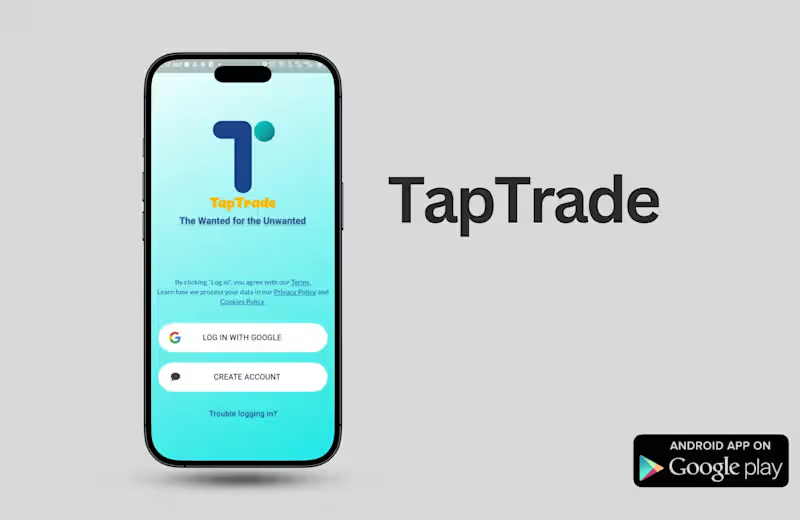



Tandoor Club
Developed a modern and user-friendly website for Tandoor Club, designed to help customers easily explore restaurant locations and reserve tables across any branch. The platform features an intuitive interface where visitors can view menus, check branch details, and make reservations in just a few clicks. The backend system allows the restaurant team to manage bookings, update location information, and monitor customer requests efficiently. Fully responsive and optimized for performance, the website delivers a seamless experience whether customers are browsing on mobile or desktop.
1
101
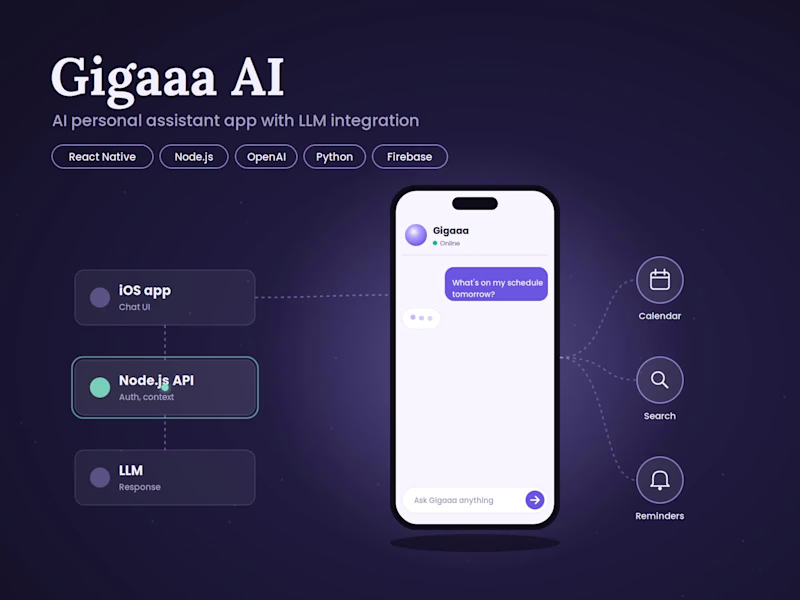
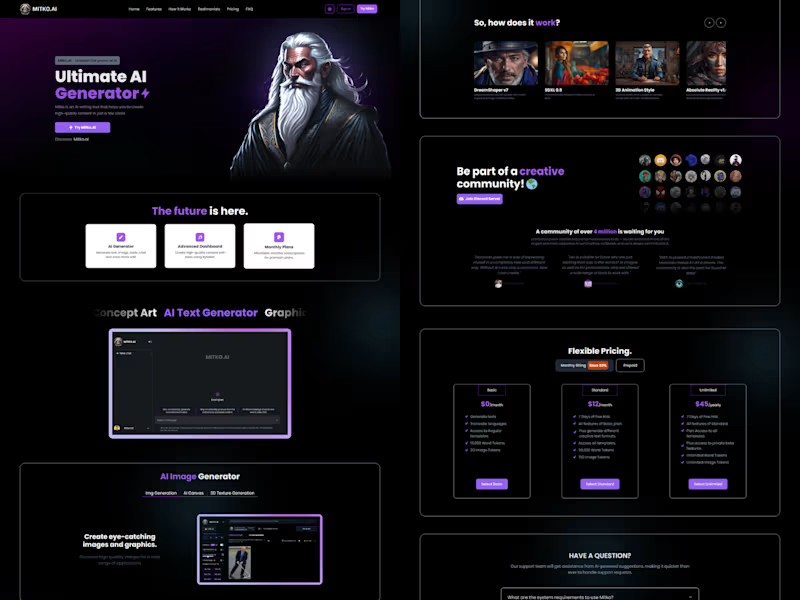

🚀 Just shipped a project: BrandBuzz, a fully interactive digital marketing agency landing page built with React + Vite!
As a Computer Science student, I wanted to move beyond tutorials and recreate a real UI design in code, so I took a design mockup and turned it into a working, responsive site.
What I built:
⚡ Sticky navbar with smooth scrolling and scroll-based active link highlighting
🎠 Auto-playing testimonials carousel that pauses on hover
🧩 Modal forms for Sign Up, Get Started and Contact Us, with keyboard support (Esc to close)
✨ Scroll-reveal animations using the Intersection Observer API
📱 A mobile-first responsive layout with a hamburger menu
♿ Accessibility basics: focus states, aria labels and reduced-motion support
What I learned:
🔹 Managing UI state with React hooks (useState, useEffect) and writing a custom useReveal hook
🔹 Building layouts with CSS Grid and Flexbox
🔹 Cleaning up event listeners and intervals properly to avoid memory leaks
🔹 Optimizing images (WebP) for faster load times
The biggest takeaway is that the small details, like hover states, transitions and spacing, are what make a website feel polished and professional.
I’m actively looking for internship and entry-level opportunities in frontend and web development, so I’d love to connect with developers, designers and recruiters. Any feedback on the project is welcome. 🙌
0
23
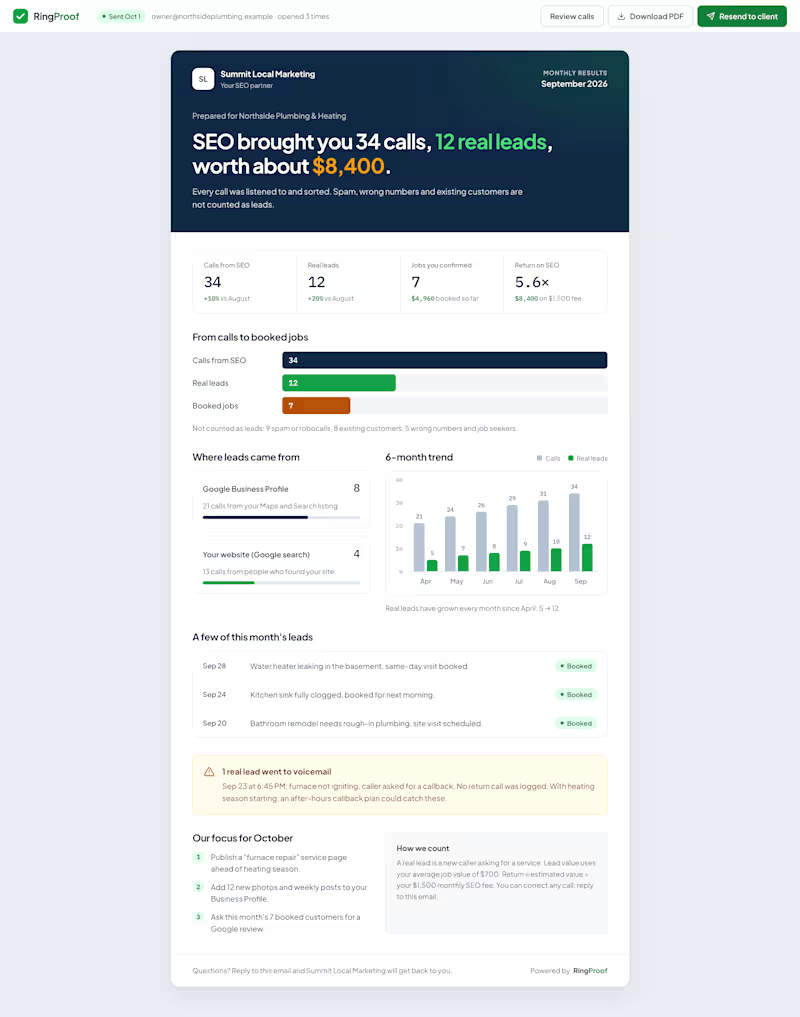
Title: RingProof: AI call reports that prove local SEO works
RingProof is a micro-SaaS concept I designed and prototyped for local SEO agencies. It turns the calls a client gets from Google Search and Business Profile into a simple monthly proof of value:
"SEO brought you 34 calls, 12 real leads, worth about $8,400."
The problem
Since Google removed call history from Business Profiles, agencies can show a call count but not which calls were real new customers. Spam, robocalls, wrong numbers and existing customers all look the same, so clients struggle to see what SEO is worth, and they cancel.
The solution
Connects to the agency's existing call tracking (CallRail first)
AI labels every recorded call: real lead, existing customer, spam, or not a lead
Each client gets a white-label monthly report with real leads, estimated value and return on SEO
Agencies get one dashboard across all clients, with alerts for missed leads
What I built
Market research and validation plan, including competitor and pricing analysis
Brand: name, color system and logo mark
Clickable prototype with 4 screens: agency dashboard, AI call log with working filters, branded client ROI report, and marketing site with pricing and a working contact form
Responsive layouts for desktop and mobile, deployed on GitHub Pages
I used Claude AI as a working partner for research and to speed up the prototype build, which took it from idea to a live, clickable demo quickly.
Status: validation stage with sample data. If you run a local SEO agency, I'd love your feedback.
Live prototype: https://mcs0801.github.io/ringproof/
(https://mcs0801.github.io/ringproof/)Sample client report: https://mcs0801.github.io/ringproof/report.html
Skills: Product Strategy, UI/UX Design, SaaS, Prototyping, Front-end Development, Local SEO, AI
0
47
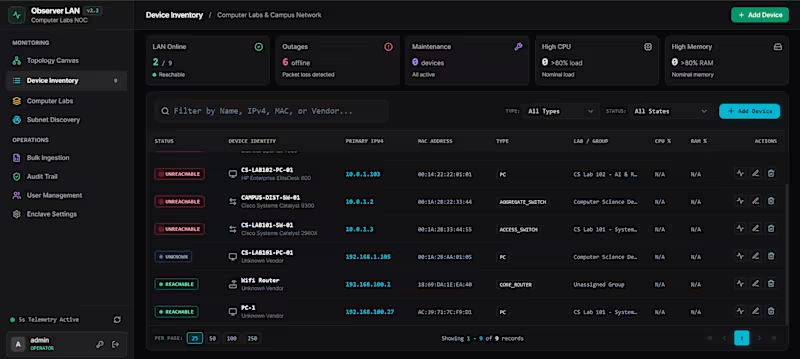
Network Observer: Air-Gapped Enterprise LAN Telemetry & Topology Engine
Executive Summary
Network Observer is a self-hosted, sovereign network telemetry and topology visualization suite engineered for air-gapped university campus labs and secure enterprise subnets. Designed from the ground up for zero external cloud dependencies, it delivers real-time device health monitoring, automated subnet discovery, hierarchical computer lab grouping, and interactive DAG network graphs with an ultra-lean memory footprint (< 500 MB RAM).
The Challenge
Educational institutions and secure facilities manage hundreds of lab machines, routers, and managed switches distributed across segmented VLANs. Existing solutions were either:
Cloud-Tethered SaaS: Violating data residency constraints and failing entirely in air-gapped environments.
Resource-Heavy Legacy Tools: Bloated platforms consuming tens of gigabytes of RAM with outdated, clunky interfaces.
Disconnected Tooling: Requiring separate software for ping sweeps, topology mapping, and asset inventory.
The goal was to build a modern, unified, tactical NOC command center that operates entirely offline, boots in seconds, and handles live telemetry without straining hardware.
Engineering & Architectural Philosophy
As the Lead Architect, I directed the end-to-end technical requirements, database schemas, API contracts, and UX patterns, leveraging state-of-the-art AI pair-programming workflows to rapidly execute and harden production code across the full stack.
Strict 4-Tier Clean Architecture: Domain, Application, Infrastructure, and Presentation layers ensuring complete testability and separation of concerns.
Zero Raw SQL Overhead: Strongly-typed EF Core 10 LINQ queries coupled with a relational PostgreSQL 18 backend running sub-millisecond query execution.
Deterministic Resource Budgeting: Engineered with an explicit ceiling under 500 MB RAM across both Kestrel backend and the frontend runtime.
Comprehensive Automated Verification: 151 automated integration and unit tests covering domain invariant rules, ICMP probes, and RBAC authentication.
Key Features & Innovations
1. Interactive Cytoscape.js Topology Canvas
Real-time network mapping with dynamic layout toggling: Lab Hierarchies (Core Router → Aggregate Switch → Computer Lab Groups → Workstations) or Pure Device-to-Device.
High-performance SVG nodes styled with tactical cyber-optic color palettes, transparent glyph backgrounds, and auto-wrapping status badges.
Hardware-accelerated cursor-anchored smooth zooming and collision-avoidance Dagre layouting.
2. Live Telemetry & Slide-Over Inspector Drawer
Background non-blocking worker threads conducting periodic ICMP/SNMP telemetry sweeps every 5 seconds.
Instant slide-over inspection drawer displaying live CPU/RAM utilization metrics, uptime gauges, IP/MAC bindings, and vendor footprints.
Route-aware state management that collapses drawers seamlessly upon switching views.
3. Subnet Sweep Discovery & Staging Pipeline
Parallelized CIDR sweep engine (e.g., 192.168.1.0/24) capable of identifying active hosts and resolving MAC/vendor footprints in seconds.
One-click staging pipeline allowing discovered network hosts to be audited and promoted directly into production inventory.
4. Role-Based Governance & Audit Trail
Air-gapped JWT token authentication paired with cryptographically secure PBKDF2 passphrase hashing.
Immutable append-only audit trail logging every device provisioning, IP reassignment, and status mutation.
Technology Stack
Backend: C# .NET 10 Kestrel Web API, Entity Framework Core 10
Database: PostgreSQL 18 with relational integrity constraints & indexing
Frontend: Vue 3 (Composition API), TypeScript, Vite, Pinia Store
Canvas Visualization: Cytoscape.js with Dagre Hierarchical Layout Engine
Styling: Tailwind CSS, Lucide Icons, Custom Tactical NOC Theme
DevOps & Quality: GitHub Actions CI/CD Pipeline, xUnit, FluentAssertions (151 passing tests)
Key Metrics & Results
100% Air-Gapped Sovereign: Zero external telemetry pings or telemetry leakage.
< 500 MB Total Memory Ceiling: Runs seamlessly on resource-constrained campus edge servers.
151/151 Test Coverage: Zero test regressions with automated GitHub Actions verification.
Sub-Millisecond Queries: Fast relational indexing across hundreds of concurrent lab nodes.
0
51