Freelance Web Developers in DhakaFreelance Web Developers in Dhaka
Brand & Website Designer | AI Video | UI/UX
$1k+
Earned
5x
Hired
5.0
Rating
277
Followers
Brand & Website Designer | AI Video | UI/UX
Framer Developer • UI UX Designer • topudesign.com
$50k+
Earned
52x
Hired
4.9
Rating
83
Followers
Framer Developer • UI UX Designer • topudesign.com
UX-led product design & dev agency for b2b saas and AI

$25k+
Earned
1x
Hired
195
Followers
UX-led product design & dev agency for b2b saas and AI
A Dedicated Framer Development Agency
$1k+
Earned
3x
Hired
4.9
Rating
53
Followers
A Dedicated Framer Development Agency

Full-Stack Web Dev & AI Engineer. Daffodil Int'l University
5.0
Rating
9
Followers
Full-Stack Web Dev & AI Engineer. Daffodil Int'l University
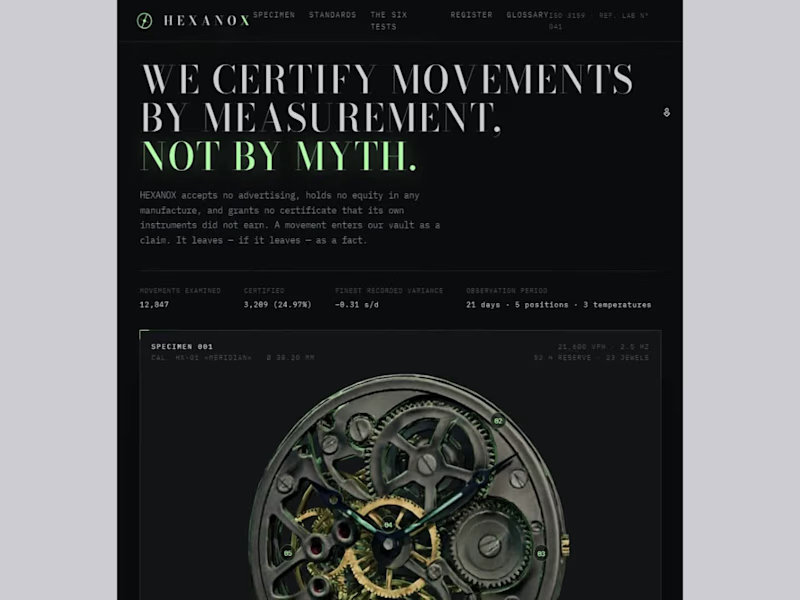
Cover image for HEXANOX: Institute of Chronometric Certification:
HEXANOX: Institute of Chronometric Certification: High-Performance Creative Web Exploration (https://samincollection2.netlify.app/hexanox) A watch movement lifted from one photograph into 3D. HEXANOX is an independent horology institute. We certify mechanical movements by measurement, amplitude, beat error, positional variance, to tolerances your eye cannot see. I built this project to test A watch movement lifted from one photograph into 3D. HEXANOX is an independent horology institute. We certify mechanical movements by measurement, amplitude, beat error, positional variance, to tolerances your eye cannot see. The core engineering challenge was sustaining uncompromised 60 FPS rendering using Three.js (GLB 3D) while handling continuous user interaction without framework overhead. WHAT I WAS TESTING: I focused on two core engineering benchmarks: Precision implementation of image → GLB under continuous interactive user input Sustained 60 FPS render performance and zero-dependency browser execution THE TECHNICAL SIDE: Engineered directly in the browser with Three.js (GLB 3D), WebGL / GLSL Shaders, Canvas2D, Image → GLB. The application runs without third-party frameworks or build-step dependencies, using hardware-accelerated rendering and custom event loops to achieve zero-latency response. Everything executes in the browser using Three.js (GLB 3D), WebGL / GLSL Shaders, Canvas2D, Image → GLB. No third-party frameworks, no heavy runtime bundles, and zero external tracking. WHAT I LEARNED: Balancing the mathematical rigors of image → GLB with tactile browser interaction required tuning event throttling and memory allocation to eliminate all garbage collection stutters. Finding the sweet spot between mathematical precision and frame budget took careful profiling, but the result runs at a steady 60 FPS even on modest hardware. TRY IT YOURSELF: (https://samincollection2.netlify.app/hexanox)The live build is deployed on Netlify. Open it in your browser, test the controls, and observe the render response times. If you are building high-performance 3D, physics, or creative web systems and want to collaborate, reach out here on Contra.
1
6
884
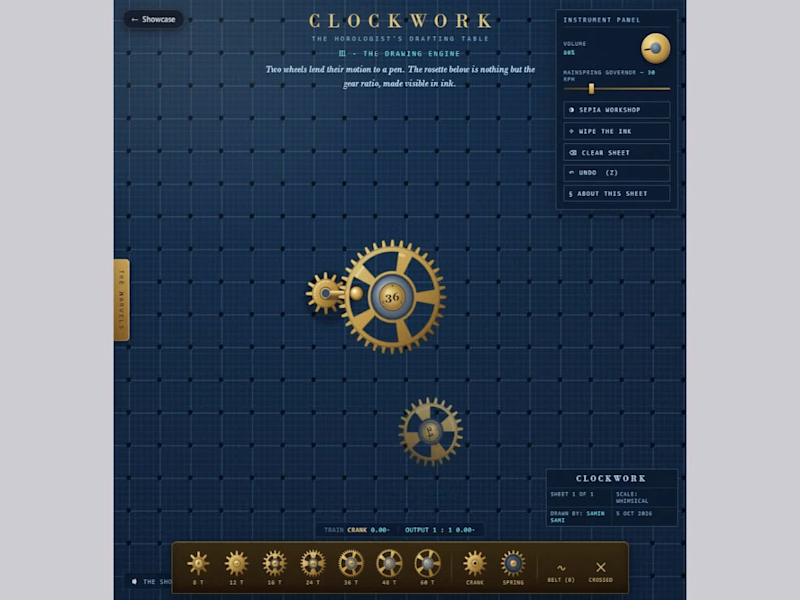
Cover image for CLOCKWORK: The Horologist's Drafting Table:
CLOCKWORK: The Horologist's Drafting Table: High-Performance Creative Web Exploration (https://samincollection3.netlify.app/clockwork/index.html) An interlocking gear-train workbench with true ratios and brass-blueprint charm. I built this project to test An interlocking gear-train workbench with true ratios and brass-blueprint charm. The core engineering challenge was sustaining uncompromised 60 FPS rendering using Canvas2D while handling continuous user interaction without framework overhead. WHAT I WAS TESTING: I focused on two core engineering benchmarks: Real-time gear mesh torque transfer and escapement tick mechanics Interactive placement of interlocking brass gears with variable ratios THE TECHNICAL SIDE: Implements true involute tooth profiles computed via parametric equations. Rotational speeds are propagated through an adjacency graph of connected gear nodes. Everything executes in the browser using Canvas2D, Mechanical Gear Physics, Involute Gear Tooth Profiles. No third-party frameworks, no heavy runtime bundles, and zero external tracking. WHAT I LEARNED: Floating-point precision drift caused gear teeth to gradually overlap after several minutes. Clamping phase angles to gear pitch intervals solved the drift. Finding the sweet spot between mathematical precision and frame budget took careful profiling, but the result runs at a steady 60 FPS even on modest hardware. TRY IT YOURSELF: (https://samincollection3.netlify.app/clockwork/index.html)The live build is deployed on Netlify. Open it in your browser, test the controls, and observe the render response times. If you are building high-performance 3D, physics, or creative web systems and want to collaborate, reach out here on Contra. Built by Samin Sami | Developer & 3D Experimentation
2
6
973
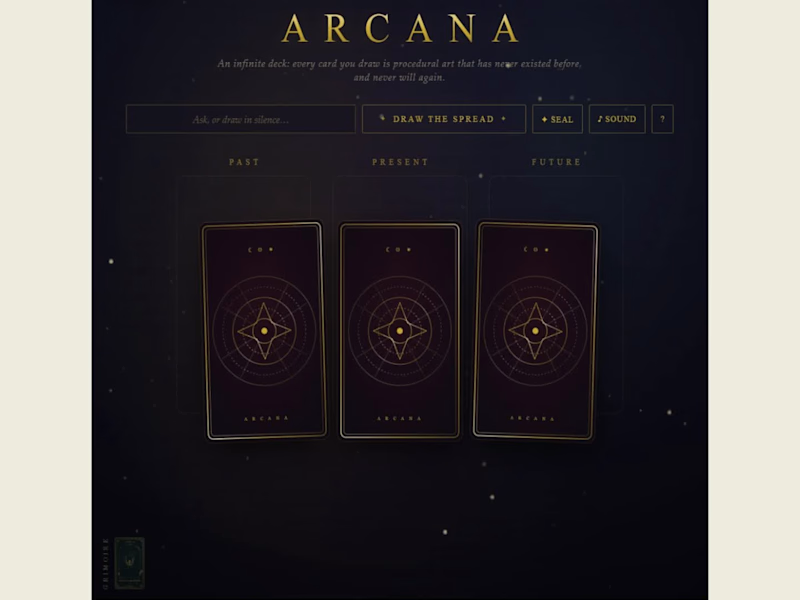
Cover image for Arcana: Interactive Creative Web Exploration
Arcana: Interactive Creative Web Exploration (https://samincollection3.netlify.app/arcana/index.html) A three-card tarot spread where every face is unique procedural sigil-art, woven into one reading. I built this project to test a three-card tarot spread where every face is unique procedural sigil-art, woven into one reading. The goal was simple: push interactive browser rendering using HTML5 Canvas and see how smoothly the system responds to direct user interaction. WHAT I WAS TESTING: I wanted to focus on two core engineering aspects: Procedural generation of unique runic card sigils from mathematical formulas Dynamic typography and card flipping choreography without heavy 3D frameworks THE TECHNICAL SIDE: The card faces render directly onto an HTML5 Canvas using polar coordinate trigonometric curves and procedural geometry. Every draw call is computed dynamically without image textures or external SVGs. Everything runs in the browser using HTML5 Canvas, Procedural Sigil Geometry, Seeded Randomness. No plugins, no heavy dependencies, and no external tracking. WHAT I LEARNED: Balancing procedural symmetry with organic irregularity was the main hurdle. Pure mathematical curves looked too synthetic, so adding minor pseudo-random offsets gave the sigils their handcrafted appearance. Finding the sweet spot between mathematical precision and tactile visual feedback took several iterations, but the end result runs consistently at 60 FPS. TRY IT YOURSELF: (https://samincollection3.netlify.app/arcana/index.html)The live experiment is deployed on Netlify. You can open it in any modern browser, interact with the controls, and test the response times. If you are working on similar 3D, physics, or creative web projects and want to collaborate, message me here on Contra.
1
7
1.3K
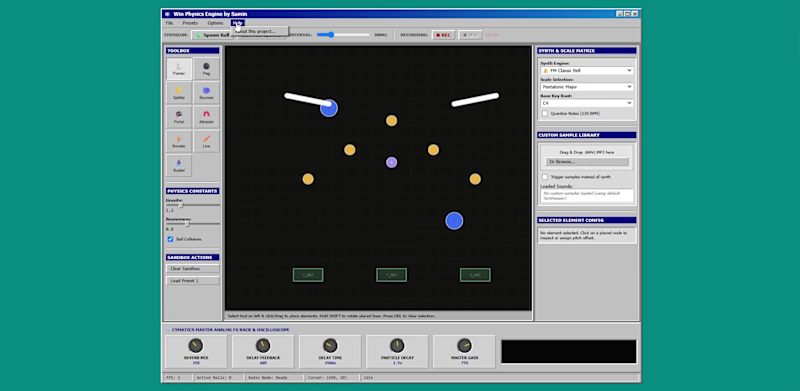
Cover image for Win Engine 95: Retro Cymatics
Win Engine 95: Retro Cymatics & Physics Sandbox (https://winphybysamin.netlify.app) "A Windows 95-style 2D physics engine that generates live audio synthesis based on particle collisions, built in one HTML file" I built this sandbox engine to merge tactile 2D physics with real-time web audio synthesis, all wrapped inside a nostalgic Windows 95 desktop simulation. The idea was to create a musical playground where gravity, bounce, and spatial collisions dictate the rhythm and melody, making it feel like a complex piece of forgotten 90s software. WHAT IT CAN DO: Users can spawn particles into a physics sandbox and route them through custom tracks. The toolbox includes sounding pegs, spring like bouncers, splitters that clone balls, gravity wells, accelerators, and portals. Every time a particle hits an object, it triggers a musical note. The right panel acts as a full synthesizer console. You can switch between FM bells, Karplus-Strong plucks, or deep sub-bass, quantize notes to different musical scales (Lydian, Pentatonic, Aeolian, etc.), and map specific pitch offsets to individual pegs. At the bottom, there is an analog-style FX rack with rotatable knobs for reverb, delay, master gain, and a live oscilloscope that visualizes the audio output. Users can even drag and drop their own .WAV/.MP3 samples to trigger instead of the built-in synths, and record their jam sessions directly to a WebM file. THE TECHNICAL SIDE: Everything sits inside one single HTML file. No frameworks, no external libraries, zero build tools. The UI is built with pure CSS and vanilla JavaScript, recreating the classic Win95 bevels, title bars, and dropdown menus. The sandbox runs on a custom 2D physics engine I wrote from scratch using HTML5 Canvas, featuring spatial sub-stepping, dynamic collision resolution, and vector math. The audio engine relies strictly on the Web Audio API. It routes synthesized oscillators through custom delay nodes, biquad filters, and a dynamics compressor to prevent clipping when hundreds of collisions happen at once. WHAT I LEARNED: The hardest part was keeping the physics and audio perfectly synced without dropping frames. When you have dozens of balls hitting pegs at the exact same time, the audio context can easily get overwhelmed. I had to implement physics sub-stepping (calculating 4 smaller simulation steps per visual frame) to prevent high-speed objects from clipping through drawn lines. I also added a slight trigger throttle so the synthesizer wouldn't distort during massive collision clusters. Building the math for the analog FX knobs was also a fun challenge; calculating mouse drag deltas and mapping them smoothly to both the visual CSS rotation and the Web Audio delay parameters.
1
7
916