Deborah Ayodele's Work | ContraWork by Deborah Ayodele
Deborah Ayodele

Deborah Ayodele

CAD Industrial Designer PCB Product Designer DFM 3D Modeler

New to Contra

Deborah is ready for their next project!

Cover image for Designing a Jewelry Pendant from
Designing a Jewelry Pendant from Sketch to Production-Ready CAD Every product starts as an idea. This pendant began as a hand sketch exploring elegant flowing curves. From there, I transformed the concept into a fully detailed 3D CAD model, refining proportions, stone placement, structural integrity, and manufacturability before creating the final photorealistic render. For jewelry design, aesthetics alone isn't enough. Every surface, thickness, and setting has to be engineered for production while preserving the original design intent. Project Workflow • Initial concept sketch • Parametric 3D CAD modeling • Diamond seat and prong development • Surface continuity refinement • Manufacturing-ready geometry • Photorealistic rendering for presentation Whether the final manufacturing process is casting, CNC machining, or 3D printing for investment casting, the objective remains the same: create a design that is both visually refined and production ready. I enjoy turning ideas into manufacturable products, whether that's jewelry, consumer electronics, mechanical components, or industrial products. Feedback is always welcome. #IndustrialDesign #CAD #ProductDesign #JewelryDesign #3DModeling #Rendering #DesignForManufacturing #MechanicalDesign #CADDesign #ProductDevelopment
0
29
Cover image for Smart Aroma Diffuser Design |
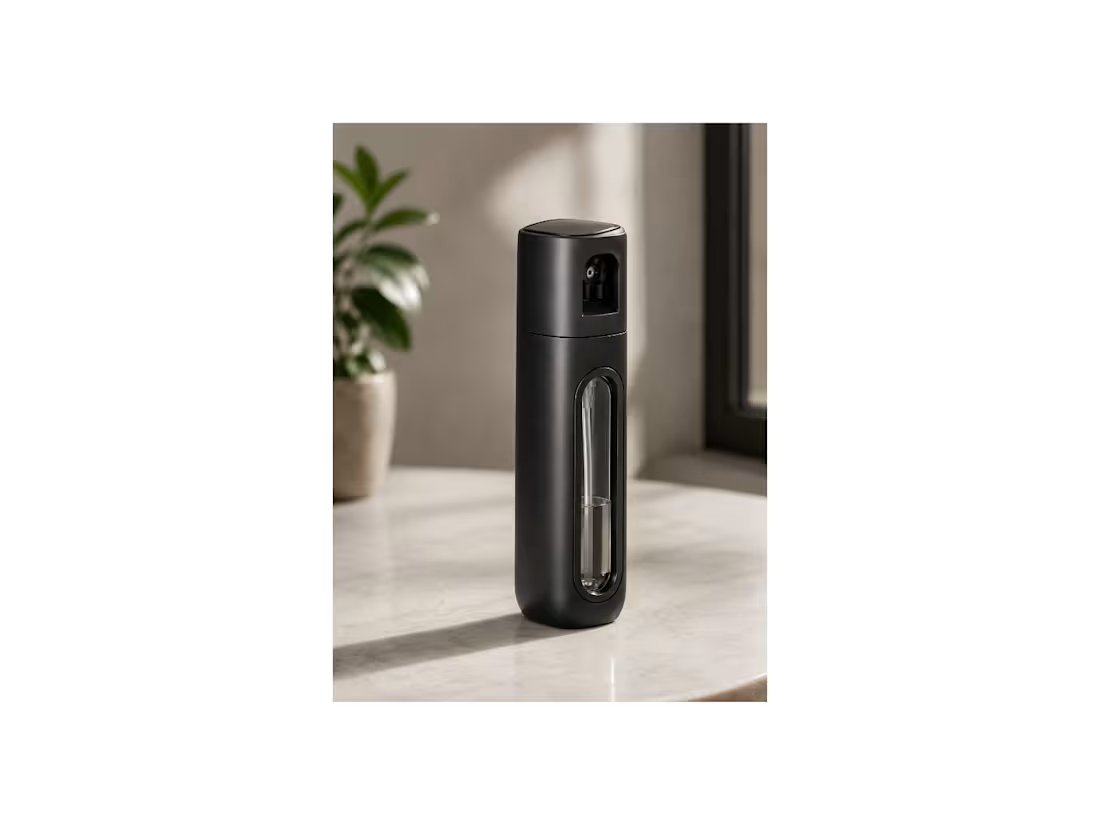
Smart Aroma Diffuser Design | Industrial Design, CAD Engineering & DFM Designed a modern smart aroma diffuser from concept development through manufacturing-ready engineering, combining clean industrial design with practical mechanical design and Design for Manufacturing (DFM). The goal was to create a premium home wellness product with a calming aesthetic, intuitive user interaction, and an internal architecture optimized for efficient production and assembly. The project included industrial design exploration, ergonomic form development, internal component packaging, ultrasonic misting system integration, injection molding optimization, wall thickness and draft angle analysis, engineering documentation, and realistic product visualization. Every design decision was made with manufacturing, assembly efficiency, serviceability, and product performance in mind. This project demonstrates the complete product development workflow, from concept and engineering to manufacturing documentation and high-quality product visualization, making it suitable for consumer electronics, home appliances, and wellness product development.
1
91
Cover image for Smart Pill Dispenser Design |
Smart Pill Dispenser Design | Medical Device CAD & Product Development Designed a smart pill dispenser from concept through manufacturing-ready product development, combining industrial design, mechanical engineering, and consumer electronics into a compact, user-friendly medical device. The objective was to create a reliable dispensing system that improves medication adherence while maintaining an intuitive user experience and a clean, modern aesthetic. The project covered the complete hardware development process, including product concept exploration, ergonomic enclosure design, internal mechanical architecture, pill carousel and dispensing mechanism, electronic component integration, exploded assemblies, engineering documentation, and production-ready CAD models. Every component was developed with Design for Manufacturing (DFM) principles to simplify assembly, optimize part count, and support efficient manufacturing and future prototyping. The result is a functional, manufacturing-focused product concept that demonstrates expertise in medical device development, precision mechanical design, CAD engineering, and product visualization.
5
183
Cover image for Precision Wall Clock Gear Assembly
Precision Wall Clock Gear Assembly | Mechanical CAD Design & DFM Designed and engineered a precision wall clock gear assembly featuring a complex multi-stage gear train, robust support frame, and manufacturing-ready mechanical components. The project focused on achieving accurate gear meshing, smooth rotational motion, reliable shaft support, and efficient assembly while maintaining a clean, visually appealing mechanical design. The complete development process included detailed 3D CAD modeling, full assembly creation, gear train optimization, section views, engineering drawings, BOM generation, and realistic product visualization. Every component was developed with Design for Manufacturing (DFM) principles to ensure manufacturability, ease of assembly, dimensional accuracy, and long-term mechanical performance. This project demonstrates expertise in precision mechanical design, CAD assembly management, tolerance considerations, production documentation, and engineering visualization for manufacturing-ready products.
4
161
Cover image for Waterproof Electronic Enclosure Design |
Waterproof Electronic Enclosure Design | CAD Modeling & DFM Engineering I designed a compact waterproof electronic enclosure from concept to manufacturing-ready CAD, with a focus on durability, assembly, and production feasibility. The enclosure features a precision-fit housing, integrated screw bosses, embossed/debossed branding, and a compression O-ring sealing system engineered for reliable water and dust protection. The project included detailed 3D CAD modeling, exploded assembly views, section analysis, seal groove optimization, tolerance considerations, and realistic product visualization to validate fit, function, and manufacturability before prototyping. Every feature was developed with Design for Manufacturing (DFM) principles to simplify assembly, improve part consistency, and reduce production risk.
4
166
Cover image for Smart Pump Room Design |
Smart Pump Room Design | Mechanical Engineering | P&ID | 3D CAD Behind every reliable water distribution system is a well-engineered pump room. This project showcases the complete design of a hydro-pneumatic booster pump system, developed to deliver stable pressure, operational reliability, and simplified maintenance for industrial and commercial applications. The project included the mechanical layout, piping arrangement, Process & Instrumentation Diagram (P&ID), General Arrangement (GA) drawing, equipment schedules, and high-quality 3D visualization. Every component, from the multistage pumps and filtration system to the pressure tank and control panel, was carefully positioned to ensure efficient operation, easy servicing, and future scalability. Project Deliverables ✔ Pump Room Layout Design ✔ P&ID Development ✔ General Arrangement (GA) Drawing ✔ Mechanical & Piping Design ✔ Equipment & Valve Schedules ✔ Technical Engineering Documentation ✔ Photorealistic 3D Visualization This project demonstrates my ability to transform engineering concepts into clear, manufacturing-ready documentation that supports fabrication, installation, and long-term operation. Tools: SolidWorks | AutoCAD | Mechanical Design | P&ID | Engineering Drawings | Industrial Design | 3D Rendering Keywords: Pump Room Design, Mechanical Engineering, Industrial Design, P&ID, General Arrangement Drawing, Piping Design, Hydro-Pneumatic System, Water Treatment, CAD Design, SolidWorks, AutoCAD, Industrial Equipment Design, Engineering Drawings, 3D CAD, Technical Documentation.
4
168
Cover image for Mechanical Clicker Keychain | Product
Mechanical Clicker Keychain | Product Design, CAD Modeling & Design for Manufacturing Simple products are often the most challenging to design well. This project explores the development of a compact mechanical clicker keychain that combines satisfying tactile feedback with a clean, durable, and manufacturing-friendly enclosure. The objective was to create a pocket-sized everyday carry (EDC) accessory that feels premium, is comfortable to use repeatedly, and can be efficiently manufactured. The design process focused on balancing ergonomics, aesthetics, structural integrity, and ease of assembly while keeping the overall form compact enough for daily carry. The product was developed as a fully parametric SolidWorks model, allowing every feature to be refined throughout the design process. I designed the enclosure around a mechanical switch assembly, incorporating internal alignment posts, snap-fit features, reinforcing ribs, optimized wall thicknesses, and smooth fillets to improve durability and manufacturability. The housing was also optimized for FDM 3D printing, reducing support material while maintaining strength and dimensional accuracy. To communicate the complete engineering process, I created exploded assembly views, cutaway visualizations, internal component layouts, manufacturing optimization studies, and presentation-ready renders. These assets demonstrate not only the appearance of the product but also how it is assembled, functions internally, and can transition from prototype to production. This project showcases my end-to-end product development workflow—from concept refinement and CAD engineering to design for manufacturing (DFM), rapid prototyping, and professional product visualization. Project Highlights Consumer product design Mechanical product development SolidWorks parametric CAD modeling Enclosure and housing design Snap-fit feature design Exploded assembly creation Internal component integration Cutaway and section visualizations Design for Manufacturing (DFM) FDM 3D printing optimization Product rendering and presentation Tools Used SolidWorks • Industrial Design • Product Design • 3D CAD Modeling • Mechanical Design • Plastic Part Design • Snap-Fit Design • Product Visualization • Rapid Prototyping • Design for Manufacturing (DFM)
3
140
Cover image for Orthopedic Side Sleeper Support Cushion
Orthopedic Side Sleeper Support Cushion | Industrial Design, CAD & Product Engineering Comfort products are only successful when thoughtful design meets real human needs. This concept explores the development of an ergonomic side sleeper support cushion designed to improve sleeping posture, reduce pressure around the hips and knees, and provide long-lasting comfort for side sleepers. The project began by studying ergonomic body positioning, pressure distribution, and user comfort to develop a shape that naturally supports alignment throughout the night. Multiple iterations were explored before refining the final form into a balanced design that combines comfort, aesthetics, and practical manufacturability. The cushion was engineered in SolidWorks as a fully parametric CAD model, allowing every curve, contour, and assembly feature to be refined with precision. The design incorporates a breathable removable cover, high-density molded foam core, internal airflow channels for improved ventilation, and an integrated magnetic attachment system that supports modular accessories while maintaining a clean exterior. To ensure the concept was ready for manufacturing, I also developed exploded assembly documentation, engineering drawings, section views, dimensional layouts, and production-focused design details. Every component was considered with manufacturing, assembly, durability, and user experience in mind. This project demonstrates my complete product development workflow—from industrial design and ergonomic thinking to CAD engineering, product visualization, and manufacturing documentation—while showcasing how functional consumer products can be transformed into production-ready designs. Project Highlights Ergonomic product research and concept development Industrial product design Consumer product engineering SolidWorks parametric CAD modeling Ergonomic surface modeling Exploded assembly creation Technical and manufacturing drawings Section views and dimensional documentation Design for Manufacturing (DFM) Product visualization and presentation Tools Used SolidWorks • Industrial Design • Product Design • Consumer Product Development • Ergonomic Design • 3D CAD Modeling • Product Visualization • Engineering Documentation • Design for Manufacturing (DFM)
4
153
Cover image for Waterproof Protective Storage Case |
Waterproof Protective Storage Case | Industrial Product Design & DFM Every successful product starts with solving a real-world problem. For this concept, I designed a compact waterproof protective case intended to keep small valuables safe from water, dust, and impact during outdoor activities such as hiking, kayaking, camping, and travel. The project began with user research and concept exploration to identify the features that would matter most in everyday use, easy one-handed access, reliable waterproof sealing, durability, portability, and a clean, modern appearance. After evaluating multiple design directions, I refined the selected concept into a production-focused solution that balances functionality, aesthetics, and manufacturability. The product was developed as a fully parametric CAD model in SolidWorks with injection molding in mind. The enclosure incorporates consistent wall thickness, reinforcing ribs, generous fillets, draft angles, integrated sealing features, and a simplified part count to support efficient manufacturing while maintaining structural strength. I also created an exploded assembly, detailed section views, and design-for-manufacturing (DFM) documentation to validate the product's readiness for production. This project demonstrates my complete product development workflow, from concept ideation and CAD engineering to manufacturing considerations, showcasing how I approach designing consumer products that are both visually refined and practical to manufacture. Project Highlights User-centered concept development Industrial product design SolidWorks parametric CAD modeling Exploded assembly creation Engineering section views Injection molding design Design for Manufacturing (DFM) review Material and finish selection Wall thickness and draft angle optimization Production-ready product documentation Tools Used SolidWorks • Industrial Design • Product Design • 3D CAD Modeling • Design for Manufacturing (DFM) • Product Development • Injection Molding Design • Product Visualization
4
142
Cover image for Bench Grinder Mechanical Assembly |
Bench Grinder Mechanical Assembly | SolidWorks CAD & Engineering Documentation This project showcases my end-to-end workflow for creating a manufacturing-ready mechanical assembly in SolidWorks. The goal was to accurately model a bench grinder while demonstrating the level of detail I bring to industrial equipment and mechanical product development. Starting from the overall product architecture, I created a fully parametric 3D assembly with individually modeled components, realistic part relationships, and assembly constraints. Every major component, including the base, motor housing, grinding wheels, wheel guards, tool rests, shafts, and junction box, was designed to reflect practical engineering and manufacturability. Beyond the CAD model, I produced detailed engineering documentation, including orthographic drawings, dimensional layouts, mounting details, and section views that reveal the internal shaft and bearing assemblies. These drawings communicate how the product is built, assembled, and manufactured while maintaining clear technical standards. This project highlights my ability to transform a product concept into a clean, organized, and production-ready CAD package suitable for prototyping, engineering review, and manufacturing documentation. Deliverables Fully parametric SolidWorks 3D assembly Individual mechanical part modeling Assembly mates and constraints Technical drawings with dimensions Orthographic and isometric views Section and detail views Manufacturing-ready documentation High-quality product rendering Tools Used: SolidWorks • Mechanical Design • CAD Modeling • Engineering Drawings • Product Visualization.
4
141
Cover image for From CAD Assembly to Manufacturing-Ready
From CAD Assembly to Manufacturing-Ready Packaging Equipment Every industrial machine starts with an engineering problem that needs a practical solution. This project showcases the complete design and development of a 6-head automatic bottle capping machine, engineered in SolidWorks with a strong focus on manufacturability, reliability, and production efficiency. Rather than creating only a visual concept, the objective was to develop a machine that could realistically move from digital design into manufacturing. The project covered the entire mechanical design process, beginning with the overall machine architecture and progressing through detailed component modeling, assembly design, engineering documentation, and final product visualization. The machine was designed around a synchronized multi-head capping system capable of processing multiple bottles simultaneously while maintaining consistent torque, alignment, and repeatability. Every subsystem was carefully considered to ensure smooth operation, straightforward maintenance, and compatibility with industrial manufacturing methods. Project Scope • Industrial Product Design • Mechanical Design • 3D CAD Modeling • Large Assembly Design • Machine Frame Design • Conveyor System Integration • Servo Motor Integration • Gearbox and Ball Screw Mechanisms • Pneumatic System Layout • Safety Guard Design • HMI Control Panel Integration • Technical Drawing Creation • Manufacturing Documentation • Product Visualization Engineering Process The project followed a structured engineering workflow that reflects how production equipment is developed for manufacturing. The process included: • Concept planning and machine architecture • Mechanical system development • Parametric part modeling • Complete assembly creation in SolidWorks • Motion and clearance validation • Component organization using subassemblies • Design for Manufacturing (DFM) • Detailed engineering drawings with dimensions • Bill of Materials (BOM) • High-quality product rendering for presentation and documentation Every component was modeled with manufacturing considerations in mind, allowing the design to remain clean, serviceable, and production-ready. Design Highlights The finished machine features: ✔ Six synchronized capping heads ✔ Stainless steel machine frame ✔ Integrated conveyor system ✔ Adjustable bottle guide rails ✔ Servo-driven lifting mechanism ✔ Ball screw positioning system ✔ Pneumatic capping assembly ✔ Touchscreen HMI control interface ✔ Protective guarding for operator safety ✔ Modular construction for easier maintenance Deliverables For this project, the final deliverables included: • Fully detailed SolidWorks assembly • Individual part files • Manufacturing-ready CAD models • Technical drawings • Dimensioned fabrication drawings • Assembly documentation • Product renderings • Production-ready engineering files Industrial equipment design requires much more than creating accurate CAD models. Every decision, from component placement to assembly structure, affects manufacturing, maintenance, reliability, and long-term machine performance. This project reflects my approach to industrial product design, combining engineering principles with practical manufacturing knowledge to produce designs that are not only visually clean but also functional and ready for production. Whether you're developing a custom automation system, packaging equipment, production machinery, or a complex mechanical assembly, I can help transform your concept into detailed engineering documentation and manufacturing-ready CAD. Tools Used SolidWorks • Mechanical Design • CAD Modeling • Assembly Design • Design for Manufacturing (DFM) • Technical Drawings • Engineering Documentation • Product Rendering
2
121
Cover image for Luxury Diaper Backpack Design |
Luxury Diaper Backpack Design | Soft Goods Product Design | CAD Development | Manufacturing Tech Pack This project showcases the complete design and development of a premium diaper backpack, taking the product from concept through manufacturing-ready documentation. The objective was to create a modern diaper bag that balances functionality, organization, comfort, and premium aesthetics while ensuring the design can be efficiently manufactured at scale. The development process focused on solving real user needs for parents by optimizing storage, accessibility, durability, and carrying comfort. Every compartment, panel, stitch line, zipper, hardware component, and material selection was carefully engineered to improve usability while maintaining a refined premium appearance. Beyond the exterior styling, this project includes detailed engineering documentation used for manufacturing, allowing suppliers and production teams to accurately understand construction methods, materials, hardware, dimensions, and assembly requirements. Project Scope • Product Strategy & User-Centered Design • Soft Goods Product Design • Industrial Design • Product Concept Development • CAD Surface Modeling • Multi-View Product Development • Internal Layout Design • Pocket Configuration • Hardware Selection • Material & CMF Development • Manufacturing Construction Design • Exploded Assembly • Technical Documentation • Manufacturing Tech Pack • Bill of Materials (BOM) • Photorealistic Product Rendering Key Features • Spacious main storage compartment • Multiple insulated bottle holders • Waterproof exterior materials • Dedicated wipe pocket • Easy-access organization pockets • Ergonomic padded shoulder straps • Breathable back panel • Premium vegan leather accents • Gold-finished hardware • Reinforced structural construction • Foldable changing mat • Stroller attachment compatibility • Durable bottom protection Deliverables ✔ Product Research & Planning ✔ Industrial Design ✔ Soft Goods Engineering ✔ Concept Development ✔ CAD Modeling ✔ Product Visualization ✔ Multi-View Product Presentation ✔ Material & Color Specification (CMF) ✔ Hardware Specification ✔ Exploded Assembly ✔ Manufacturing Drawings ✔ Production Tech Pack ✔ Bill of Materials (BOM) ✔ Manufacturing Documentation Design Approach A successful soft goods product is more than an attractive render. It must be manufacturable, durable, cost-efficient, and intuitive for the end user. This project demonstrates a complete workflow, from defining user requirements and product architecture to selecting materials, engineering construction details, documenting manufacturing specifications, and creating production-ready assets for suppliers. The result is a product that is not only visually refined but also designed with manufacturing feasibility and long-term performance in mind. I work with startups, consumer brands, manufacturers, and entrepreneurs to transform product ideas into production-ready designs through industrial design, soft goods development, CAD engineering, manufacturing documentation, and photorealistic visualization.
5
162
Cover image for Duffel Bag Product Design |
Duffel Bag Product Design | Soft Goods Design | CAD Engineering | Tech Pack Development This project showcases the complete product development process for a modern travel duffel bag, from concept exploration through manufacturing-ready documentation. The objective was to create a premium travel bag that combines clean aesthetics, efficient organization, durability, and production feasibility while maintaining a minimalist design language. Rather than focusing only on appearance, the project was developed with manufacturing in mind. Every design decision, from panel construction and zipper placement to hardware selection, material specification, and assembly sequence, was carefully considered to create a product that can move efficiently from concept to production. Project Scope • Product Strategy & Feature Planning • Soft Goods Product Design • Industrial Design • Design Sketches & Concept Development • CAD Modeling • Manufacturing-Oriented Construction Design • Material & CMF Selection • Hardware & Trim Specification • Exploded Assembly Development • Technical Drawings • Production Tech Pack • Bill of Materials (BOM) • Product Visualization & Photorealistic Rendering Design Highlights The bag features a spacious main compartment, dedicated shoe compartment, internal organization pockets, water bottle pocket, reinforced carry handles, removable shoulder strap, premium hardware, durable construction, and water-resistant materials designed for everyday travel, business trips, and gym use. Special attention was given to: • Ergonomic usability • Material optimization • Manufacturable panel construction • Durable stitch reinforcement • Production-ready dimensions • Assembly efficiency Deliverables ✔ Product Concept ✔ Industrial Design ✔ Photorealistic Product Renderings ✔ Multi-View Product Presentation ✔ Manufacturing Drawings ✔ Exploded Assembly ✔ Material Specification ✔ CMF Development ✔ Technical Pack ✔ Bill of Materials (BOM) ✔ Production Documentation I help startups, product companies, and brands transform product ideas into manufacturing-ready designs through industrial design, CAD engineering, technical documentation, and realistic product visualization.
5
161
Cover image for Transform Ideas into Market-Ready Products: A Design Journey
From concept sketch to manufacturing-ready design. Every product starts as an idea. Before a backpack becomes something, you can carry every day, it goes through countless design decisions, engineering refinements, and iterations. This project followed a structured product development process: Concept Development The journey began with exploring different forms, proportions, storage layouts, and user needs through sketching. This stage is where functionality and aesthetics start coming together. Design Refinement Once the direction was established, the concept evolved into a more detailed design. Material choices, pocket layouts, ergonomics, and construction details were refined to improve both usability and manufacturability. CAD Engineering The product was then developed in CAD, where every component, panel, zipper, handle, and strap was accurately modeled. This stage focuses on dimensions, fit, assemblies, and ensuring the design can move toward production. Visualization High-quality renders help evaluate the product from multiple angles, validate proportions, communicate the design intent, and present the concept before physical prototyping begins. Engineering Review Exploded assemblies provide a deeper understanding of how every component fits together. This step helps verify assembly order, identify potential manufacturing issues, and improve serviceability before production. One of the biggest misconceptions about product design is that it begins with CAD. In reality, CAD is only one stage in a much larger development process. Successful products are built through research, iteration, engineering, and continuous refinement long before they become a finished product. Whether I'm designing consumer electronics, wearables, soft goods, or mechanical products, I follow the same principle: Design products that are functional, manufacturable, and built around the people who will use them.
6
176
Cover image for Good product design starts with
Good product design starts with understanding the user—even when the user can't speak. Designing a pet product is very different from designing a product for people. The customer buys the product, but the dog is the one who decides whether it's comfortable. That changes the entire design approach. A well-designed harness isn't just a collection of straps and buckles. Every feature serves a purpose. Pressure distribution A good harness spreads pulling forces across the chest and shoulders instead of concentrating pressure around the neck. This improves comfort and reduces the risk of injury during walks. Adjustability No two dogs have the same body shape. Multiple adjustment points allow the harness to fit different breeds while keeping the product secure and comfortable. Material selection The outer fabric needs to resist wear, while the inner padding should remain breathable and soft against the dog's fur. Choosing the right materials directly affects durability and comfort. Hardware placement Buckles, D-rings, and handles aren't positioned randomly. Their placement influences leash control, load distribution, and how easily the harness can be put on or removed. Safety through visibility Reflective stitching may seem like a small detail, but it improves visibility during early morning or evening walks, making the product safer in low-light conditions. Industrial design isn't limited to electronics or mechanical products. Whether it's a wearable medical device, a household appliance, or a pet accessory, the design process always begins with the same question: Who will use this product, and how can we make their experience better? The best products don't succeed because they include more features. They succeed because every feature has a purpose. #IndustrialDesign #ProductDesign #PetProducts
1
8
189
Cover image for The best medical devices are
The best medical devices are the ones patients barely notice they're wearing. Designing a medical wearable isn't just about fitting electronics into a compact enclosure. It's about designing for people who may wear the device for hours—or even days, at a time. That changes the design priorities completely. Instead of asking, "How can we make it look better?", designers often ask: How can we make it feel invisible? For a wearable medical monitor, several factors become critical: Comfort comes first A device that causes skin irritation or feels bulky is less likely to be worn consistently. Smooth edges, lightweight materials, and thoughtful ergonomics all contribute to long-term comfort. Every interaction should be effortless A patient shouldn't need to read a manual to understand the product. Clear indicators, simple controls, and intuitive feedback reduce confusion and improve confidence. Reliability over complexity Medical devices operate in real-world conditions. Sweat, movement, accidental bumps, and daily wear all influence the design. Every component has to perform consistently throughout its intended use. Design supports trust The appearance of a medical product also matters. Clean surfaces, balanced proportions, and a clear visual hierarchy help communicate professionalism and reliability before the device is even turned on. One thing I've learned from designing products is that successful medical devices don't try to impress people. They focus on making healthcare more comfortable, more intuitive, and more dependable through thoughtful engineering and human-centered design. Good industrial design isn't just about creating products. Sometimes, it's about improving someone's everyday experience in ways they may never consciously notice. #IndustrialDesign #ProductDesign #CAD
6
165
Cover image for The smaller the product, the
The smaller the product, the harder the design challenge. One of the biggest misconceptions about product design is that smaller products are easier to create. In reality, they're often much more difficult. Take a smartwatch as an example. Inside a device that fits comfortably on your wrist, engineers have to package a display, battery, processor, sensors, antennas, vibration motor, charging system, buttons, and multiple circuit boards, all within a compact enclosure that's lightweight, durable, and comfortable enough to wear all day. Every millimeter matters. Increasing the battery size may improve battery life, but it reduces the available space for sensors. Making the enclosure thinner can improve aesthetics, but it may reduce structural strength or limit component placement. Even the shape of the wristband influences comfort, weight distribution, and how accurately the health sensors maintain contact with the skin. This is where industrial design becomes a balance between human factors and engineering. The goal isn't simply to fit everything inside a smaller package. It's to create a product that feels effortless to wear, intuitive to use, and practical to manufacture at scale. When you look at a smartwatch, you're seeing much more than a display and a strap. You're looking at hundreds of design decisions compressed into a device that's only a few millimeters thick.
6
159
Cover image for Good product design is often
Good product design is often about balancing trade-offs, not chasing perfection. Designing a consumer electronic product like a projector isn't about making every feature bigger, smaller, or more powerful. It's about finding the right balance. Take a projector, for example. A larger cooling system can improve thermal performance, but it also increases the overall size of the product. A more powerful fan can keep internal components cooler, but it may introduce unwanted noise during use. A larger lens can enhance image quality, yet it takes up valuable space that other components also need. Even something as simple as the vent placement requires careful planning. Airflow has to be optimized without disrupting the clean appearance of the product or making it uncomfortable to use. This is where industrial design and engineering work together. Every decision influence another, cooling affects acoustics, component placement affects assembly, material choice affects weight, and enclosure design impacts manufacturing costs. The products that feel effortless to use are often the result of solving dozens of these trade-offs behind the scenes. That's one of the reasons I enjoy product design so much. The challenge isn't just creating something that looks good, it's designing products where engineering, manufacturing, and user experience work together seamlessly.
6
144
Cover image for What makes a consumer product
What makes a consumer product feel "premium"? Most people assume it's the material. In reality, premium products are the result of hundreds of engineering and design decisions working together. Take an ice maker like this. At first glance, it looks like a simple countertop appliance. Under the outer shell, however, every component has to work within tight space constraints while remaining easy to manufacture and assemble. Here are a few design principles commonly used in products like this: A balanced visual hierarchy The control panel is positioned where users naturally look first, reducing the learning curve and making the interface intuitive. Material contrast Brushed metal paired with matte polymer creates a perception of quality while allowing each material to serve its functional purpose. Efficient internal packaging The compressor, condenser, fan, water reservoir, and ice-making mechanism all compete for limited space. Good product design is often about arranging these components efficiently without compromising airflow or serviceability. Design for Manufacturing (DFM) A visually appealing enclosure still needs to be manufacturable. Wall thickness, fastening methods, draft angles, and assembly sequences are considered long before the product reaches production. One lesson I've learned from product design is that users rarely notice good engineering. They simply notice that a product feels intuitive, reliable, and well made. That's exactly what good industrial design should achieve.
5
108
Cover image for Most people only see the
Most people only see the finished product. Designers see everything that came before it. When someone picks up a handheld vacuum, they usually notice the color, the buttons, or how lightweight it feels. As a product designer, I see something completely different. I see the hundreds of decisions that shaped the final product. Before a product ever reaches the rendering stage, it typically goes through a process like this: 1. Understanding the problem Who will use it? What pain point does it solve? Where will it be used? 2. Exploring concepts Multiple sketches and ideas are created before narrowing down the most practical direction. 3. CAD development The product starts taking shape in 3D, where proportions, internal components, assembly, and manufacturability are carefully considered. 4. Engineering refinement Every wall thickness, snap fit, screw boss, ventilation opening, and internal clearance is reviewed to ensure the product can actually be manufactured. 5. Visualization and validation Only after the engineering work is complete do realistic renders bring the design to life. By the time you see a polished render like this, most of the real design work has already happened. The final image is simply the result of countless decisions made throughout the product development journey. What's one consumer product you use every day that you think has exceptional design?
5
134
Cover image for A great suitcase isn't designed
A great suitcase isn't designed for the showroom; it's designed for years of travel. When designing consumer products, the goal isn't just to make them look premium. The real challenge is balancing aesthetics, durability, ergonomics, and manufacturability. For a hard-shell suitcase like this, every design decision has a purpose: • Rounded corners help absorb impacts during handling and transport. • Reinforced corner protectors improve durability in high-wear areas. • Ribbed exterior panels increase structural stiffness without adding unnecessary weight. • The telescopic handle and wheel placement are designed for smooth maneuverability and stability. • Material selection plays a critical role in impact resistance, weight, and long-term performance. A successful product isn't judged only by how it looks on day one. It's judged by how well it performs after countless trips, baggage handling, and everyday use. This is where industrial design and engineering come together—creating products that are visually appealing, functional, and ready for manufacturing. If you were designing a premium travel suitcase, what would you prioritize first: durability, lightweight construction, security, or user comfort?
6
123
Cover image for Why every cutout on an
Why every cutout on an electrical enclosure matter At first glance, an electrical enclosure looks like a simple metal box. In reality, every hole, vent, mounting point, and panel opening has a purpose. When designing an enclosure like this, I'm thinking far beyond the exterior appearance. Here are a few of the engineering considerations that influence the design: • Airflow and thermal management for internal electronics • Structural rigidity without adding unnecessary weight • Efficient cable routing and maintenance access • Mounting locations for DIN rails, panels, and electrical components • Manufacturing constraints such as bending, punching, and assembly • Ease of installation and long-term serviceability Good enclosure design isn't just about fitting components inside. It's about creating a product that's practical to manufacture, simple to assemble, and reliable throughout its lifecycle. Every opening you see in this model was placed with functionality and manufacturability in mind. What's the first thing you look for when reviewing an enclosure design—cooling, accessibility, or manufacturability?
6
131