
pro
Danny Maddock
No/low-code specialist - Make/n8n/Notion/Airtable


A few months ago I posted about Dextr - an AI physio app I'm building to help with my recovery after carpal release surgery on both hands. Here's what's happened since:
The platform changed - as much as I love building in Bubble, it is still a mostly manual process and I was struggling to make progress around client work.
So I switched to Lovable! Once again I was blown away by what AI can build and the speed at which it does it. Within 20 minutes I had a working app with signup/login, an onboarding process, dashboard, warm up and hand stretching exercises with pain level reporting and logging.
After a few iterations, I began to see how quickly you can burn through credits, and this coupled with some emerging limitations led me to switch again. I used up my remaining credits iterating on the UI because that is where Lovable really does shine - then downloaded the code and set Claude to work.
I'm now building the app locally using Claude Code and Gemini - feeding screenshots to Gemini for design iteration, then building prompts for Claude to implement the changes. It's a surprisingly effective workflow.
Right now the app handles warm-up stretches and tendon exercises with guided timers, pain level check-ins, and session logging. There's also an early AI layer that generates a short practice session for me - scales, arpeggios, chords, and finger dexterity exercises, complete with tablature and a built-in metronome. You can see it in action in the video.
I'm not playing bass yet. But I'm stretching every day using the app, and that's the first step.
I find it almost poetic that I'm using my new skills to aid in the recovery of the thing that ended my old career. It's a perfect case study in using AI to build tools for our daily lives - not a startup, not a SaaS side hustle, just a tool I needed that didn't exist. And the barriers to doing this are dropping month by month, week by week.
The end goal hasn't changed: play bass again. 🤘
#buildinpublic (https://www.linkedin.com/search/results/all/?keywords=%23buildinpublic&origin=HASH_TAG_FROM_FEED) #ai (https://www.linkedin.com/search/results/all/?keywords=%23ai&origin=HASH_TAG_FROM_FEED) #lovable (https://www.linkedin.com/search/results/all/?keywords=%23lovable&origin=HASH_TAG_FROM_FEED) #claudecode (https://www.linkedin.com/search/results/all/?keywords=%23claudecode&origin=HASH_TAG_FROM_FEED) #rehabilitation (https://www.linkedin.com/search/results/all/?keywords=%23rehabilitation&origin=HASH_TAG_FROM_FEED) #careerchange (https://www.linkedin.com/search/results/all/?keywords=%23careerchange&origin=HASH_TAG_FROM_FEED) #nocode (https://www.linkedin.com/search/results/all/?keywords=%23nocode&origin=HASH_TAG_FROM_FEED)
1
3
325
I haven't played bass in four years. Before that, I played daily since I was 15 — multiple bands, daily practice. It was a big part of who I was.
Carpal tunnel syndrome ended that — and my previous career as a cabinet maker and fabricator.
Four weeks ago I had surgery on one hand, with the other due soon. Recovery's going well, but no app gives me the adaptive, personalised rehab I need to get back to playing.
So I'm building one.
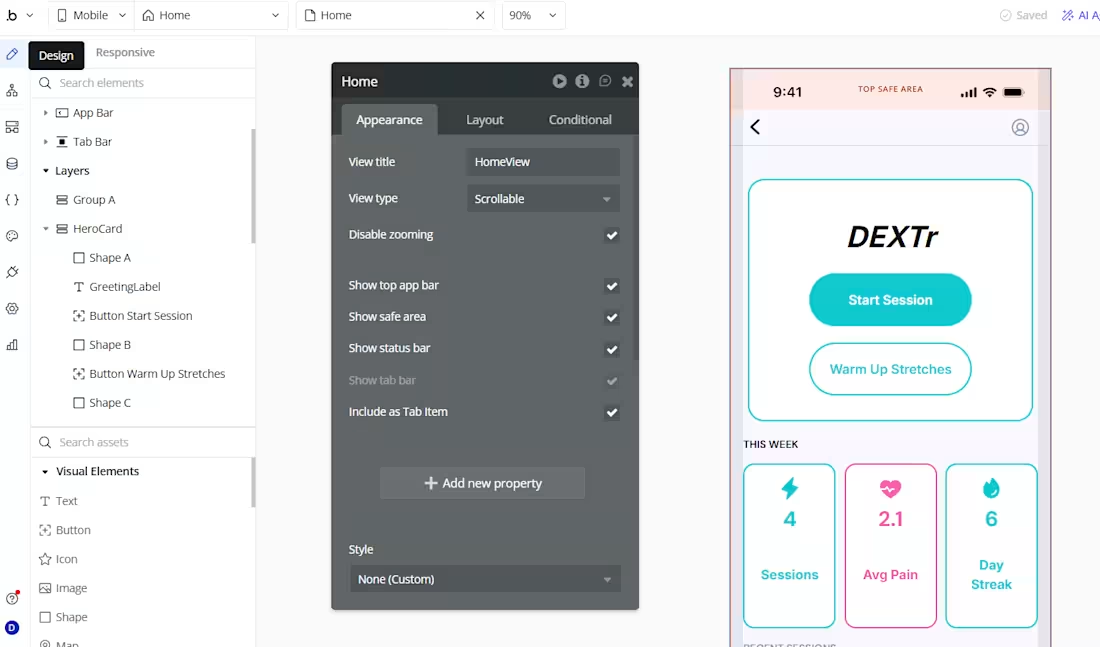
It's called Dextr — a personal AI physio built in Bubble. It builds a tailored exercise plan, tracks progress, and adapts as I recover. The end goal: join a metalcore band 🤘
I've pivoted into no-code and AI-powered automation over the past two years. This is where those skills meet something personal.
I'll be sharing the build on Contra — if you've got design or UX feedback, I'd love to hear it.
0
140
AI Content Engine
1
18

Secure Bi-Directional Notion Architecture
1
11