The network for creativity
Join 1.25M professional creatives like you
Connect with clients, get discovered, and run your business 100% commission-free
Creatives on Contra have earned over $150M and we are just getting started
Back to feedPost


Pros and Cons of AI in Graphic Design (According to Designers)
TL;DR:
AI graphic design tools can drastically reduce costs and free up designers to unleash their full creativity. But what about the originality of AI-enhanced designs, intellectual property rights and job security for designers? If you’re excited about the potential of AI in the graphic design industry but also concerned about the risks, this article has you covered.
Artificial intelligence (AI) is making waves in just about every industry, including creative services. But is this a good or bad thing? (spoiler alert: it’s definitely a good thing!)
Today, Superside will dive into the pros and cons of using AI in graphic design, look at what the research is saying about the impact of AI on design and designers, plus get expert input from Supersiders who know a thing or two (or ten!) about AI and graphic design.
Exploring AI’s Role in Graphic Design
There’s no denying the power of AI to skyrocket output and revolutionize efficiency—something the creative industry is fast catching onto, with AI design trends developing at the speed of light.
In a recent Canva survey of more than 4,000 marketing and creative leaders from nine countries, 75% of respondents reported that generative AI is an essential part of their toolkit and 69% believe it’s enhancing their teams’ creativity.
However, adoption patterns vary significantly across creative disciplines. Research from Envato, based on a survey of 1,780 creative professionals, reveals that while content creators (58%) and marketers (60%) lead in daily AI usage, graphic designers and illustrators sit at just 40%, (a 25-percentage-point gap). This disparity reflects how AI intersects differently with various creative workflows: disciplines optimized for volume see AI as pure acceleration, while those built on bespoke craft navigate questions about value and differentiation.
Generative AI is built on data sets, which are massive amounts of data from all over the internet. When you give an AI tool a prompt, it uses custom-built algorithms to generate an answer derived from that data.
The same goes for graphic design—AI turns mountains of data into images, video and other visual formats. Machine learning algorithms and software automate and enhance design tasks, such as generating design elements, suggesting layouts and optimizing color schemes.
While using AI in graphic design may be new to some, it’s actually come a long way since starting out as a basic automation tool. Nowadays, there are specialized AI design agencies and sophisticated AI-driven platforms that can analyze design trends and user preferences, resulting in more personalized designs.
7 Pros of AI in Graphic Design
Design efficiency and cost savings are just two ways AI can positively impact graphic design. Let’s explore more of the potential benefits of using AI in this field.
1. Automation of repetitive tasks
Generative AI and other current technologies have the potential to automate activities that absorb 60-70% of employees’ time, according to recent research by McKinsey Digital.
This is true for graphic designers, too. AI can handle repetitive tasks by automating processes such as resizing images, image editing, applying filters, generating templates and ensuring brand consistency. This speeds up production, allowing designers to focus more on the strategic and creative aspects of their work.
High-growth brands need to churn out a massive amount of ad creative, but resizing and reformatting digital ads at scale can be hugely time consuming and slow down the process of getting to market.
Superside’s Craft & Productivity Team knew there had to be a better way, so they embarked on delving into the design tools and workflows used for producing large-scale ad creative and finding ways to work faster, ensure consistency and add value.
With their solution identified, the Craft & Productivity Team spent three months developing a workflow that increases ad design productivity by 70%. Nearly 400 Superside customers now use this workflow to scale their digital campaigns, using the best of both human and AI talent.
2. Faster design processes
AI automation in design can result in quicker design processes and project turnarounds.
Along with handling mundane tasks, AI tools can streamline design workflows and enhance collaboration, all of which boost productivity. In fact, one Forbes Advisor survey suggests 64% of businesses believe artificial intelligence can increase their overall productivity.
With 500+ (and counting) AI-enhanced creative projects now complete, Superside has helped customers save more than 17,770 design hours.
On average, our AI-enhanced creative projects are delivered twice as fast and up to 60% more efficiently than projects that don’t use AI technology. Our past design projects also earned a 4.9/5 customer satisfaction rating.
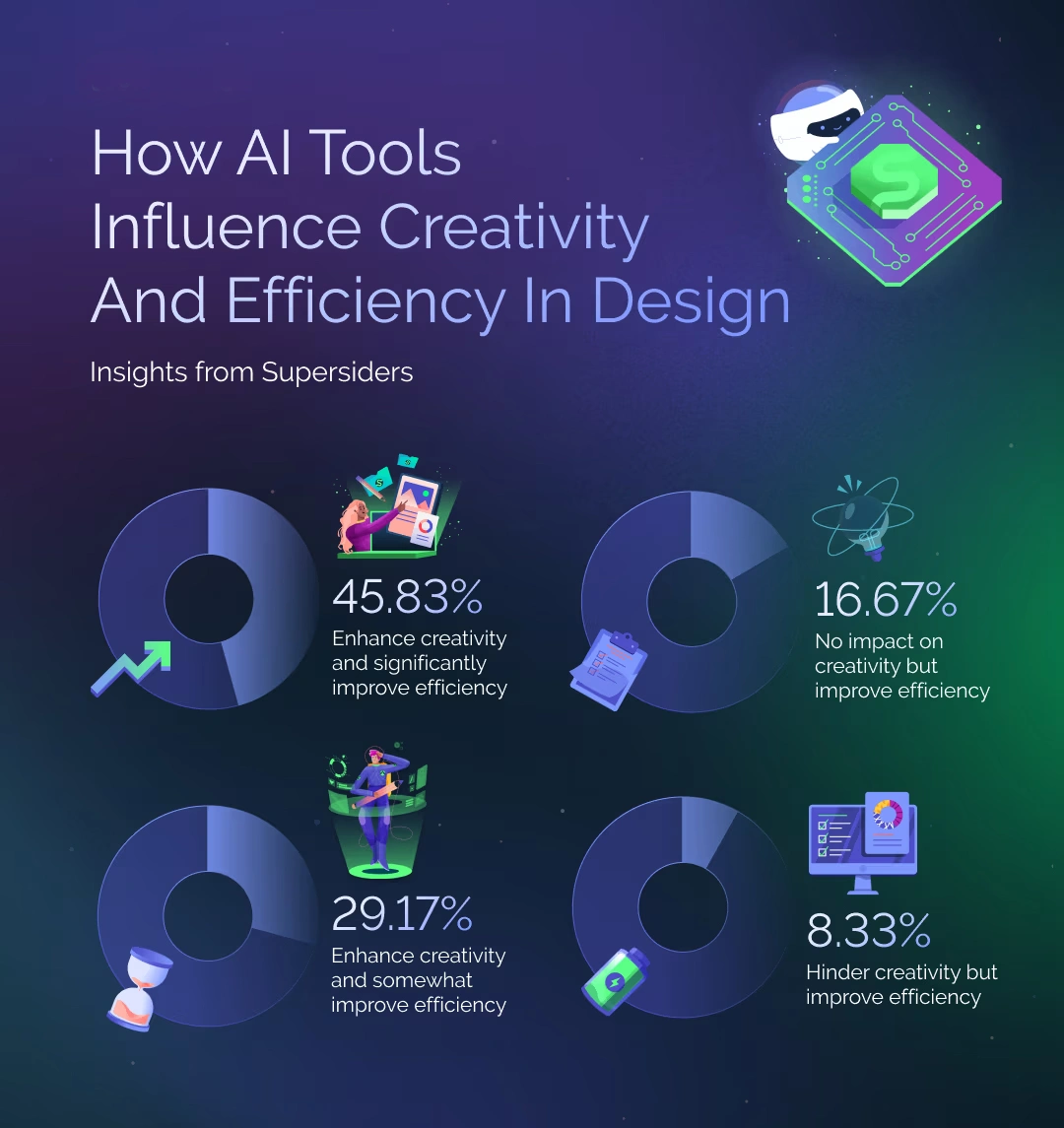
$1.4M+ Design Costs Saved
See work samples and what we've discovered
after completing 500+ AI-Enhanced Projects.
3. Cost-effectiveness
Thanks to automation, fewer errors and all-round quicker design and project turnaround times, AI can significantly reduce the need for extensive (and often expensive) human labor. This lowers overall project costs and allows businesses to allocate resources more efficiently.
Worldwide, businesses across a range of functions agree. In a 2021 survey looking at leading AI cost decreases, more than 50% of respondents said their business had seen cost reductions from implementing AI-driven programs.
Integrating AI into creative workflows to take care of the busy work allows design teams to work on complex problem-solving and creative thinking that only a human brain can do. This is how AI produces return on investment (ROI).
4. Affordable tools and software
Many AI graphic design tools offer affordable subscription models and user-friendly interfaces, making them accessible to a wide range of users.
5. Innovation and creativity
Generative AI design algorithms can produce unexpected patterns and layouts, sparking greater creativity in graphic designers. What’s more, AI-powered insights into trends and user preferences enable designers to tailor their work more effectively and push the boundaries of conventional design.
A Harvard Business Review investigation recently found that one of the biggest opportunities generative AI offers is to augment human creativity and make innovation more accessible. The report suggests using AI to promote new ways of thinking.
When mobile workforce enablement platform —product imagery, icons and backgrounds—that would refresh a website and serve as an asset library, the brief was clear: Adhere to existing brand guidelines while exploring innovative illustration formats and sizes to enhance visual appeal across marketing channels.
6. New possibilities for creative expression
AI can provide graphic designers with innovative tools that inspire unique ideas and designs.
A 2024 Adobe report confirms that designers are already experiencing these benefits. According to the global survey of 2,541 creative professionals:
83% are using generative AI
20% say their companies or customers require them to use some type of generative AI in their work
66% say they’re making better content with generative AI tools
69% believe generative AI will provide them with new ways to express creativity
The take from these findings: AI is transforming how graphic designers work, allowing them to discover fresh means of creative expression and create more impactful work.
7. Making design more accessible to non-designers
AI gives non-design professionals access to high-quality design by simplifying the design process. And trained designers agree: AI makes the design process easier overall.
Intuitive tools, drag-and-drop interfaces, automated design suggestions, pre-made templates and AI-driven features, like automatic image enhancement and layout optimization, enable users without design skills to produce professional-quality visuals.
Wondering how even your non-creative team can get creative with AI? From AI presentation makers and logo generators to AI ad copy generators and thumbnail makers for YouTube, there are plenty of easy-to-use AI tools that can help everyone get quality design assets to market more quickly.
7 Cons of AI in Graphic Design (& How We Overcome Them)
It’s clear that AI can positively impact design processes and creativity, but what about the potential challenges of AI in graphic design? Let’s take a closer look at some of the disadvantages of using AI in this field and what we do to overcome these barriers.
1. Quality and originality
AI-generated designs can sometimes lack the depth and originality of those created by humans.
Designers may become too dependent on the automated templates and pre-set styles provided by AI tools, leading to generic and monotonous designs. Some research suggests this over-reliance on AI could lead to human designers losing their unique knowledge and skills.
2. Potential loss of unique, human touch
There’s no replacement for the human touch, something that can get diminished with the use of AI tools in design. AI also has no understanding of cultural or emotional contexts, which can result in designs that fail to resonate or connect with target audiences.
According to Forbes research into the biggest risks posed by AI, increasing reliance on AI tools could lead to less empathy, poorer social skills and fewer human connections. Maintaining a balance between technology and human interaction remains essential.
3. Impact on employment for human designers
With some research suggesting 41% of design professionals could be in danger of being replaced by AI, it’s understandable that graphic designers may be nervous about the significant advancements of AI in design.
What’s more, a McKinsey Global Institute report estimates that 15% of the global workforce, or about 400 million workers, could lose their jobs to AI by 2030.
4. Intellectual property concerns
The use of AI in graphic design raises concerns around the originality and ownership of AI-generated designs. After all, who owns the rights to AI creations—the user or the AI developer? Is intellectual property unique to humans?
What’s more, AI could inadvertently replicate existing designs, leading to copyright infringement and legal disputes.
According to The AI Journal, since the launch of ChatGPT alone, there have been 12 lawsuits in the United States against OpenAI and Microsoft. In the United Kingdom, 76% of content right holders say their content has been used by AI without permission or payment.
6. Over-reliance on AI tools
There’s a risk of graphic designers becoming too dependent on automation tools, which could lead to reduced creativity and originality, and affect their skills development.
Superside is all about using AI as a support tool to help save time and money on design projects, but never as a replacement for human talent.
When National Gas Metering in the United Kingdom needed help designing a large number of animated visuals for a convention, the project specifications were flexible and gave Superside’s designers plenty of opportunity for creative expression, but time and budget were tight.
Using Midjourney and Adobe Photoshop AI tools, the design team delivered 675+ unique images, saving National Gas Metering more than $9,000 and 85% design time
7. Potential for technical issues and errors
In a recent survey, 67% of CEOs cited potential errors as a top risk of AI adoption and 43% of business leaders said they were concerned about the trustworthiness of AI.
Their concerns are not unfounded. AI tools can and do make mistakes in graphic design too, which leads to flawed designs requiring human intervention to fix and reducing the efficiency of using AI in the design process.
Are AI Benefits Greater Than Drawbacks in Graphic Design?
Getting the pros of using AI in graphic design to outweigh the cons requires not only extensive knowledge and experience of working with AI, but balance.
AI and Human Creativity in Harmony: Superside’s Graphic Design Success
When used in tandem with human talent, AI can transform creative processes and output for businesses and brands, and ultimately help drive growth.
Don’t let the potential risks of AI stop you from experiencing its incredible benefits: Book a call to discover what partnering with AI design experts can do for you.
The network for creativity
Join 1.25M professional creatives like you
Connect with clients, get discovered, and run your business 100% commission-free
Creatives on Contra have earned over $150M and we are just getting started
Trending

Claude
Claude has entered the design space. How are you using it?

Contra University
Learn from expert creatives how to earn more using next-gen AI tools.
Brand Design
The best brand designers are on Contra. Scroll to see what's trending in brand design. What are you building?
creativeaiflow
Creative AI workflows are evolving. What tools do you use, and what are their strengths and weaknesses?
freelancerlife
Freelancer life is wins, pivots, and everything in between. What’s yours right now?



Related posts



Great work

Spec AI for Social Media.
One image.
One prompt.
Automated editing and sound design.
All done with Seedance 2.0


Looks really cool👍

AI gave ideas. Human judgment built the brand.
For the Human by Design Challenge, I created Cronut Café; a conceptual bakery brand, to explore how AI can speed up ideation without replacing creative direction.
I used Envato's ImageGen to generate early logo concepts, then relied on my own judgment to refine the logo, typography, colour palette, and visual identity in Adobe Illustrator. Once the brand direction felt right, I returned to Envato to create mockups, also using VideoGen to bring the identity to life through motion.
The biggest decision was knowing what to keep, what to change, and what to throw away.
That's the part of design that will never change 🚀
Thanks @Envato and @Contra for the challenge! 💚


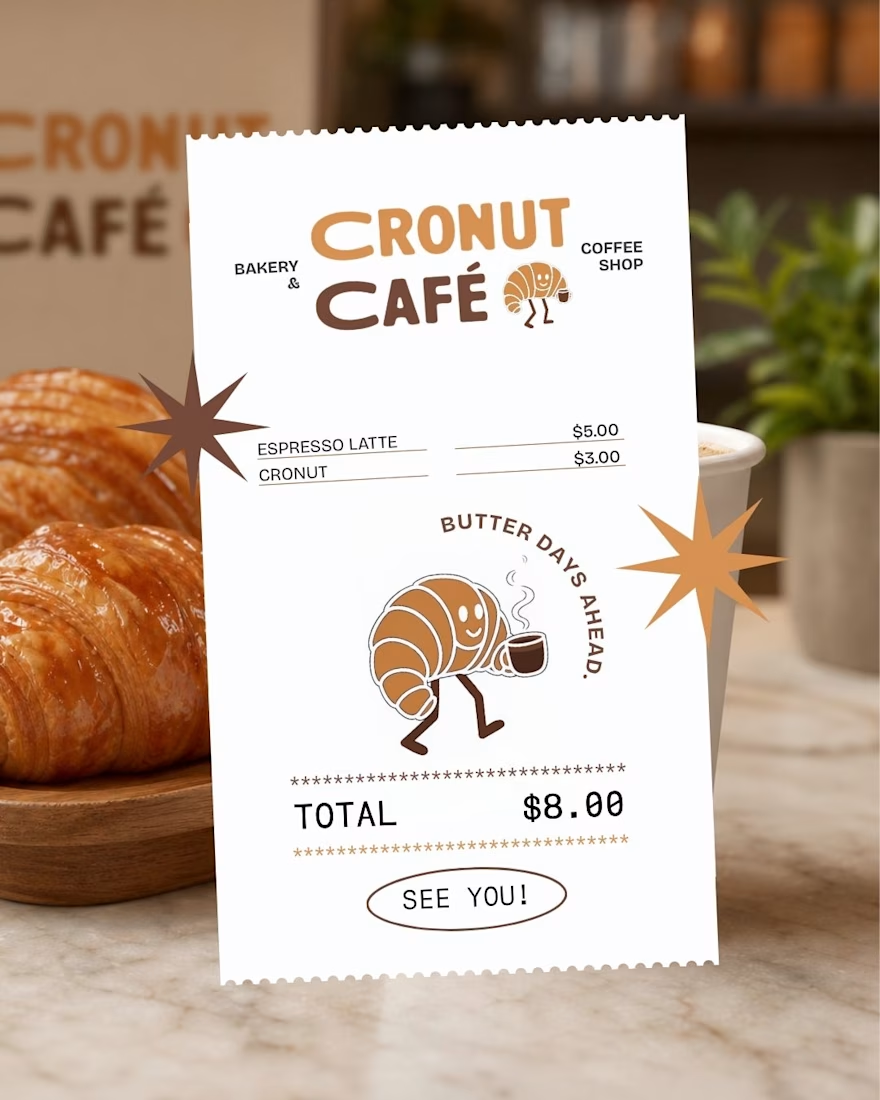


The Cronut Café name and that latte art shot sell the concept before you even read the caption. Good call using ImageGen just for early concepts and pulling it into Illustrator once you had a direction, that workflow keeps the judgment where it should be.