The network for creativity
Join 1.25M professional creatives like you
Connect with clients, get discovered, and run your business 100% commission-free
Creatives on Contra have earned over $150M and we are just getting started
Back to feedPost


The network for creativity
Join 1.25M professional creatives like you
Connect with clients, get discovered, and run your business 100% commission-free
Creatives on Contra have earned over $150M and we are just getting started

Challenges
View all


Related posts

I’ve been building SabiFlow for a while, and honestly, the most interesting part of the project isn’t the code.
It's the problem.
Because it's personal.
I've experienced that thing where money comes in and somehow, without you really noticing, it starts disappearing.
Not because you don’t earn enough.
Not necessarily because you're irresponsible either.
Sometimes money simply has no job when it arrives.
And as an engineer, that got me thinking:
What if the problem isn't budgeting? What if the problem is that we’re asking people to make too many good decisions at the exact moment they have the most temptation to make bad ones?
That question became the foundation for SabiFlow.
Instead of telling someone, "You should save 20% of your income," I started thinking about what would happen if the system simply helped assign every inflow a purpose the moment it arrived.
That led me down a rabbit hole.
Funnels.
Automated distribution.
Wallet infrastructure.
Virtual accounts.
User behaviour.
Transaction flows.
KYC.
Compliance.
Even the psychology behind notifications.
And this is probably my favourite part of being both an engineer and a founder.
I don’t just ask:
"How do I build this feature?"
I ask:
"Why does this problem exist, and what kind of system could make dealing with it easier?"
Then the engineer in me comes along and asks:
"Okay… but how do we actually make this work reliably?" 😂
That tension between the founder thinking about the problem and the CTO thinking about the system is probably what I enjoy most about building SabiFlow.
I’m still figuring a lot of it out.
But I'm curious:
What’s a problem you’ve experienced personally that eventually made you want to build something around it?


The framing around “why does this problem exist?” is exactly the kind of product thinking that keeps a financial tool from becoming another dashboard. SabiFlow sounds strongest where the behavioral insight meets the practical system design—especially around notifications and reliable follow-through.

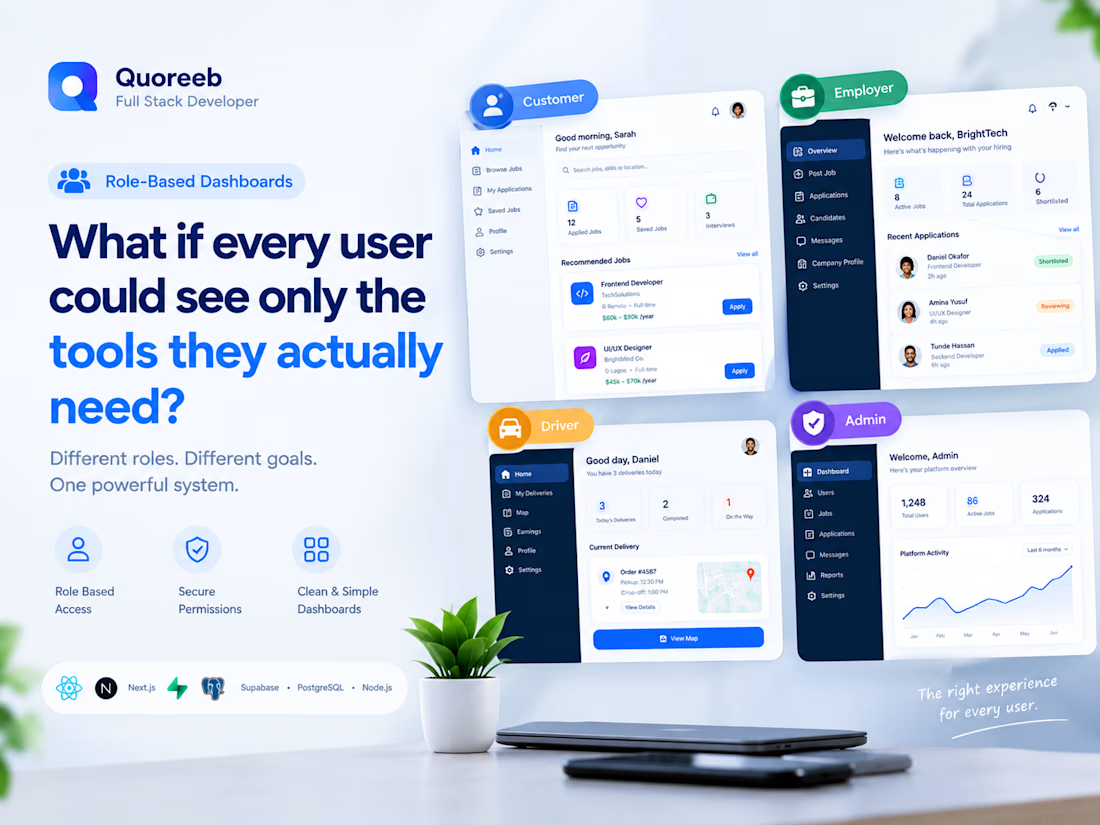
What If Your App Had Different Dashboards for Different Users?
What if every user could see only the tools they actually need? 👥
A customer, employee, vendor, driver, or administrator shouldn't necessarily have the same experience.
With role-based access and dedicated dashboards, each user can get the right features, information, and workflows for their role.
This makes complex applications easier to manage and gives every user a cleaner experience.



Very nice

Not gonna lie! I am obsessed with complex systems and especially dashboards. Saas B2B AI (My favourite)
Posted a case study check it out