The network for creativity
Join 1.25M professional creatives like you
Connect with clients, get discovered, and run your business 100% commission-free
Creatives on Contra have earned over $150M and we are just getting started
Back to feedPost
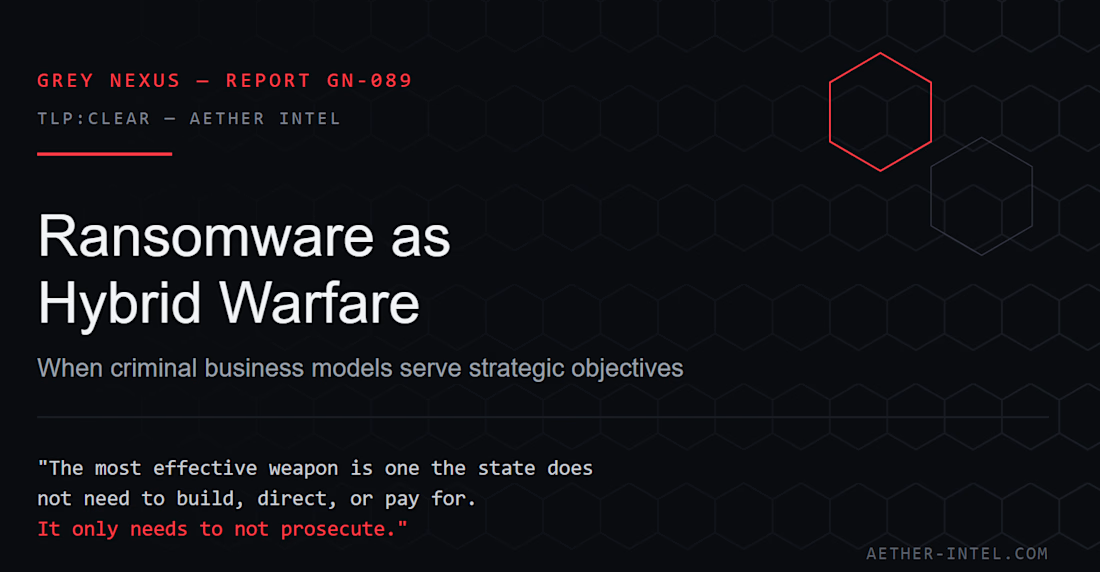
Ransomware isn't just cybercrime anymore.
Not because every operator has geopolitical ambitions.
But because thousands of independent profit-driven decisions can collectively produce the strategic effects a hostile state wants.
From the perspective of many ransomware operators, the objective is straightforward:
Find a victim that can pay.
Maximize profit.
Avoid unnecessary attention.
For some, ransomware is simply a business.
For others, it's a way to survive.
Geopolitics rarely enters the equation ( for RaaS groups ne-affiliated with states org )
Yet when ransomware crews consistently avoid domestic targets, operate from jurisdictions where they face little risk of prosecution, and repeatedly impact critical infrastructure in geopolitical rivals, the outcome becomes much larger than the intentions of any individual operator.
No recruitment.
No command-and-control.
No formal agreement.
Just aligned incentives.
The criminals pursue profit.
The state benefits from economic disruption, political pressure, and degraded public confidence in its adversaries.
Neither side needs to coordinate when both benefit from the same outcome.
In GN-089, I examine five mechanisms that explain how ransomware can evolve from a criminal business model into a hybrid warfare instrument:
• Tacit tolerance instead of active sponsorship
• Target steering without direct orders
• Strategic timing around geopolitical events
• Economic warfare as a byproduct of greed
• Critical infrastructure disruption under criminal cover
The most effective hybrid weapon isn't always the one a state builds.
Sometimes it's the one it simply chooses not to stop.
N
ew GREY NEXUS Report (GN-089): Ransomware as Hybrid Warfare — When Criminal Business Models Serve Strategic Objectives.
TLP:AMBER available too - to know how a RaaS operator thinks and what he does with details
Read the full report, free, at aether-intel.com.
The network for creativity
Join 1.25M professional creatives like you
Connect with clients, get discovered, and run your business 100% commission-free
Creatives on Contra have earned over $150M and we are just getting started
Related posts

The Criminal groups Does the Intrusion. The State linked groups Only Has to Shop.
Part of GN-090 Report which is available to read for free on Aether-Intel
The cybercriminal selling stolen credentials for $500 thinks they're making another routine marketplace sale.
What if the real customer isn't another criminal?
One of the arguments I explore in my latest GREY NEXUS report is that the underground data economy has quietly become an intelligence marketplace.
The intrusion is funded by crime.
The marketplace handles distribution.
The buyer may be pursuing something far beyond financial gain.
The same dataset can have two completely different values:
• A criminal sees VPN credentials.
• An intelligence service sees pre-positioning.
• A criminal sees leaked personal data
.• An intelligence service sees targeting material.
• A criminal sees a telecom breach.
• An intelligence service sees population-level signals intelligence.
The data doesn't change.
Only the buyer's objective does.That's why I believe every major breach should be viewed through two lenses:
What can criminals do with it?
What could a state actor do with exactly the same data?
This report argues that the criminal data economy isn't just enabling cybercrime it also functions as a self-sustaining intelligence supply chain where the end buyer may never be visible to the seller.
In recent weeks, I've observed what appears to be a renewed purchasing campaign by state-linked actors targeting millions of social media accounts and large credential databases containing email/password combinations. The intrusion may be criminal. The acquisition objective may be something else entirely.
GN-090 - The Intelligence Marketplace: Where Criminal Data Brokers Sell to State Buyers Without Knowing It is now available to read TLP:CLEAR on Aether-Intel

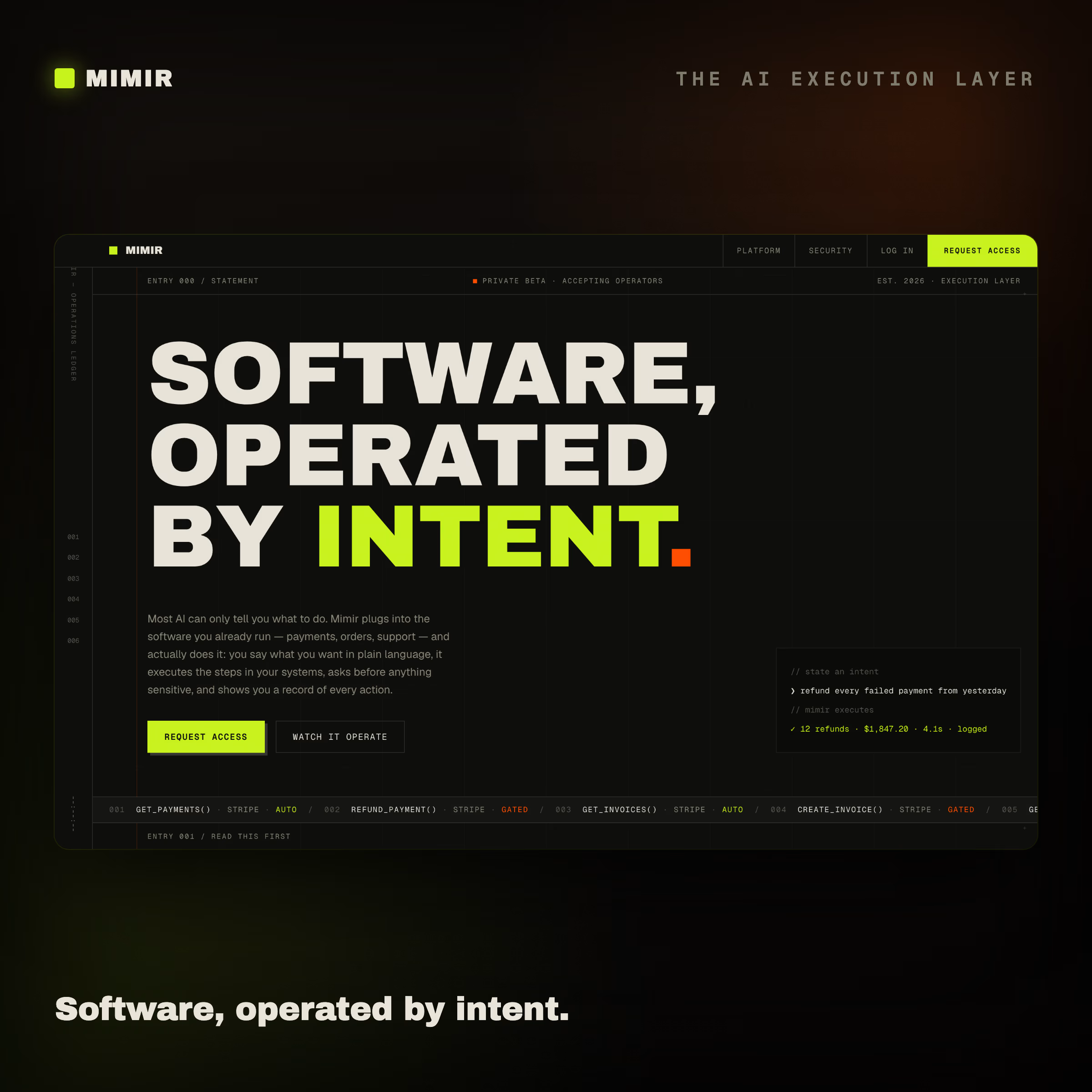
Mimir — the AI execution layer for software
Build story
I kept hitting the same wall with AI agents: they can tell you what to do, but the moment you let one actually touch a real system — payments, orders, refunds — you're one hallucinated call away from a disaster. The demo is easy. The safety is the whole product. So I built Mimir around that problem instead of around the demo.
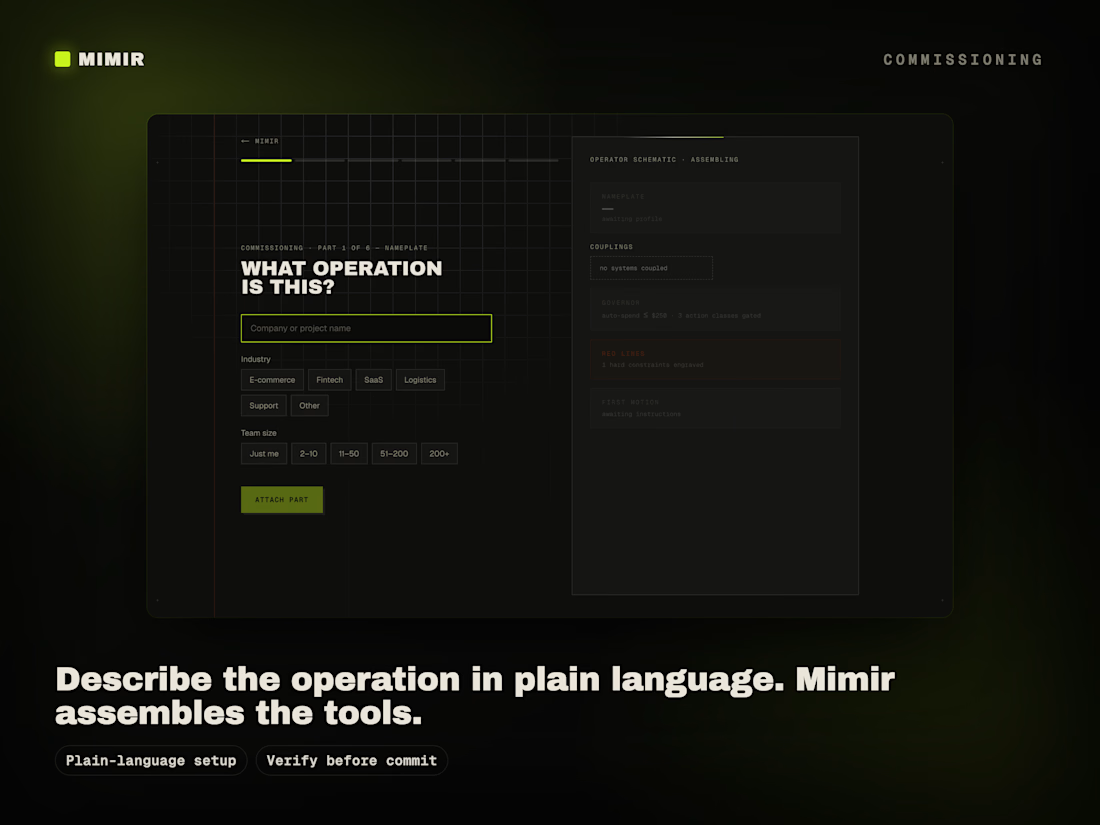
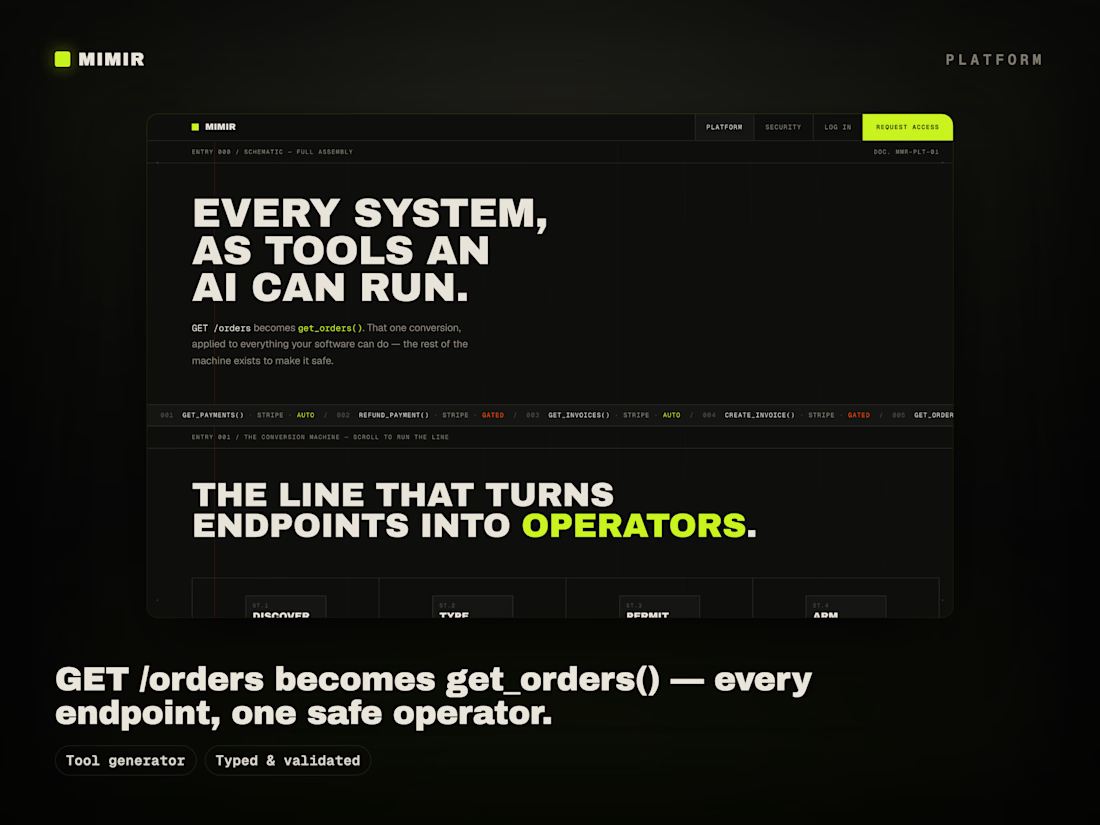
The core move is a single conversion: every API endpoint becomes one safe, callable operator. GET /orders becomes get_orders(). You point Mimir at an OpenAPI spec — or just paste the docs — and the model reads it, normalizes it, and commits it as a set of typed, validated tools an agent can run.
Three decisions shaped the build:
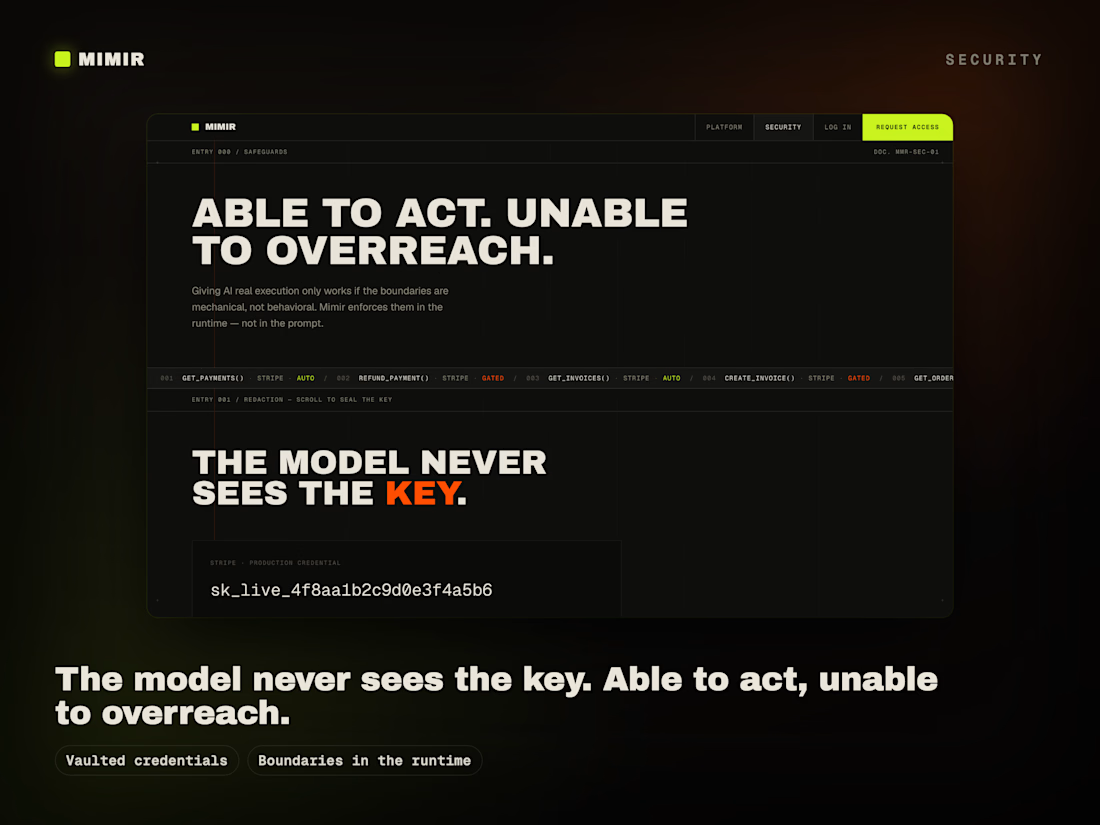
Boundaries live in the runtime, not the prompt. Permissions, approval gates, and destructive-write flags are enforced in code. You can't jailbreak a policy that was never a sentence. The agent is able to act, unable to overreach.
The model never sees the key. Credentials are vaulted and injected at execution time. The LLM operates the system without ever holding the secret to it.
Every action is signed and logged. Runs are stamped to an operator and written to an audit trail — so "the AI did it" is always answerable with who, what, and when.
The part I'm most proud of: I engineered it to run on a local 7B model, not a frontier API. That forced real discipline — small-model-first, code-enforces-not-prompts, eval-driven, structured output over brittle parsing, and a rule I made non-negotiable: the AI understands the docs and normalizes them; code only validates against known types. No hard-coding one company's naming conventions, because the next API won't share them. It's a deliberately-engineered system, not a wrapper around a chat box — and it's executed real refunds end-to-end.
Stack: Next.js 16 · React 19 · Tailwind v4 · TypeScript on the front; FastAPI · Postgres · LiteLLM → Ollama on the back. The interface is a custom design system I call "Operations Ledger" — carbon, bone, and one acid accent; Archivo Black; flat brutalist. It's meant to feel like an instrument panel, not a landing page.
Software you can operate by intent — safely.
#SoftwareArchitecture #SystemDesign #FullStack #SaaS #AIEngineering #DistributedSystems #React #PostgreSQL #NodeJS #Python #ProductEngineering #WebDevelopment

Sovereign Tender Navigation & G2B Procurement Advisory
Providing high-level strategic advisory and structural compliance positioning for global enterprises participating in public and private procurement tracks. To safeguard institutional anonymity and uphold sovereign guidelines, specific tender metrics and enterprise identifiers remain fully non-disclosed under standard mutual NDA compliance.









Trending

Claude
Claude has entered the design space. How are you using Claude Design?

Contra University
Learn from expert creatives how to earn more using next-gen AI tools.
fifaworldcup2026
The World Cup is here and the whole world's watching. How are you designing for the world stage?
creativeaiflow
Creative AI workflows are evolving. What tools do you use, and what are their strengths and weaknesses?
freelancerlife
Freelancer life is wins, pivots, and everything in between. What’s yours right now?