The network for creativity
Join 1.25M professional creatives like you
Connect with clients, get discovered, and run your business 100% commission-free
Creatives on Contra have earned over $150M and we are just getting started
Back to feedPost

🏗️ Bulldozer Price Prediction — End-to-End Machine Learning Project
🚜 Overview
How do you accurately estimate the value of heavy equipment at auction?
In this project, I built a machine learning model to predict the sale price of bulldozers using historical auction data — effectively creating a data-driven “blue book” valuation system.
This project simulates a real-world ML workflow:
Handling messy, real-world data
Engineering meaningful features
Iterating through models and tuning
Evaluating performance using proper metrics
🎯 Problem Statement
Auction prices for heavy equipment can vary significantly based on:
Machine specifications
Usage and configuration
Market conditions over time
The objective is to build a model that can accurately predict the SalePrice, enabling:
Better pricing decisions
Reduced uncertainty in auctions
Data-driven valuation systems
📊 Dataset
The dataset is split into three time-based sets:
Train Set → Data up to 2011
Validation Set → Jan 2012 – April 2012
Test Set → May 2012 – Nov 2012
This structure mimics real-world forecasting, where models are trained on past data and evaluated on future data.
⚠️ Due to size limitations, the dataset is not included in this repository.
👉 Download here:
https://www.kaggle.com/competitions/bluebook-for-bulldozers/data
⚙️ Machine Learning Workflow
🧹 Data Preprocessing
Converted saledate to datetime format
Extracted time-based features:
Year, Month, Day, Day of Week
Handled missing values:
Numerical → median imputation
Categorical → encoded as numerical values
🧠 Feature Engineering
Created time-based features from sale date
Leveraged machine attributes and configuration data
Improved model performance through iterative feature refinement
🌲 Model Used
RandomForestRegressor
Why?
Handles non-linear relationships well
Works great with structured/tabular data
Robust to noise and missing values
📈 Results
Metric Training Validation
MAE 2953.82 5951.25
RMSLE 0.1447 0.2452
R² 0.9588 0.8818
🔁 Iteration Journey (What Actually Happened)
This project wasn’t a straight line — and that’s where the real learning happened.
Stage Validation RMSLE
Baseline Model 0.2936
First Tuning Attempt 0.5638 ❌
Final Optimized Model 0.2452 ✅
💡 Key Takeaway:
Better hyperparameters don’t guarantee better performance — experimentation does.
🔧 Hyperparameter Tuning
Used RandomizedSearchCV (100 iterations) to explore the parameter space.
Best parameters:
n_estimators=40
min_samples_leaf=1
min_samples_split=14
max_features=0.5
💡 Key Insights
Feature engineering had the biggest impact on performance
Poor tuning can significantly degrade model accuracy
Time-based splits are crucial for realistic evaluation
Iteration and experimentation are core ML skills
🚀 Future Improvements
Apply log transformation to improve RMSLE
Experiment with LightGBM / XGBoost
Build a deployment-ready app (Streamlit)
Add feature importance visualization
📁 Project Structure
bulldozer-price-prediction/
│
├── notebook.ipynb
├── README.md
├── .gitignore
└── requirements.txt
🧑💻 Author
Toby Chuks
GitHub: https://github.com/tobychuks01
LinkedIn: https://www.linkedin.com/in/toby-chuks-630b44217
⭐ Final Note
This project reflects more than just building a model —
it demonstrates the importance of iteration, experimentation, and learning from failure in machine learning.



The network for creativity
Join 1.25M professional creatives like you
Connect with clients, get discovered, and run your business 100% commission-free
Creatives on Contra have earned over $150M and we are just getting started
Related posts

Designed, built and deployed a Prospect Finder tool.
AI-Powered Lead Intelligence & Outreach Platform.
Built a fully custom, AI-powered prospecting and outreach platform from the ground up to power an entire sales operation solo, without an engineering team.
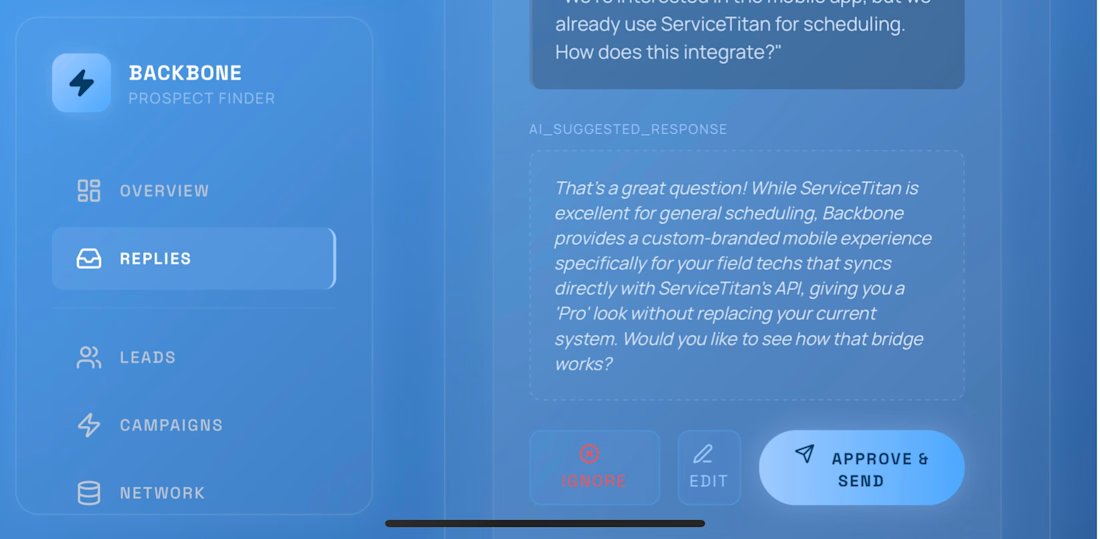
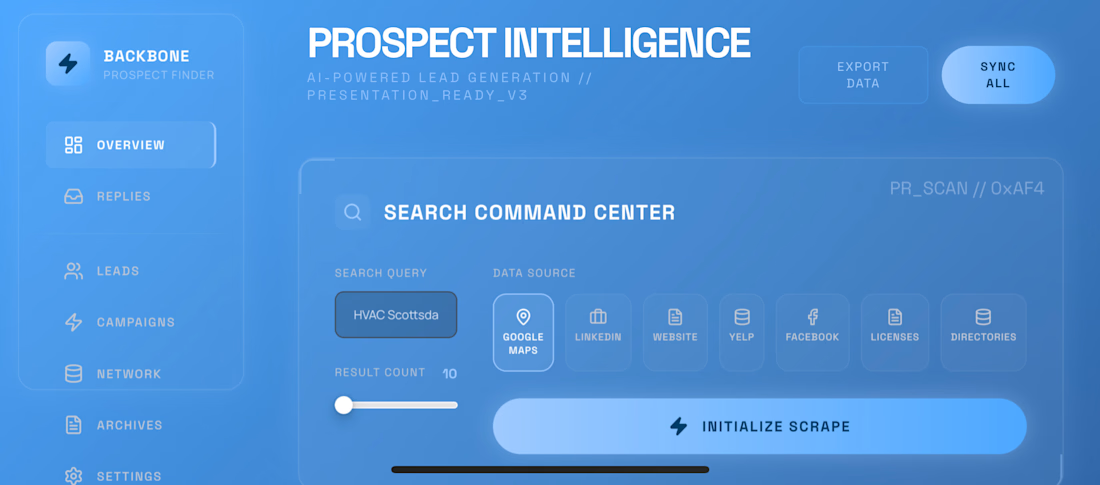
The platform functions as a complete sales intelligence command center, pulling prospect data across multiple sources simultaneously; Google Maps, LinkedIn, business websites, Yelp, Facebook, license databases, and directories and scoring each lead with a proprietary AI Fit Score to prioritize outreach by conversion likelihood.
From there, the system manages the full 8-touch outreach campaign lifecycle per prospect, tracking each contact’s position across the sequence in real time. When prospects reply, the platform surfaces AI-generated response suggestions tailored to the conversation context, allowing instant, intelligent follow-up with a single “Approve & Send.”
What I built:
[] Search Command Center with multi-source data scraping (Google Maps, LinkedIn, Yelp, Facebook, Licenses, Directories)
[] AI Fit Scoring engine that ranks prospects by conversion likelihood
[] 8-touch campaign status tracker per contact
[] AI-suggested reply system with Ignore / Edit / Approve & Send workflow
[] Lead management dashboard with overview, replies, leads, campaigns, network, and archives modules
[] Export functionality for pipeline data
Platform tools of dev: Agentic AI development workflows, Claude API, n8n automation, no-code platforms.
End product output: A single operator running a sales intelligence and outreach system that would typically require a dedicated SDR team and a $30k+/year software stack. Built and deployed solo in weeks.



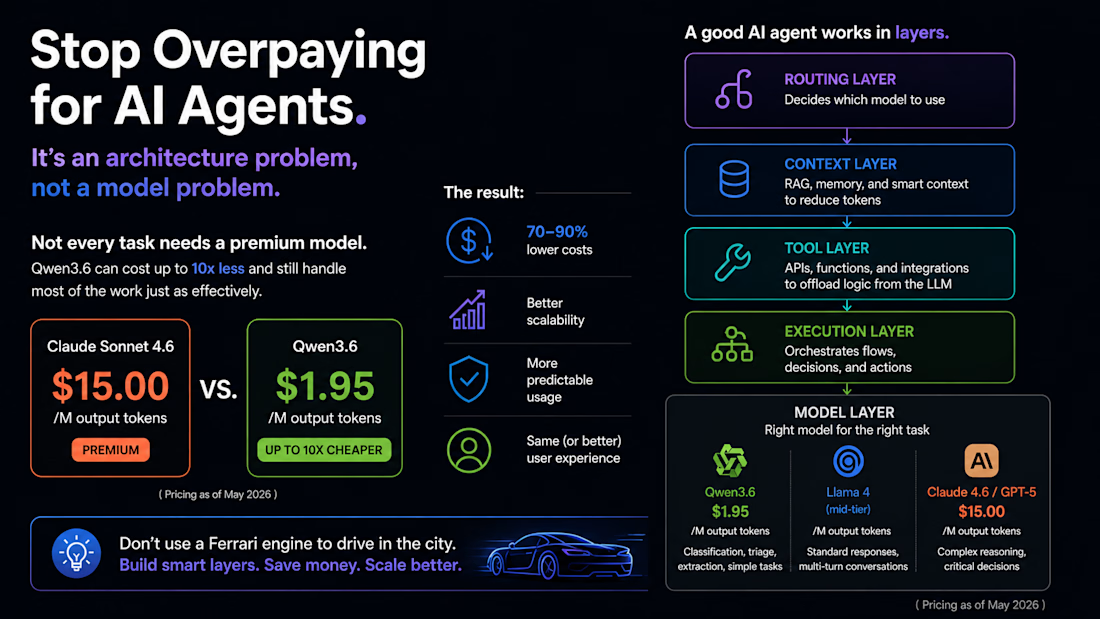
Most AI agents are unnecessarily expensive and the problem is usually architecture, not the model.
One of the biggest pain points when building AI agents is LLM cost. Many teams use high-end models like Claude Sonnet or GPT-5 for everything, even tasks that don’t need that level of reasoning. That quickly becomes unsustainable at scale.
The reality is: not every task needs a premium model. Models like Qwen 3.x can cost up to 10x less and still handle tasks like intent classification, basic responses, structured extraction, and routing decisions with similar efficiency.
A well-designed AI agent isn’t just an LLM wrapper it’s a layered system. Routing decides which model to use, context (RAG/memory) reduces tokens, tools handle logic, and execution orchestrates everything. The LLM is just one component.
The winning strategy is simple: use the right model for the right job.
If your AI agent is expensive, it’s probably an architecture problem.

📝 Ninth Publication: Efficiency vs. Repetition: The Logic of Stored Procedures 🌱
In data analysis, the most valuable resource isn't just the data itself—it’s time. Today, I’m exploring how moving from manual, repetitive queries to automated systems can transform a workflow from reactive to proactive.
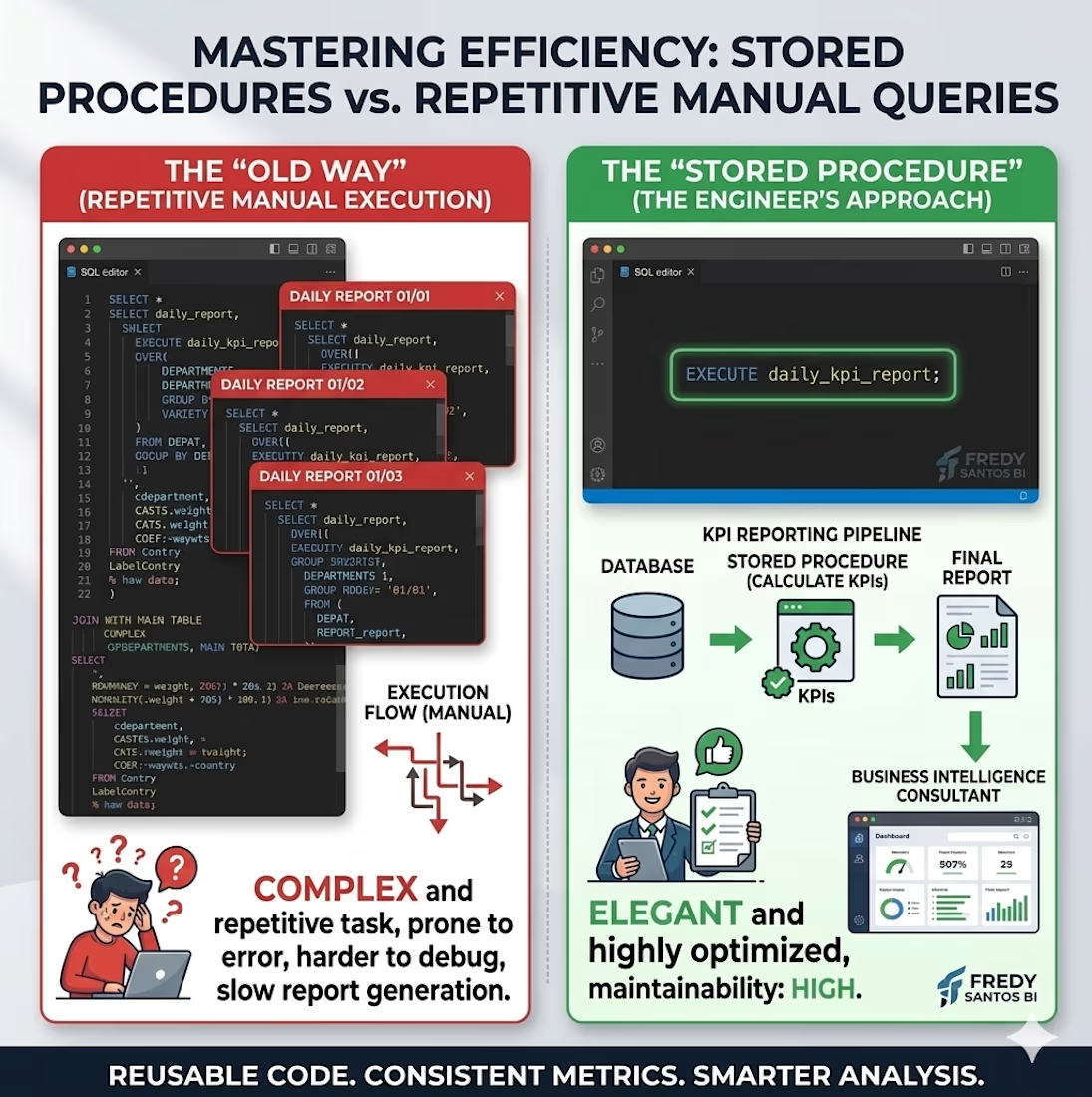
🔍 The Difference Between Running Tasks and Building Tools "Mastering SQL is about more than just finding answers; it’s about creating repeatable processes. When we face complex logic that needs to be executed frequently, we have two choices: rewrite it every time, or build a Stored Procedure.
The Manual Way: Rewriting 50+ lines of joins and aggregations every morning. It’s slow, prone to human error, and creates 'data debt'.
The Professional Way: Wrapping that logic into a saved procedure that can be called with a single command. It ensures that every stakeholder sees the same consistent metrics, every time.
The Result: By automating the routine, we free up mental space to focus on deep analysis and strategic decision-making."
💡 Why Automated Logic Wins:
Consistency: The calculation for a metric remains identical regardless of who runs the report.
Performance: Stored procedures are often optimized by the database engine, leading to faster execution times than raw scripts.
Scalability: A single procedure can handle data for one department or an entire organization with the same level of precision.
✨ My Philosophy
The journey of a data professional is defined by the systems they leave behind. Choosing to build reusable tools instead of performing one-off tasks is a fundamental shift toward a senior mindset. Every procedure is a step toward higher quality, more reliable reporting.
Did you use them? How?




Trending

Claude
Claude has entered the design space. How are you using Claude Design?

Contra University
Learn from expert creatives how to earn more using next-gen AI tools.
creativeaiflow
Creative AI workflows are evolving. What tools do you use, and what are their strengths and weaknesses?
portfolioreview
The best portfolios tell a story, not just show a grid. Share yours for feedback.
freelancerlife
Freelancer life is wins, pivots, and everything in between. What’s yours right now?