The network for creativity
Join 1.25M professional creatives like you
Connect with clients, get discovered, and run your business 100% commission-free
Creatives on Contra have earned over $150M and we are just getting started
Back to feedPost

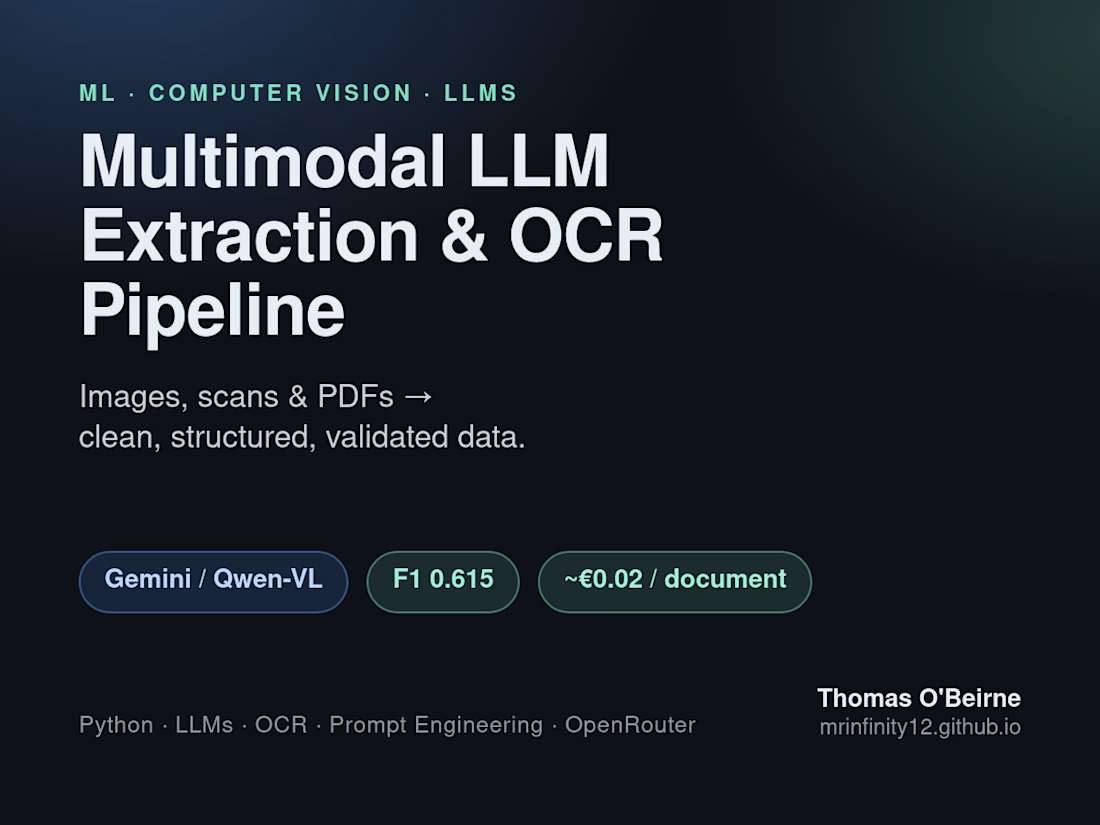
A Gemini Flash pipeline that turns images and PDFs into clean structured data: text extraction with
bounding boxes, an LLM proofreading/QC pass, inpainting and automated typesetting. Benchmarked at F1 = 0.615 for ~€0.02
per document.


The network for creativity
Join 1.25M professional creatives like you
Connect with clients, get discovered, and run your business 100% commission-free
Creatives on Contra have earned over $150M and we are just getting started








Related posts

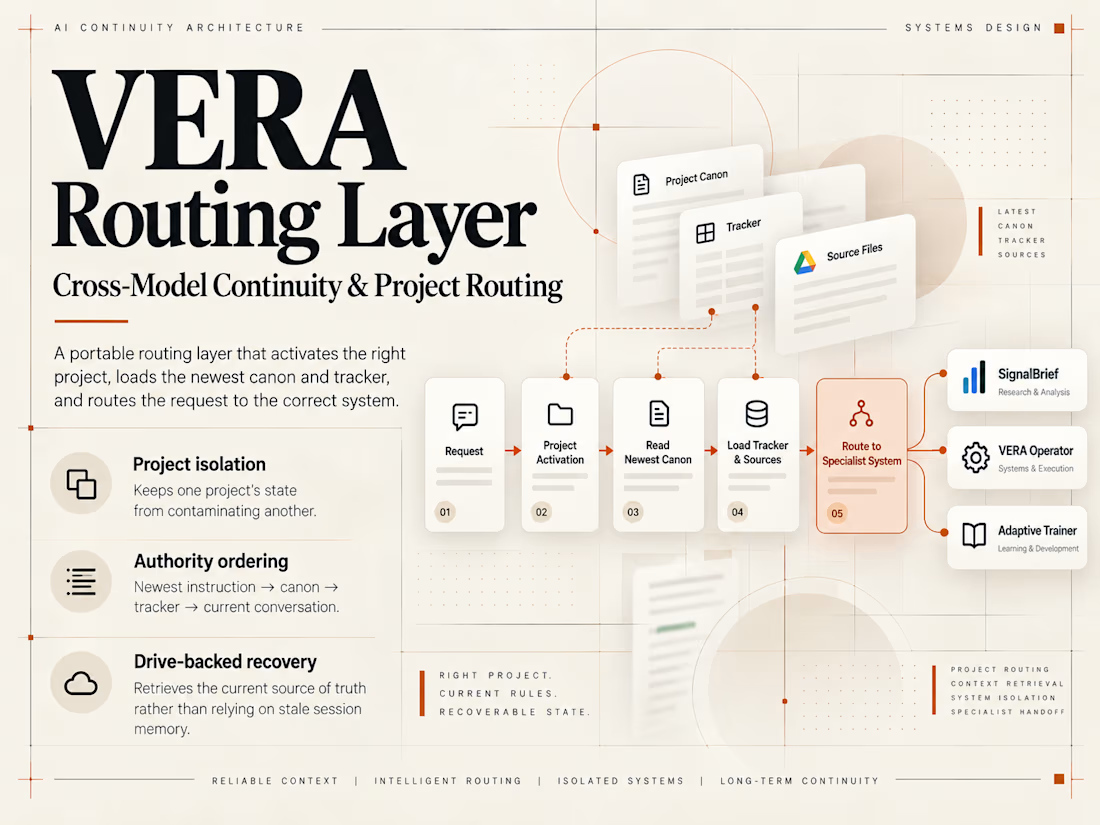
A strong specialist skill is useless if the wrong system gets invoked. Long-running AI work breaks in boring, expensive ways.
That is not a prompting problem. It is a routing and authority problem.
How I can help you:
I build project routers for teams using multiple AI workflows, agents, or specialist assistants so that they work with each other as a team.
I design source-of-truth resolutions so your agents retrieve the current rules instead of improvising or relying on assumptions or stale chat data.
I create reusable skill registries and specialist handoff logic hardened by determined and dedicated flow states reducing the need for model reliance on its own internal and displaced memory context.
I separate project states with individualized canonical states bound by rules living under essential model instructions and routed properly so unrelated workflows do not contaminate one another, but exist with awareness of the role each project plays, enabling a persistently growing ecosystem to develop organically.
I add governance wrappers, escalation hooks, and recovery mirrors around existing AI stacks so that trust is designed at the root, and variance is eliminated with rule based source archiving and implementation.
Trust means closing your eyes at night and sleeping soundly because your agents got your back. And I can put it all together for you, precision results sourced and undisputed because I got tired of doing things the hard way.

Phillip, agree that routing is where it breaks. In our builds the worst bugs came from an agent pulling an old rule from chat history instead of the current source. Pinning one source of truth per project fixed more than any prompt change did.

NetworkAI — AI-Powered Campus Network Monitoring System
A real-time network monitoring dashboard designed to help campus IT teams observe network health, monitor interfaces, and identify potential issues from a single interface.
What I built
Real-time network monitoring with live interface and system status
Network interface analytics showing traffic and connection activity
Historical monitoring data for analyzing network behavior over time
Live WebSocket communication for continuously updated monitoring data
Network controls to start and stop monitoring directly from the dashboard
Interactive charts and visualizations for easier interpretation of
network metrics
Responsive dashboard UI designed for clear monitoring rather than unnecessary complexity
FastAPI backend providing REST APIs and WebSocket communication
React frontend with a modern monitoring-focused interface
Why I built it
The goal was to create a practical campus network monitoring system that demonstrates how real-time networking data can be collected, processed, and presented through a modern web interface.


How does the dashboard show when a metric was last updated? If monitoring stops or the collector loses contact with a device, I'd want the last reading to look clearly stale rather than still healthy.

AI Agent Landing Page | Figma, Framer & AI Workflow
Designed and prototyped an AI Agent landing page using Figma, animated in Framer, and accelerated with an AI-powered workflow.
Focused on a bold visual identity, immersive motion, modern typography, and a high-converting SaaS experience.


Ashar, the motion and the dark red palette work well together. One thing I see on a lot of AI agent sites is that visitors can't tell what the agent actually does in the first five seconds. A short live demo of one real workflow above the fold usually does more than another feature grid.