The network for creativity
Join 1.25M professional creatives like you
Connect with clients, get discovered, and run your business 100% commission-free
Creatives on Contra have earned over $150M and we are just getting started
Back to feedPost

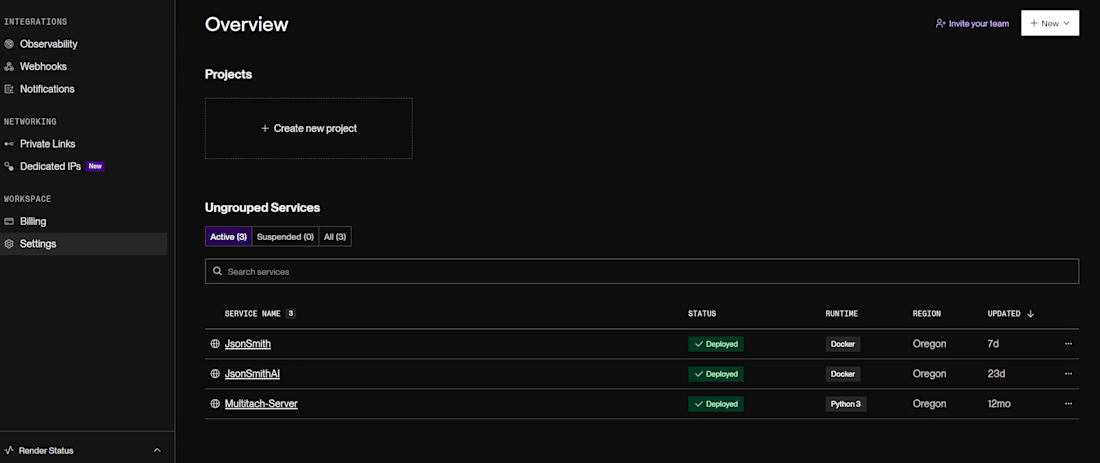
Tired of wrestling with AWS or Azure just to deploy a side project? 😅
I found my sweet spot — Render.
I've been using it to deploy all my portfolio projects and honestly, it's been a game changer. No complex IAM roles, no billing surprises, no 47-step setup guides.
Just push your code → it deploys. That simple.
🐳 Docker support? Yep.
☁️ Free tier for personal projects? Yes.
⚡ Auto-deploys from GitHub? Absolutely.
For someone building and shipping projects to showcase to employers, Render removes all the friction that gets in the way of what actually matters — the work itself.
⚠️ One catch though — on the free tier, your service spins down after 15 minutes of inactivity. So the first request after idle? A little slow. You also get 500 free minutes per month, which sounds limited but honestly covers most portfolio projects just fine.
Is it perfect? No. Is it good enough to get your work in front of people without the cloud overhead? Absolutely.
If you're a student, self-taught dev, or anyone just trying to get projects live — give Render a shot.
Your portfolio will thank you. 🚀
#WebDevelopment #Render #DevTools #Portfolio #CloudDeployment #SoftwareEngineering
The network for creativity
Join 1.25M professional creatives like you
Connect with clients, get discovered, and run your business 100% commission-free
Creatives on Contra have earned over $150M and we are just getting started







Related posts

I’ve spent the last three months building this.
Deframer is finally here.
It started with the same conversation with clients: they wanted to leave Framer but felt stuck, since moving meant rebuilding their sites.
I felt it too. Pricing kept getting harder to justify, and the product experience felt worse.
Our template sales also took a hit after the marketplace and community changes.
Other template creators have been seeing their revenue dip too.
So I built Deframer.
Some exporters just package what the browser loads from your published URL.
Deframer writes a clean Next.js + TypeScript project, following Next.js best practices. Code you can read, maintain and run yourself.
It also optimizes for SEO, AEO and speed.
Paste your Framer URL, verify it’s yours, and convert. Your pages, components, layouts and motion come along.
Three months later, it’s ready for you to try.
https://deframer.co
If you’ve been wanting to move off Framer, I’d love to hear how it works for you.


End of an era.
After 3 good years on Framer, we moved
@designme to our own stack.
Framer got us far, and I'd still recommend it for a lot of teams.
But the more we grew, the more we needed control: over the code, structure and speed of testing and shipping new things.
So, we rebuilt everything from scratch in Astro.
It's the same setup we now build for our clients (which is exactly why we had to run our own site on it first).
Really proud of the team and how fast we're moving now.
DesignMe 2.0 is live ↓


Big move! Framer is great for speed, but having full control over the stack opens up so many possibilities.

I send clients rough work on purpose now, and it's saved me more time than any plugin ever has.
I used to spend two weeks polishing every frame of a video and send it over feeling proud. Then I'd get back something like "can we try a different direction?" Two weeks gone, and I was almost starting from zero.
Now the client sees the full storyboard before I animate anything. Then they get a few seconds of rough movement so they can feel the pacing. Changes at that stage take an hour. The same changes after the final animation take days.
Clients who see the messy middle understand where the video is going, and their feedback is much clearer. Clients who only see the finished thing usually say "I love it but something feels off," and they can't tell you what it is.
Show it early. A sketch is a lot cheaper to fix than a render.