The network for creativity
Join 1.25M professional creatives like you
Connect with clients, get discovered, and run your business 100% commission-free
Creatives on Contra have earned over $150M and we are just getting started
Back to feedPost

Today I spent the entire day rebuilding my international portfolio.
Something unexpected happened.
I thought I was simply organizing my work.
Instead, I realized I was finally defining what my work actually is.
For years, I've introduced myself as a social media manager, video editor, designer...
But when I looked at all my projects together, I noticed that the common thread wasn't the software I used.
It was the way I think.
In one project, I turned a technical topic into a simple visual analogy.
In another, I chose to tell a person's story instead of leading with the procedure.
In another, I built a brand around an idea rather than just a visual identity.
That's when it clicked.
My job isn't simply creating content.
My job is finding the clearest, most meaningful way to communicate an idea.
It's the first time I've been able to explain my own work so clearly.
The network for creativity
Join 1.25M professional creatives like you
Connect with clients, get discovered, and run your business 100% commission-free
Creatives on Contra have earned over $150M and we are just getting started



Related posts


What happens when one website has to talk to two different people?
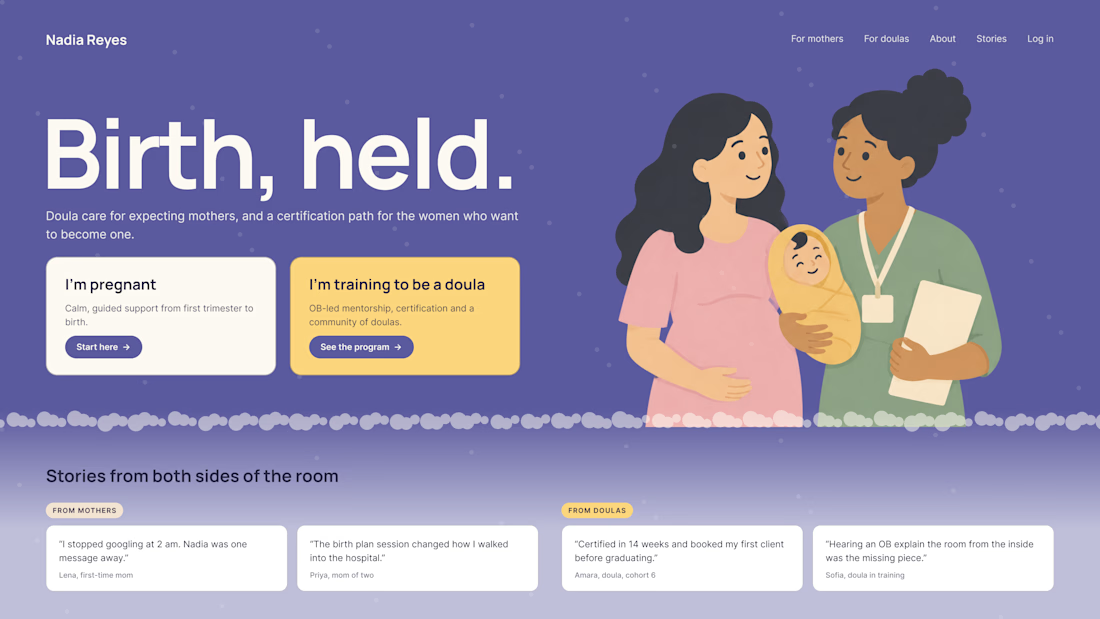
A client of ours teaches two audiences at once: expecting mothers who want a calm pregnancy, and women who want to become doulas. One brand, one site, two very different reasons to visit.
The usual fix is a hero that speaks to "everyone" and lands with no one. We designed it as a fork in the road instead:
1. Two doors in the hero. "I'm pregnant" and "I'm training to be a doula", side by side, equal weight. The visitor picks a path in one click, and the headline above them stays about the shared value.
2. One voice, two tones. The mothers' path is softer: fewer words, more room, gentle photos. The doula path is more structured: modules, certification, dates. Same fonts, same colors, different rhythm.
One proof section, split in two. Testimonials from mothers on the left, from doulas on the right. Each visitor sees people like them before the price.
Writing for everyone is writing for no one. Give each reader a door.
Have you ever designed a page for two audiences at once? How did you split it?


Really great point! Designing for two distinct audiences under one brand is always a challenge. Excited to see your approach to solving it.

I felt something was off with my own website.
Too plain. Not how I envisioned the brand.
So I added more creative touches and built a real story into it. Now everything makes sense.
It finally feels like Outredge 🚀
https://outredge.com/


That big bold wordmark with the corner brackets gives it so much more character. "A marketing site as good as your product" is a strong line too, says exactly what you do.


Across my career, I've worked with more than 100 clients.
One call worth getting right before you spend on design: is this a brand problem or an explanation problem?
A rebrand fixes a mismatch between the company and how it presents itself.
If buyers can't tell what your product does, a new identity leaves that question open. The explanation still has to be written.
List what buyers get wrong about you. If most of it is about what the product does and who it's for, start with the explanation.