The network for creativity
Join 1.25M professional creatives like you
Connect with clients, get discovered, and run your business 100% commission-free
Creatives on Contra have earned over $150M and we are just getting started
Back to feedPost

• Designed and implemented the full ticketing workflow, from event creation to checkout and ticket delivery
• Built and maintained microservices-based backend architecture to ensure scalability and reliability
• Developed a marketplace system enabling multiple organizers to sell through the platform
• Implemented Stripe and Stripe Connect for payments, onboarding, and fund withdrawals
• Designed secure payout flows for vendors with proper handling of commissions and transfers
• Managed payment webhooks, subscription logic, and transaction lifecycle events
• Delivered new product features in close collaboration with product stakeholders
• Maintained and improved application performance, stability, and code quality


The network for creativity
Join 1.25M professional creatives like you
Connect with clients, get discovered, and run your business 100% commission-free
Creatives on Contra have earned over $150M and we are just getting started



Related posts

Resolve: an AI support agent that answers from a company’s own policies, looks up orders, and escalates weak matches to a human instead of guessing. A human approves replies before they go out.
Live demo: support-resolver.vercel.app


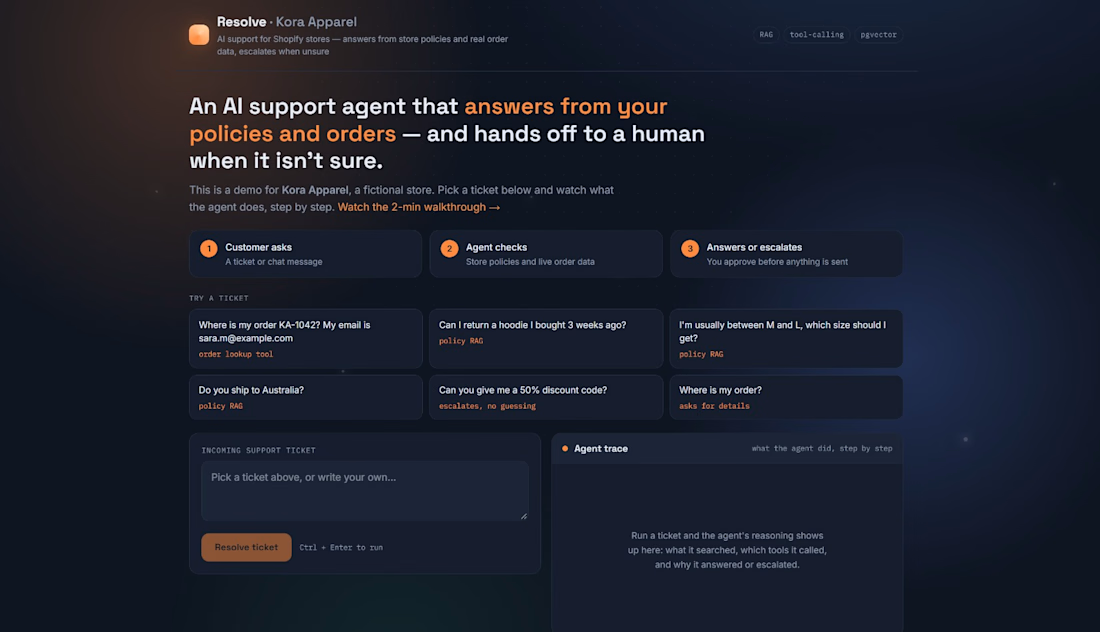

For the human approval step, I'd show the exact policy passage and its effective date beside the draft. Does Resolve flag a reply for re-review if the policy changes while it waits for approval?

Been Away for a while Building...
Worked on Several projects, firstly as a backend Engineer of an Enterprise OS project that turns product development into real life scenario for average users...
Project was paused due to internal issues 🥲... can't explain much on that.
That did not stop me i moved on to work on a Mobile application for Australian Workers.
PayTracc is the name and i built it on Flutter which is a cross native platform that allows developers to build iOS/ Android Apps easily.
Paytracc is an Australian employee‑focused work and pay‑tracking app that consolidates shifts, timesheets, leave, multiple jobs, and estimated pay into one mobile dashboard. It’s designed for shift workers, people with variable schedules, and anyone who wants a clear, private record of their working life before payday.
When i started the discussion with the founder, on our first meeting i did not get anything he said at all cause i wasn't familiar with Australian work life and how it worked.
It took several meetings of him explaining things to me to get the grasp of it.
I worked hand in hand with the Ui designer to bring the vision to life.
It took me 4 months to work on this project and still minor bugs to fix daily, it's just never ending at the point but i am loving every step.
It's been a great journey and i both suffered and enjoyed every step of the way...
The Android Application was launched and approved Last month, while the IOS has been approved for testing, i am still fixing some bugs before we push for launch.
The journey has been a good one from struggling to know how to setup the awards to finding out about Australian Fairworks commission and how they provide an api for you to connect to and pull all the latest australian awards. Fair works really helped ease my job as previously we are aiming to upload the individual awards on the database and guess what? we have over 5000+ awards, imagine how stressful that would have been.
Thankful to God for the strength and wisdom he gave me to push through the entire project.


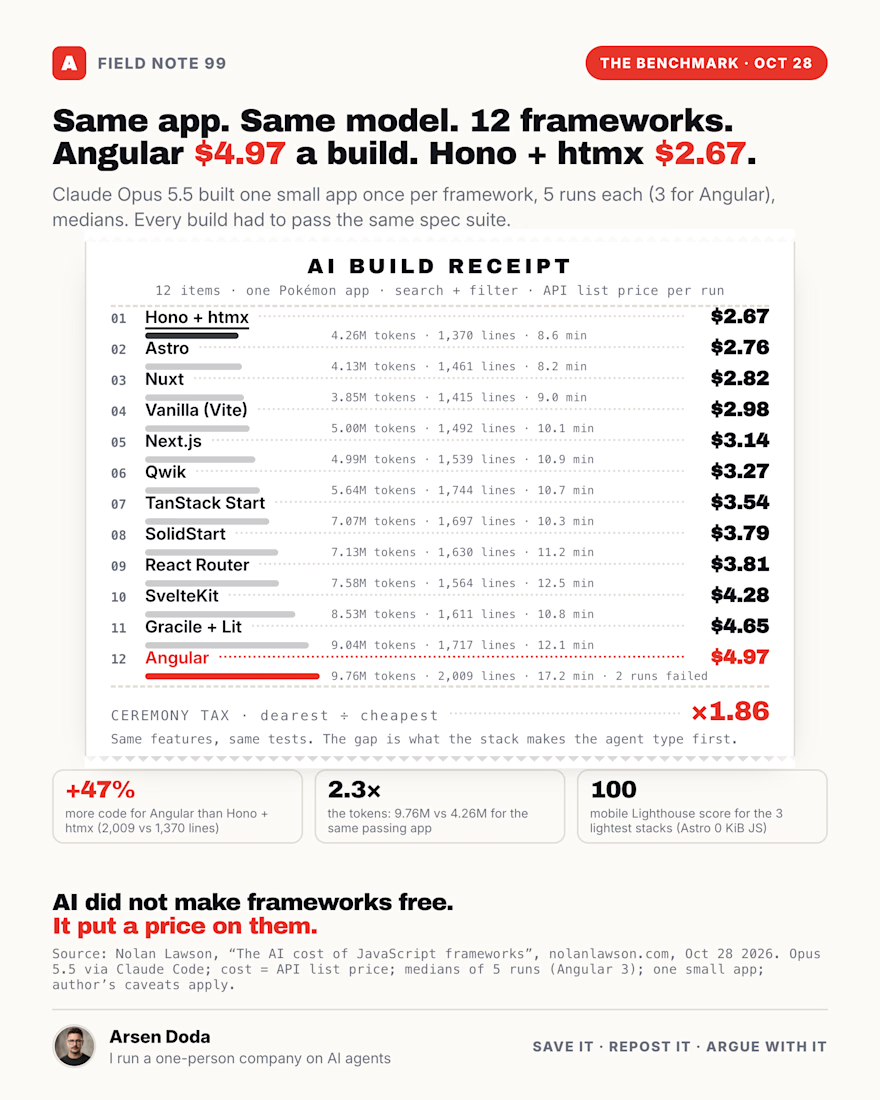
Same app. Same model. Same spec.
Built with Angular, it cost $4.97 per run. Built with Hono + htmx, $2.67.
The framework you pick is now a line on your AI bill.
Nobody budgets for this yet. Here is the data.
Nolan Lawson (engineer at Socket, the PouchDB maintainer) had Claude Opus 5.5 build the same small Pokémon app 12 times over, once per framework, 5 runs each (3 for Angular), medians reported.
Every build had to pass the same spec suite.
→ Cheapest: Hono + htmx, $2.67, 4.26M tokens, 1,370 lines, 8.6 min
→ Astro $2.76 · Nuxt $2.82 · plain Vite $2.98
→ Next.js $3.14 · React Router $3.81 · SvelteKit $4.28
→ Most expensive: Angular, $4.97, 9.76M tokens, 2,009 lines, 17.2 min
→ Source: nolanlawson.com, Oct 28 2026. Two Angular runs failed the spec and were counted as failures.
The gap is not the model. It is the ceremony.
Angular made the agent write 47% more code for the same features. More code costs tokens twice: once to write it, once to re-read it on the next change.
Plain Vite was not the cheapest. No framework means no conventions, so the agent invents its own, and that costs tokens too.
The cheap column was also the fast column. Astro, Hono + htmx and Lit all scored 100 on mobile Lighthouse with almost no JavaScript shipped.
Why it works that way:
An agent pays for every file it opens.
Config, boilerplate, framework docs, a second read after each error.
Less ceremony is fewer pages before the first useful line.
Call it the ceremony tax: everything your stack makes the agent type before it ships a feature.
I run a one-person company on AI agents. Most of my code is written by them now, and I watch tokens per task the way I used to watch cloud bills. The same feature costs me very different amounts depending on which codebase the agent is standing in.
If agents write your code, the framework is no longer a developer-experience choice. It is a unit cost.
Rule 1: Measure tokens per task, not per month. A monthly bill hides which stack is burning it.
Rule 2: Pick the stack the agent types least in. Fewer lines written today is fewer lines re-read tomorrow.
Rule 3: Cheap must still pass the spec. Every run here cleared the same tests and Lighthouse; cheaper and better landed in the same column.
One small app, one model, one author's benchmark, and the author says so himself. Treat it as a pattern, not a law. The direction matches what I see every day.
Angular is good software. I mean that. It was built for teams of humans.
AI did not make frameworks free.
It put a price on them.
For an agent-built app, would you go Minimal or Batteries? One word is enough. 👇