The network for creativity
Join 1.25M professional creatives like you
Connect with clients, get discovered, and run your business 100% commission-free
Creatives on Contra have earned over $150M and we are just getting started
Back to feedPost

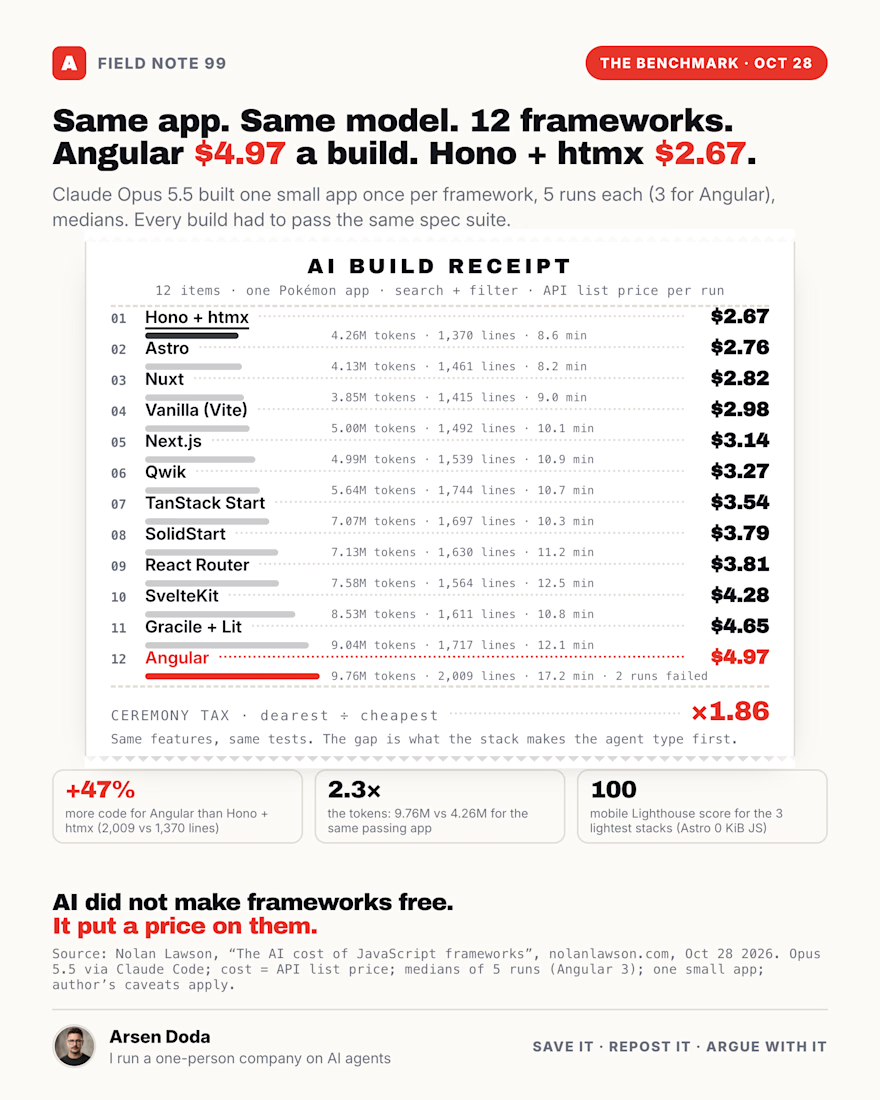
Same app. Same model. Same spec.
Built with Angular, it cost $4.97 per run. Built with Hono + htmx, $2.67.
The framework you pick is now a line on your AI bill.
Nobody budgets for this yet. Here is the data.
Nolan Lawson (engineer at Socket, the PouchDB maintainer) had Claude Opus 5.5 build the same small Pokémon app 12 times over, once per framework, 5 runs each (3 for Angular), medians reported.
Every build had to pass the same spec suite.
→ Cheapest: Hono + htmx, $2.67, 4.26M tokens, 1,370 lines, 8.6 min
→ Astro $2.76 · Nuxt $2.82 · plain Vite $2.98
→ Next.js $3.14 · React Router $3.81 · SvelteKit $4.28
→ Most expensive: Angular, $4.97, 9.76M tokens, 2,009 lines, 17.2 min
→ Source: nolanlawson.com, Oct 28 2026. Two Angular runs failed the spec and were counted as failures.
The gap is not the model. It is the ceremony.
Angular made the agent write 47% more code for the same features. More code costs tokens twice: once to write it, once to re-read it on the next change.
Plain Vite was not the cheapest. No framework means no conventions, so the agent invents its own, and that costs tokens too.
The cheap column was also the fast column. Astro, Hono + htmx and Lit all scored 100 on mobile Lighthouse with almost no JavaScript shipped.
Why it works that way:
An agent pays for every file it opens.
Config, boilerplate, framework docs, a second read after each error.
Less ceremony is fewer pages before the first useful line.
Call it the ceremony tax: everything your stack makes the agent type before it ships a feature.
I run a one-person company on AI agents. Most of my code is written by them now, and I watch tokens per task the way I used to watch cloud bills. The same feature costs me very different amounts depending on which codebase the agent is standing in.
If agents write your code, the framework is no longer a developer-experience choice. It is a unit cost.
Rule 1: Measure tokens per task, not per month. A monthly bill hides which stack is burning it.
Rule 2: Pick the stack the agent types least in. Fewer lines written today is fewer lines re-read tomorrow.
Rule 3: Cheap must still pass the spec. Every run here cleared the same tests and Lighthouse; cheaper and better landed in the same column.
One small app, one model, one author's benchmark, and the author says so himself. Treat it as a pattern, not a law. The direction matches what I see every day.
Angular is good software. I mean that. It was built for teams of humans.
AI did not make frameworks free.
It put a price on them.
For an agent-built app, would you go Minimal or Batteries? One word is enough. 👇
The network for creativity
Join 1.25M professional creatives like you
Connect with clients, get discovered, and run your business 100% commission-free
Creatives on Contra have earned over $150M and we are just getting started
Related posts

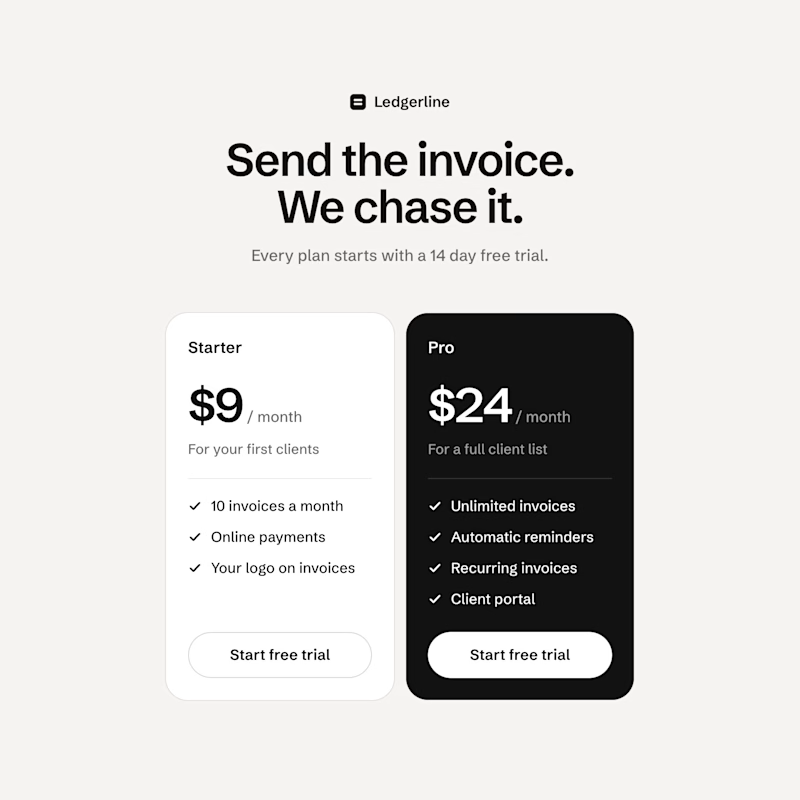
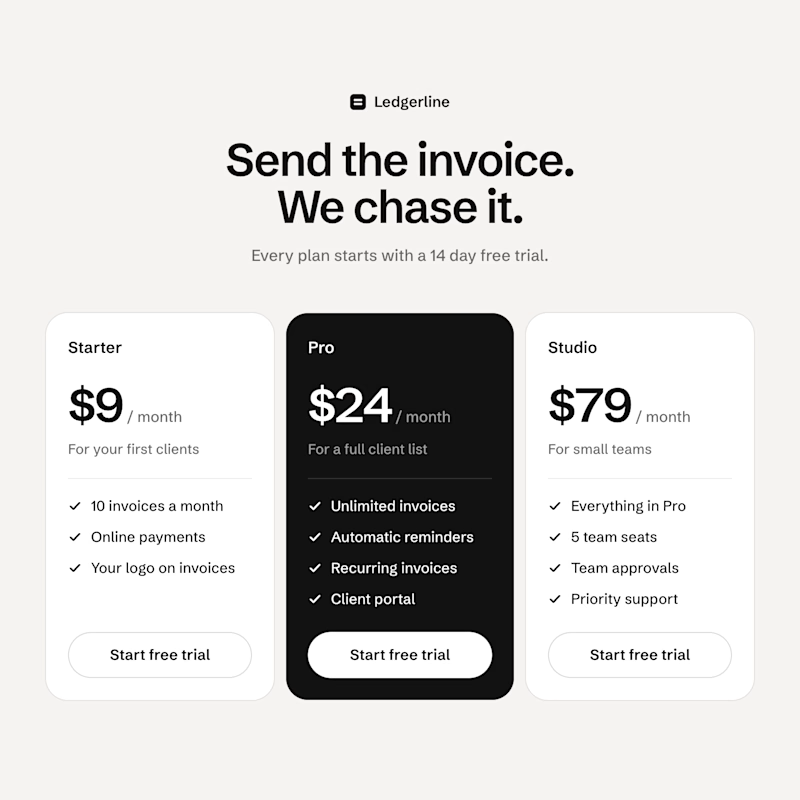
Built two pricing sections for a concept invoicing app in code with Claude Code. Same Starter, same Pro, same prices. B only adds a $79 plan that isn't really there to be bought.
Which one gets you to pick Pro, A or B?

0 voted
0%
24 voted
100%
24 votes
Closed

B for me. Next to $79, Pro at $24 looks like the sensible middle, and the dark Pro card already does half the work.

An automated n8n workflow that receives incoming leads via webhook, validates them, qualifies them with AI (Google Gemini), scores them, and syncs the result to Airtable without creating duplicates.


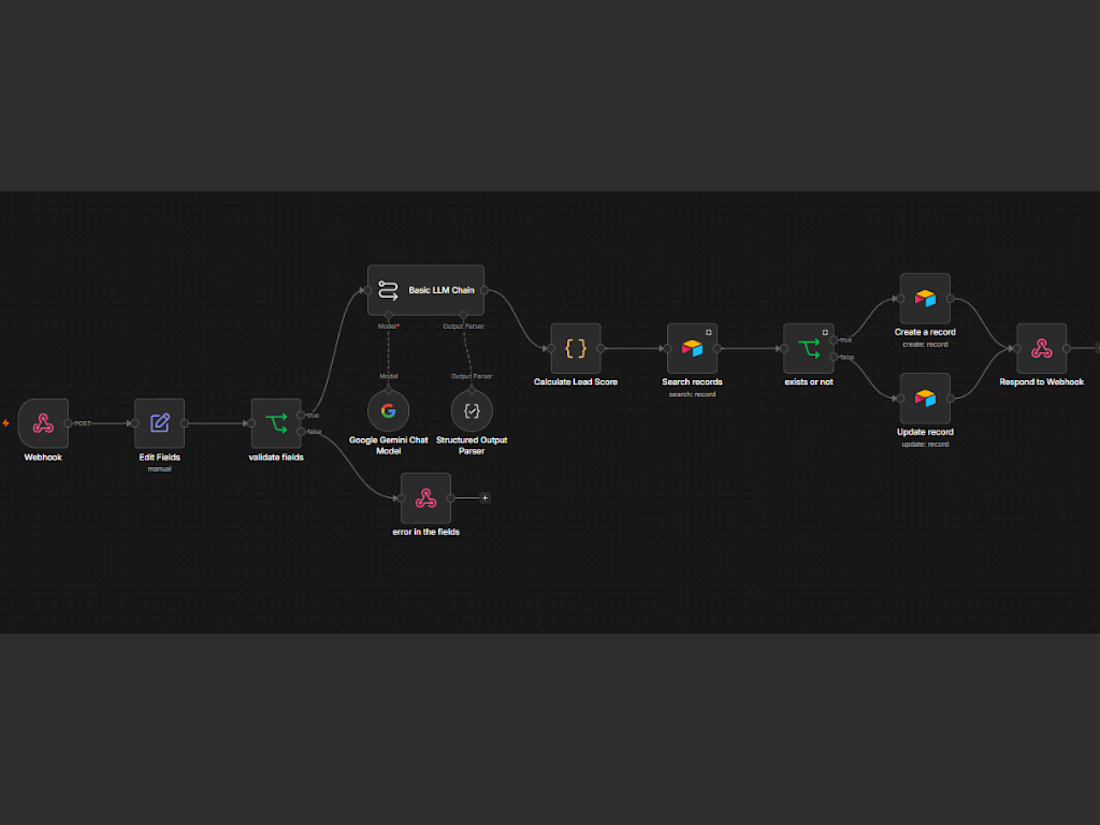

really optimized workflow

The hardest part of our projects this year has been the same every time, and it has nothing to do with design.
Getting a decision out of the founder.
Founders were always busy, so that part is not new. What changed in the last year is worth saying out loud though.
AI made starting things cheap. A founder who would have run one thing is now running five, because execution got cheap and saying yes got cheaper. More shipping, more going on, more in flight at once.
What did not change is how many good decisions one person can make in a week.
So you get someone who is genuinely doing more than they were two years ago, and who is also the bottleneck in six places at the same time. From inside it feels like achieving more. From outside it looks like nobody can get twenty minutes.
We changed how we work because of it. We stopped asking for feedback, because feedback is an open question and open questions are the most expensive thing you can put in front of a busy person.
Now we send decisions instead. Two options, which one we recommend, and the date we move forward on if nobody objects. Most founders take the recommendation. The ones who don't reply in one line, which is all we needed anyway.
And we own everything that does not actually need them. Every question you send a founder costs them something, and honestly most questions are the designer avoiding a decision they could have made themselves.

Giving the founder two options and a deadline makes the decision easier to answer. I'd put the cost of changing it later beside each option, so they can see which choices need their attention now.