The network for creativity
Join 1.25M professional creatives like you
Connect with clients, get discovered, and run your business 100% commission-free
Creatives on Contra have earned over $150M and we are just getting started
Back to feedPost

NutriMind AI
Short Explanation
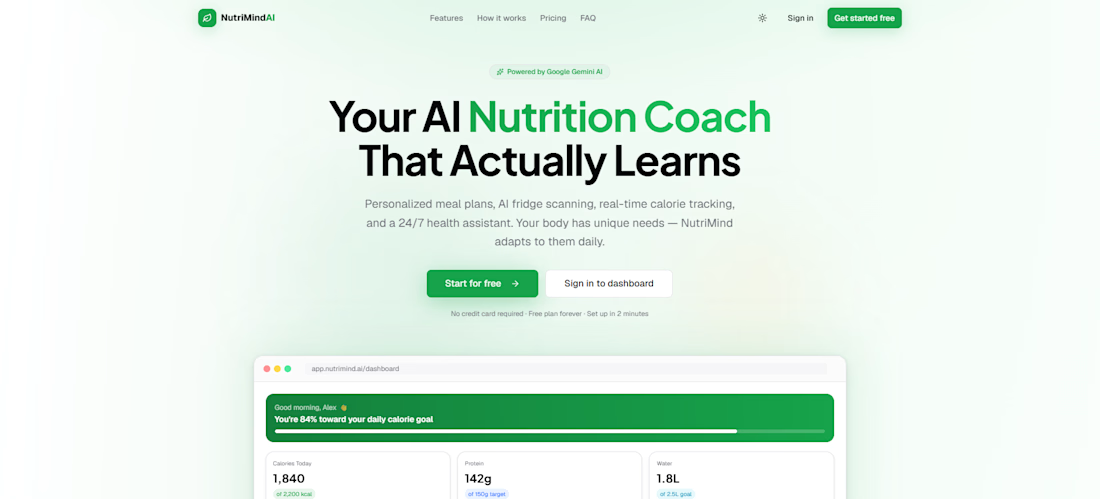
NutriMind AI is a full-stack, AI-powered nutrition and wellness platform built with Next.js 16 and Google Gemini. It enables users to plan personalized weekly meals, scan their fridge with a camera to get instant recipe suggestions, track daily calorie and macro intake, and converse with an intelligent health assistant — all from a single, beautifully designed web application. The platform is designed for health-conscious individuals, fitness enthusiasts, and anyone seeking a smarter, more personalized approach to nutrition management.
Tech Stack
Frontend: Next.js 16.2.6 (App Router), React 19, TypeScript 5
Styling/UI: Tailwind CSS 4, shadcn/ui (Radix UI), Framer Motion 12, Lucide React, Recharts 3
State Management: Zustand 5, TanStack React Query 5
Forms & Validation: React Hook Form 7, Zod 4
Backend: Next.js API Routes (Node.js, server components)
Database: Supabase (PostgreSQL) with Row-Level Security
Authentication: Supabase Auth (email/password + Google OAuth)
AI/LLMs: Google Gemini (gemini-3-flash-preview — chat, vision, structured generation)
Image Management: Cloudinary (upload, storage, CDN)
Recipe Images: Spoonacular API
Deployment: Vercel (inferred — standard Next.js deployment target)
Fonts: Geist Sans/Mono, Plus Jakarta Sans
Other Tools: React Dropzone, Sonner, date-fns, next-themes, class-variance-authority
Problem Solved
Most people struggle with consistent, personalized nutrition because meal planning is time-consuming, recipe discovery is generic, and tracking calorie/macro intake requires manual effort. Existing nutrition apps lack real AI intelligence — they offer static meal templates rather than dynamically personalized plans that adapt to individual health goals, dietary restrictions, and pantry contents. NutriMind AI closes this gap by combining computer vision, conversational AI, and real-time nutrition analytics into one cohesive product.
Results / Key Features
AI Meal Planner: Generates complete, calorie-balanced 7-day meal plans using Google Gemini, tailored to each user's health goals, macros, dietary restrictions, and cuisine preferences.
Fridge Scanner (Vision AI): Analyzes uploaded food images with Gemini Vision to detect ingredients and immediately suggest meals that can be cooked with what's on hand.
Conversational Health Assistant: Streaming AI chat powered by Gemini, with full user context (goals, macros, restrictions) baked into every prompt for deeply personalized advice.
Nutrition Dashboard & Analytics: Real-time calorie and macro tracking with 7-day and 30-day trend charts, adherence scoring, and BMI/BMR/TDEE calculations.
Recipe Discovery Engine: AI-recommended recipes via Gemini + Spoonacular image enrichment, fully integrated with save, nutrition view, and quick-log features.
Grocery List Automation: Automatically derives a consolidated shopping list from the active meal plan.
Workout Plan Generator: Produces AI-generated 7-day exercise programs aligned with the user's fitness goal.
5-Step Onboarding Wizard: Collects user profile, health goals, dietary preferences, and auto-calculates personalized macro targets (Mifflin-St Jeor formula).
Full Dark/Light Mode: System-aware theming with CSS variable design tokens.
Production-Grade Security: Supabase Row-Level Security on all 10 database tables, server-side session enforcement via middleware.
Problem
Before NutriMind AI, health-conscious users faced a fragmented experience: generic meal plan templates with no personalization, no way to leverage existing pantry contents, disconnected macro tracking spreadsheets, and AI health assistants with no knowledge of the user's actual goals or dietary needs. Dietitians and nutritionists are expensive and inaccessible for most people, and no single consumer app combined real AI intelligence, vision-based ingredient detection, personalized planning, and meaningful analytics in one place.
Solution
NutriMind AI solves this end-to-end through four technical pillars:
Personalization Engine: A structured onboarding flow captures health goals, activity level, dietary restrictions, and cuisine preferences. These data points are persisted in Supabase and injected into every AI prompt — making every suggestion genuinely tailored.
Multi-Modal Gemini Integration: Gemini handles text-based chat streaming, structured JSON meal plan generation, computer vision for fridge scanning, and recipe recommendations — all via a unified API layer in src/lib/gemini/.
Full-Stack Next.js Architecture: API routes on the server handle AI calls and database operations; React Server Components + client islands deliver fast initial loads and interactive UIs without architectural compromise.
Persistent Nutrition Intelligence: All logs, plans, scans, and conversations are stored in Supabase with RLS-protected user partitioning, enabling longitudinal analytics and a personalized experience that improves with use.
7. Features
User Authentication: Email/password and Google OAuth via Supabase Auth, with server-side session management in Next.js middleware
5-Step Onboarding: Collects personal stats, fitness goals, activity level, dietary restrictions, allergies, and cuisine preferences; auto-calculates BMR, TDEE, and daily macro targets
AI Meal Planner: Generate, save, and activate weekly meal plans; each plan includes 4 meals/day with individual macro breakdowns and an auto-generated shopping list
Fridge Scanner (Vision AI): Drag-and-drop or camera upload; Gemini Vision detects ingredients and returns 3–5 meal suggestions with estimated nutrition; scan history saved in database
AI Health Chat: Streaming conversational assistant with persistent session history; user context (goals, restrictions, macros) embedded in every system prompt
Recipe Discovery: AI-generated recommendations + Spoonacular image enrichment; filter by meal type and cuisine; save recipes to personal library
Detailed Recipe View: Full ingredient lists, step-by-step instructions, per-serving nutrition breakdown, and one-click meal logging
Grocery List: Auto-generated from active meal plan; editable per-item with check-off capability
Workout Plan Generator: Gemini-generated 7-day exercise routine by fitness goal; includes exercises, sets, reps, rest periods, and duration estimates
Nutrition Dashboard: At-a-glance daily calorie radial chart, macro progress bars, 7-day calorie trend, water intake tracker, recent meals log, quick-action shortcuts
Analytics Dashboard: 7-day and 30-day views; calorie area chart, macro pie chart, actual-vs-target bar chart, average adherence percentage
Profile Management: Edit personal stats, health goals, and activity level; avatar upload; real-time BMI/BMR/TDEE display
Settings: Theme switcher (light/dark/system), account management, account deletion with confirmation dialog
Command Palette: Keyboard-accessible Cmd+K navigation across all sections
Responsive Design: Collapsible sidebar, mobile bottom navigation, adaptive layouts
Toast Notifications: Real-time feedback for all async operations via Sonner
8. Stack (Organized by Category)
Frontend
Next.js 16.2.6 (App Router, Server Components)
React 19.2.4
TypeScript 5 (strict mode)
Framer Motion 12 (page transitions, card animations)
TanStack React Query 5 (server state, caching)
Zustand 5 (client UI state — onboarding, grocery, meal-plan)
React Hook Form 7 + Zod 4 (form validation)
Backend
Next.js API Routes (Node.js runtime)
Supabase SSR (@supabase/ssr) for server-side auth
Cloudinary SDK (server-side upload signing)
Google Generative AI SDK (@google/generative-ai)
Spoonacular REST API (recipe image search)
Database
Supabase (PostgreSQL)
10 tables: profiles, meal_plans, nutrition_logs, water_logs, fridge_scans, recipes, saved_recipes, grocery_lists, chat_sessions, workout_plans
Row-Level Security (RLS) on all tables
Automatic triggers: updated_at, auto-profile creation on signup
8 performance indexes on user_id + timestamp pairs
Authentication
Supabase Auth (email/password + Google OAuth)
Server-side session management via Next.js middleware
Protected routes with onboarding-completion enforcement
AI / LLMs
Google Gemini API (gemini-3-flash-preview)
Text generation: meal plans, recipes, workout plans, chat
Streaming: health chat (Server-Sent Events)
Vision: fridge ingredient detection and meal suggestions
Structured JSON: all non-chat AI outputs use typed schema responses
Styling / UI
Tailwind CSS 4 (@tailwindcss/postcss)
shadcn/ui (16 Radix UI primitives)
Recharts 3.8 (area, radial bar, pie, bar charts)
Lucide React (icons)
next-themes 0.4.6 (dark/light/system)
Geist Sans/Mono + Plus Jakarta Sans (custom fonts)
CSS design tokens: gradients, shadow layers, animation timings, glassmorphism utility classes
Deployment
Vercel (inferred — standard Next.js target, no explicit config file)
Cloudinary CDN for image assets
Supabase hosted PostgreSQL and Auth
Other Tools
React Dropzone 15 (file upload UX)
Sonner 2 (toast notifications)
date-fns 4 (date formatting and arithmetic)
CMDK 1.1 (command palette)
class-variance-authority + tailwind-merge (component variant patterns)
9. Your Role
As the sole developer and architect of NutriMind AI, responsibilities span the full product lifecycle:
System Architecture: Designed the App Router project structure with route groups (auth) and (dashboard), middleware-enforced auth, and a clean separation of server components, client islands, and API routes.
Database Design: Authored the full Supabase PostgreSQL schema (10 tables, RLS policies, auto-triggers, performance indexes) with a security-first data model ensuring users can only access their own records.
AI Integration: Integrated Google Gemini across five distinct use cases (streaming chat, structured meal planning, computer vision fridge scanning, recipe recommendation, workout generation) via a purpose-built abstraction layer in src/lib/gemini/.
Frontend Development: Built 15+ feature component categories with React 19, including multi-step onboarding, AI tool interfaces, data visualization dashboards, and an accessible component system built on shadcn/ui.
Backend API Development: Authored 16+ RESTful API route handlers covering nutrition logging, AI generation, image processing, profile management, and data analytics.
State Management: Architected a hybrid state strategy — Zustand for ephemeral UI/onboarding state, TanStack React Query for server-synchronized data, Supabase real-time for auth context.
UX / Design System: Implemented a custom Tailwind CSS 4 design system with green-branded color tokens, glassmorphism effects, dark/light themes, CSS animation variables, and consistent typography using Geist and Plus Jakarta Sans.
Third-Party Integrations: Integrated Cloudinary for image upload/CDN, Spoonacular for recipe image enrichment, and Supabase Storage for avatar management.
Nutrition Science Logic: Implemented BMR (Mifflin-St Jeor), TDEE (activity multipliers), goal-based calorie adjustment, macro ratio calculations, BMI, and water goal formulas in src/lib/nutrition/calculations.ts.
Performance & Security: Configured Next.js image optimization for external CDN domains, unsigned Cloudinary upload presets for browser-safe uploads, service-role client isolation to server-only routes, and TypeScript strict mode throughout.
10. Live URL
https://nutri-mind-ai-iota.vercel.app/
GitHub GitHub: https://github.com/engraya/NutriMind-AI


The network for creativity
Join 1.25M professional creatives like you
Connect with clients, get discovered, and run your business 100% commission-free
Creatives on Contra have earned over $150M and we are just getting started
Related posts

Kumo — Interactive Matcha Tea Landing Page UI-UX
Choosing a drink online is often a flat and boring experience — static product cards don’t convey taste, freshness, or emotion. For a premium product like matcha, this makes it harder to stand out and convert.
This animated landing page for Kumo turns product selection into an interactive and sensory experience. Instead of reading long descriptions, users visually explore flavors through motion, ingredients, and composition.




yummy =)

🚀 Excited to share my submission for the Figma Config Makeathon.
Over the past few weeks, I've been exploring a challenge that millions of professionals face every day: career transitions.
Many people know where they want to go, but they struggle to understand where they stand, which skills they're missing, and what actions will have the greatest impact on reaching their target role.
To address this, I built AI Career Twin.
An AI-powered career transition platform that helps users:
✨ Analyze their experience and career history
🧠 Verify real skills through AI-powered assessments
📊 Identify critical skill gaps
🗺 Follow personalized growth roadmaps
👥 Connect with mentors who made the same career transition
💼 Build portfolio-ready projects tailored to their goals
🎯 Discover AI-matched job opportunities based on verified skills and progress
The vision behind AI Career Twin is simple:
Turn career transitions from uncertainty and guesswork into a clear, measurable, and personalized journey.
Built entirely with Figma Make.
🎥 Watch the walkthrough below.
I’d love to hear your thoughts and feedback.
@Figma
#ConfigMakeathon #FigmaMake #AI #ProductDesign #UXDesign #CareerDevelopment #Innovation

figma.com
Figma
Created with Figma


Hey Mohamed - make sure to add a video walkthrough in the comments.

CommunityAid AI
CommunityAid AI is an AI-powered community support platform designed to connect people with the help, resources, and services they need most.
Many individuals struggle to find reliable information about food assistance, healthcare support, blood donors, emergency housing, volunteers, and community services. CommunityAid AI simplifies this process by providing a single, intelligent platform where users can quickly discover local resources, request support, and connect with their communities.
The platform combines AI guidance with real-world community networks to help users navigate challenges faster and more confidently. Whether someone needs urgent assistance, healthcare information, volunteer support, or access to essential services, CommunityAid AI makes help more accessible through an intuitive and human-centered experience.
Key Features
• AI-Powered Community Assistant
• Local Resource Discovery
• Blood Donor Network
• Volunteer Marketplace
• Emergency Support Hub
• Community Resource Map
• Healthcare & Social Service Directory
• Smart Search & Personalized Recommendations
• Community Impact Dashboard
The Problem
People often don't know where to turn when facing challenges such as food insecurity, healthcare access, emergency situations, or financial hardship. Information is scattered across multiple organizations and platforms, making support difficult to find during stressful situations.
The Solution
CommunityAid AI acts as a trusted digital companion that helps individuals discover relevant services, connect with volunteers, access critical resources, and receive guidance tailored to their specific needs.
Impact
By reducing barriers to support and strengthening connections between people, organizations, and volunteers, CommunityAid AI aims to create stronger, more resilient communities where help is easier to find and access.
Built using Figma's latest tools during the Config Makeathon to demonstrate how design and AI can work together to create meaningful social impact.



Challenges
View all



Trending

Claude
Claude has entered the design space. How are you using Claude Design?

Contra University
Learn from expert creatives how to earn more using next-gen AI tools.

MagicPath
The canvas is infinite, and exploration is becoming the workflow. How are you using MagicPath?
creativeaiflow
Creative AI workflows are evolving. What tools do you use, and what are their strengths and weaknesses?
freelancerlife
Freelancer life is wins, pivots, and everything in between. What’s yours right now?