The network for creativity
Join 1.25M professional creatives like you
Connect with clients, get discovered, and run your business 100% commission-free
Creatives on Contra have earned over $150M and we are just getting started
Back to feedPost

The Flowstep Challenge was an interesting feat that involved solving a puzzle.The Flowstep Challenge was a challenge to solve a puzzle.
This has been an issue I have had on my mind for quite a while.
We tend to throw away broken items when they're too costly to repair. Three year old kettle. After seven, there is a washing machine. We assume that they are "too far gone. We don't often ask them if they can be fixed because it is just easier to get a replacement.
The knowledge for repairing already present. iFixit has been recording repairs for a more than 15 years. But that info is only in forums, behind model numbers that most people don't know about, and it's never when you're standing in front of a broken product with a screwdriver in your hand.
Thus the object goes into the trash can.
It's one of the little, silent ways millions of perfectly repairable products are discarded each year.
My answer is BENCH.
It's a walk down memory lane for physical items. Just point your phone at a broken thing, and BENCH will tell you what the problem is, if it's fixable, how to fix it, and will remember it all.
Complete flow
Scan
Photograph one of the damaged items. BENCH identifies it from just one photograph.
Break it down
The object is broken down into its constituent parts and each discernible part is named.
Diagnose
BENCH is able to identify the most probable failed component, and why it failed, and also give a confidence score for each diagnosis.
Repair
Follow a step by step repair procedure, from a single screw to replacing a component to soldering repair. BENCH can also make recommendations for an auto repair shop if one is required.
Attempts matter
A halfway completed repair is a repair attempt. BENCH recorded repairs; did not hide repairs.
Automatic repair log
Once the repair is complete BENCH automatically logs the failure, the replacement and the amount of waste that was diverted from landfill. Manual typing is not required.
The Shelf
Each object has its own lifespan record, such as its age, repairs, maintenance, environmental effects, etc.
There is no “Buy a replacement” button on BENCH, you can order a replacement part but you won't be able to order a brand new replacement part through the app.
Handover
All repair records are attached to the object. If it is sold or donated, the next owner will get the entire repair history.
How I built it
The prototype was developed with the help of Claude + Flowstep via MCP.
All screens created with prompts using the Flowstep MCP server. I have never used Canvas to make any interface by hand. All of the project was created via prompts; Claude is managed by get-design-guidelines and update-design-guidelines and these prompts were all sourced from a single DESIGN.md file.
The prototype has a uniform design system as all screens are designed the same way, so there is no need to maintain each screen manually.
Making BENCH a real product
All of the features exhibited in the prototype are technologically feasible in today's environment.
iFixit API – Repair guides, teardown instructions and parts identification.
Nearby repair shops / Repair Café locations: Overpass API / OpenStreetMap.
Wikidata REST API for product metadata, manufacturing year and product lineage.
#FlowstepChallenge


The network for creativity
Join 1.25M professional creatives like you
Connect with clients, get discovered, and run your business 100% commission-free
Creatives on Contra have earned over $150M and we are just getting started

Challenges
View all


Related posts


Hear the sound 🎧
An experimental exploration of bringing AI conversations to life through motion. ✨
Tool stack: Figma × Claude × After Effects


Really impressive

I wanted to see how far I could take a static hero with a little motion and some help from Claude.
So I’m experimenting with scroll animation on a dental website concept. I design the layout and motion direction, then work with Claude to bring it to life.
A quick screen recording of where it’s at. Still tweaking, but this part is fun.


Great concept I like how everything managed with animations great job 🎉🔥

This looks so minimalistic.


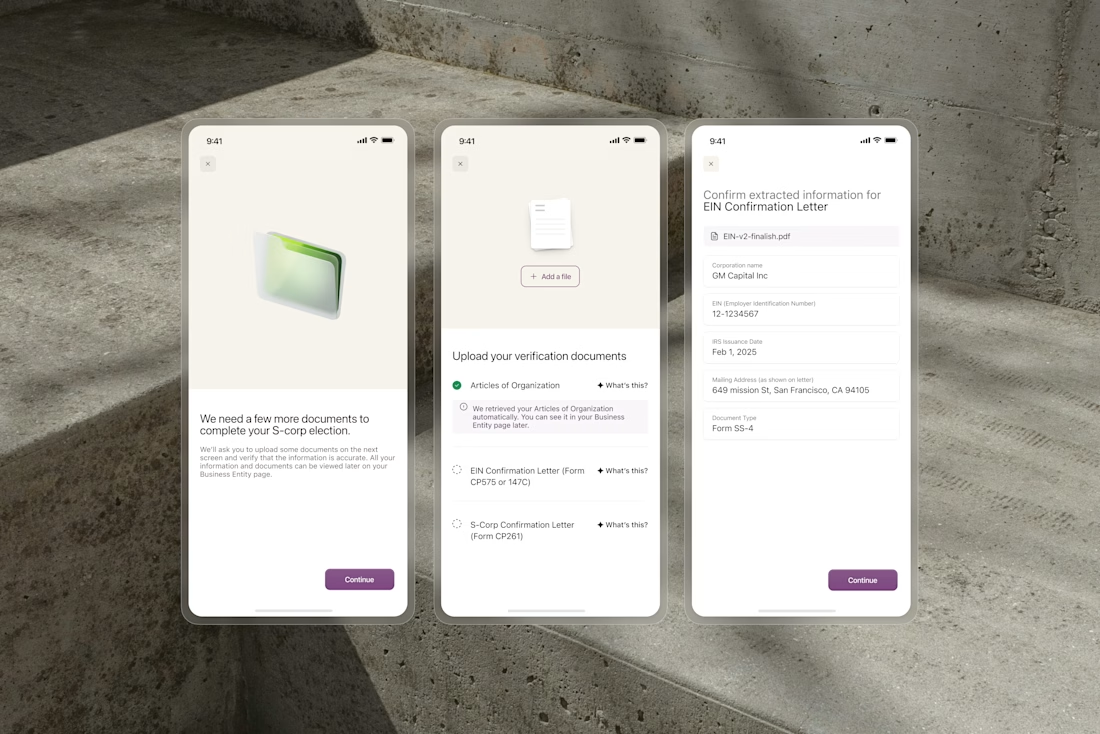
OCR extracts business names, formation dates, and addresses from uploaded documents automatically. But users still need to trust what the system found before anything gets submitted.
We designed the confirmation flow around editable fields that surface extracted data clearly....