The network for creativity
Join 1.25M professional creatives like you
Connect with clients, get discovered, and run your business 100% commission-free
Creatives on Contra have earned over $150M and we are just getting started
Back to feedPost

Many SaaS companies are adding AI to their product.
Very few are changing how they sell it.
That’s where the gap starts.
If an AI feature reduces manual work, automates operational tasks, or lowers the number of users needed to complete a workflow, seat-based pricing can quickly become misaligned with the value created.
Enterprise buyers are not buying “AI.”
They are buying lower costs, higher throughput, reduced operational risk, or faster decisions.
A better way to think about AI-native pricing:
1. Value Proof
Which economic metric improves?
Time saved. Tickets resolved. Forecast accuracy. Fewer errors. Lower manual workload.
2. Usage Signal
Which behavior proves real value?
Queries. Completed workflows. Processed documents. Agent runs. Executed automations.
3. Pricing Trigger
When should the customer pay more?
Not necessarily when they add another user.
But when they receive more measurable output.
The point is not to abandon subscription pricing.
The point is to stop treating AI as a premium feature and start treating it as an expansion lever.
For many B2B SaaS companies, the most defensible model will be hybrid: recurring base fees for predictability, plus usage or outcome-based pricing to capture incremental value.
Takeaway:
If AI changes the work your product performs, it should also change how your product is monetized.
Curious: in your SaaS, is AI already tied to a measurable value metric, or is it still being sold as an add-on?


looks fantastic, great work
The network for creativity
Join 1.25M professional creatives like you
Connect with clients, get discovered, and run your business 100% commission-free
Creatives on Contra have earned over $150M and we are just getting started
Related posts

Your Business Doesn't Need More Tools. It Needs Better Systems.
Most businesses don't have a software problem. They have an integration problem.
Their CRM is disconnected from their database. Their spreadsheets require manual updates. Their reports take hours to prepare. Their teams waste valuable time moving information between platforms.
That's where I come in.
I'm a Full-Stack AI Engineer specializing in building connected, intelligent business systems.
What I can build for your business:
CRM & ERP Integrations — Connect business platforms, databases, and third-party services through APIs.
Workflow Automation — Eliminate repetitive processes with intelligent automation.
Custom Dashboards — Turn scattered business data into actionable insights.
Data Pipelines — Build reliable systems for collecting, processing, validating, and synchronizing data.
AI-Powered Solutions — Integrate LLMs, intelligent agents, and automation into existing workflows.
Custom Software — Build complete web applications and business platforms from architecture to deployment.
I've independently developed complex digital platforms, including government-level systems, international applications, and AI-powered products.
My approach is simple:
Understand the business problem. Design the right architecture. Build the complete solution. Make it reliable.
I'm interested in working with founders, agencies, and businesses looking to modernize their operations and build software that actually solves problems.
Have a complex workflow or an integration challenge? Let's build something that works.
#FullStackDevelopment #AIAutomation #CRMIntegration #WorkflowAutomation #SoftwareEngineering #AIEngineering #Contra
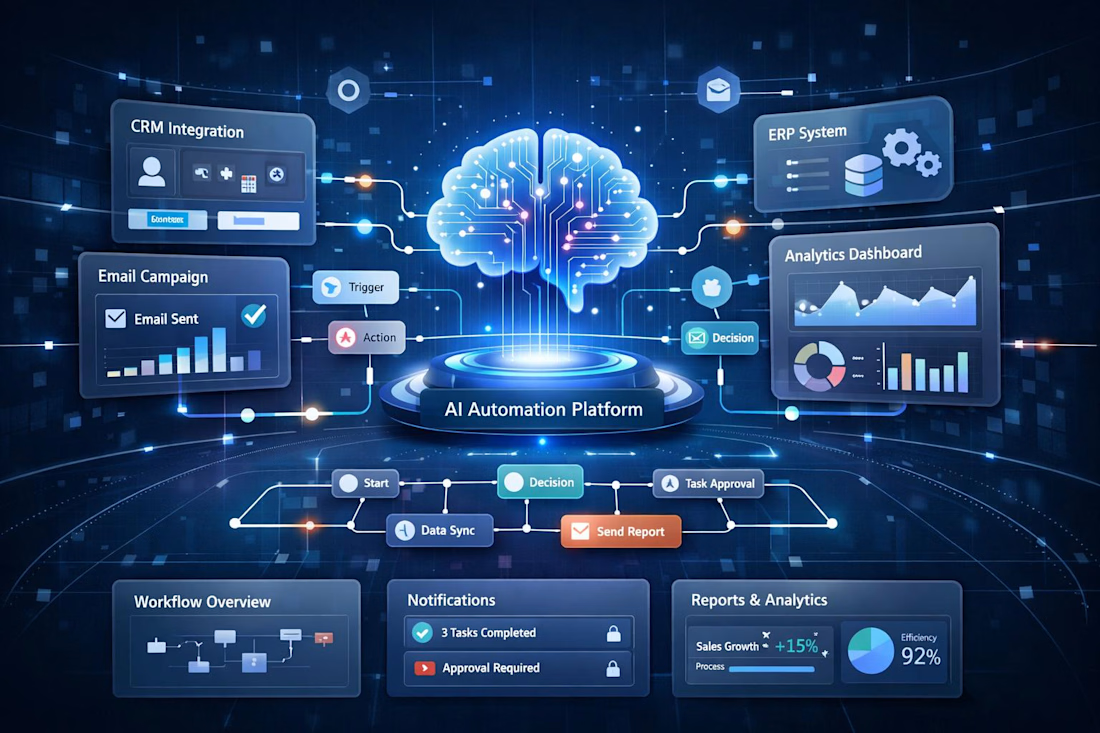

When a CRM-to-database sync fails halfway, how do you handle it: idempotent retries, or a reconciliation pass afterward? That's usually where integrations start to drift.

Kept is SaaS providing location tracking task management services. We created a 3D animation featuring the main services.


For a local service business, the first reply often matters more than the best reply.
This is the speed-to-lead setup I build in GoHighLevel:
• Trigger: Form Submitted (or Facebook Lead Form Submitted)
• Create or update the opportunity in the New Lead stage
• Send an SMS with the calendar link straight away
• Internal notification to the owner, so a person can call too
• Appointment Status trigger moves the card to Booked
• When the job is Won, a review request goes out
The pipeline is what makes it useful. Every lead has a stage, so nobody asks "did anyone call them?". The board answers it.
One thing to sort before switching on SMS for US numbers: A2P 10DLC registration, or the messages may not be delivered.
How fast does a new lead hear back from your business today?
🎬 A new website build every day. Follow @sellwrightstudio so you catch the next one.
Follow for more videos: instagram.com/sellwrightstudio · youtube.com/@sellwrightstudio
Moving the card to Booked off the Appointment Status trigger is a nice touch. What happens when the same person submits the form twice, does the opportunity get updated or do you end up with a duplicate in New Lead?