The network for creativity
Join 1.25M professional creatives like you
Connect with clients, get discovered, and run your business 100% commission-free
Creatives on Contra have earned over $150M and we are just getting started
Back to feedPost

From Campaign Activity to Controlled Testing
An active Google Ads account is not necessarily a controlled one.
I recently audited an e-commerce account with more than 10 active campaigns, mostly Performance Max.
At first glance, everything looked busy:
campaigns were running;
conversions were being recorded;
tROAS strategies were active;
product feeds were connected;
Google showed high optimization scores.
But “a lot happening” and “a clear testing system” are two different things.
Most of the budget — around $9K+ — was going through Performance Max, while Search accounted for only a very small share.
At the same time, conversion tracking mixed purchases with calls, local actions and other events.
So before trying to scale anything, I would rebuild the testing logic.
Step 1 — Fix measurement
First, define what actually matters to the business.
For e-commerce, that normally means:
Purchase = primary business conversion
Other actions can still help with funnel analysis, but they shouldn’t automatically drive optimization.
Step 2 — Separate demand
I would analyze:
branded traffic;
non-branded traffic;
product/category demand;
irrelevant search terms;
traffic that spends budget without producing purchases.
A high ROAS from branded demand can look impressive while telling us very little about new customer acquisition.
Step 3 — Create testing hypotheses
Instead of changing five things at once, test specific assumptions.
For example:
Hypothesis: one product category can generate purchases at an acceptable CPA without relying heavily on branded traffic.
Then define:
budget;
audience/signals;
campaign structure;
creative;
landing page;
acceptable CPA / ROAS.
Step 4 — Give the test enough time
For most campaigns, I normally plan around 2 weeks of testing.
But that doesn’t mean waiting 14 days no matter what.
My basic decision logic is:
No results in the first few days → stop or rethink the test.
Average results → optimize and continue testing.
Good results → keep running and prepare to scale.
The exact thresholds are defined before launch based on the business economics.
Otherwise, every result becomes “not bad” after the money has already been spent.
The main idea
The goal isn’t to create more campaigns.
It’s to create a system where we know:
what we are testing,
why we are testing it,
what success looks like,
and what happens next.
That is the difference between campaign activity and performance management.
A Google Ads audit should not end with a list of problems.
It should give you a clear roadmap for what to fix, what to test first and what not to spend money on yet.
If your account has been running for months but you still can’t clearly explain which campaigns actually create profitable new demand, that’s usually where I’d start.
#GoogleAds #PPC #PerformanceMax #Ecommerce #GoogleAdsAudit
The network for creativity
Join 1.25M professional creatives like you
Connect with clients, get discovered, and run your business 100% commission-free
Creatives on Contra have earned over $150M and we are just getting started











Related posts


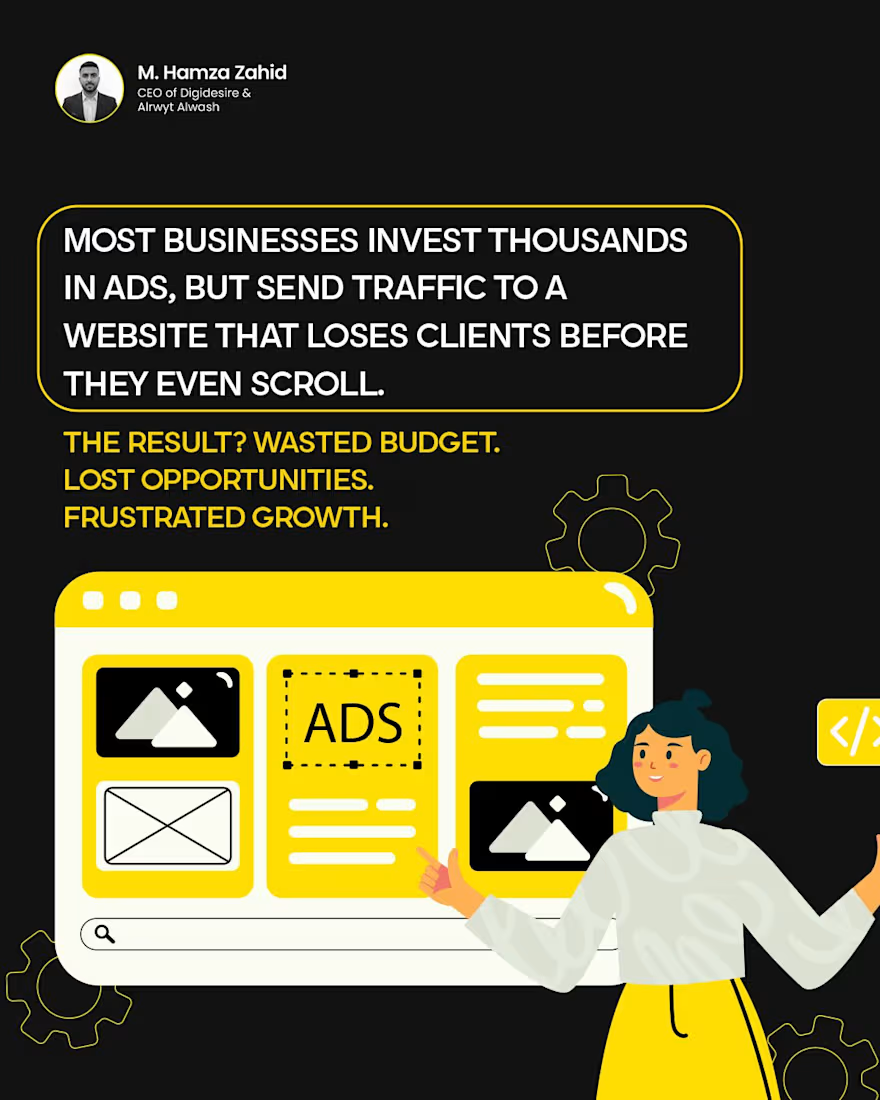
Most businesses spend thousands on ads, but send that traffic to a website that loses potential customers before they even scroll.
The result? Wasted ad spend, lost opportunities, and slower growth.
Your ads can bring the traffic, but your website needs to convert it. A strong UX, clear messaging, compelling offers, trust signals, and frictionless user journey can make the difference between a click and a customer.
Don’t just drive more traffic. Make your traffic count. 🚀

I run a small WooCommerce store selling pet supplies. 5 things it taught me that I now check on every client site
1) Photos are usually why a store is slow. One 3 MB banner can cost you 20 seconds on a phone.
2) Two caching plugins don't make a site twice as fast. They fight each other.
3) Never cache the cart or checkout. It breaks in ways customers notice before you do.
4) Clear shipping times on the product page do more than a fancy theme.
5) Most visitors are on a phone. Test there first, not on your laptop.
What's the one thing on your site you keep meaning to fix?


Ali this is exactly what running your own store teaches you that client work never does. I had the same experience running Meta Ads for my own Shopify store before offering it as a service. Pet supplies is such a strong category for paid social, too. Curious — are you running ads for HousePet yet, or is it all organic so far?
I add trust signals to almost every store audit I do — and the highest-impact spot is the one most store owners ignore: right under the Add to Cart button. A payment-security badge, a short delivery promise, an "easy returns" line. Why there? Because that is the exact second your visitor decides whether to trust you with their card. The hero section already did the selling; the buy box is where trust closes the deal. It is a small change, but on low-ticket products I have seen it quietly move the needle on conversion rate. Do you have trust badges near your Add to Cart, or are they buried at the bottom of the page? #Shopify #Ecommerce #DigitalMarketing


Agree on the spot under Add to Cart. On Amazon you can't edit the buy box, so the same job gets pushed into the first bullet and the main image (delivery, returns, what's in the box). For smaller stores with low traffic, how do you tell the badge helped, when a test takes weeks to reach significance?