The network for creativity
Join 1.25M professional creatives like you
Connect with clients, get discovered, and run your business 100% commission-free
Creatives on Contra have earned over $150M and we are just getting started
Back to feedPost

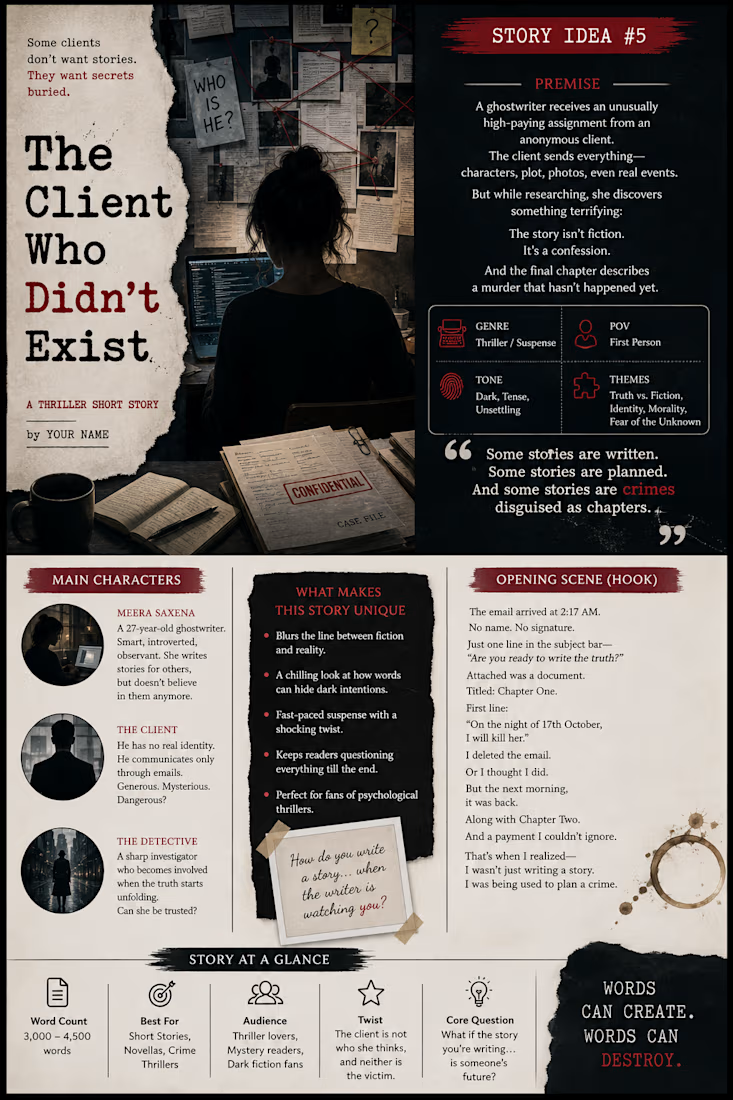
The Client Who Didn’t Exist —
The email arrived at 2:17 a.m. No name. No signature. Just one sentence in the subject line: “Are you ready to write the truth?” I almost deleted it. I was a ghostwriter, and mysterious clients weren't unusual, but something about this email felt different. Maybe it was the payment offered. Ten times my usual rate. Maybe it was the attachment. A document titled simply, “Chapter One.” I opened it. The first line read: “On the night of October 17th, I will kill her.” I stared at the screen. Then I closed the document. I deleted the email. I went to bed. At 8:03 the next morning, the email was back. Same subject.
Same attachment. Same first line. But this time there was a second chapter. I should have ignored it. Instead, I opened it. The story was about a woman named Elena. Twenty-eight years old. Writer. Lived alone. Drank coffee without sugar. Took the same route home every evening. None of it was particularly strange until I reached the final paragraph.
“At 6:40 p.m., Elena will stop at the bookstore on Willow Street. She will buy a blue notebook. She will leave at 7:05.” I checked the date. October 14th. Three days before the date mentioned in the first chapter. I told myself it was fiction. It had to be. That's what I did for a living. I wrote fiction for people who didn't want their names on it. So I accepted the assignment. The client sent another email. “Finish the story before October 17th.
Do not change the ending.” I replied with one question: “Who are you?” The answer came thirty seconds later. “Someone who knows what happens next.” I spent the next two days researching Elena.
I found the bookstore. I found her social media. I found photographs of her apartment building. Everything in the manuscript was real. Too real. On October 14th, I went to Willow Street.
I told myself I was only curious. At 6:38 p.m., Elena entered the bookstore. She was wearing a grey coat. At 6:40, she picked up a blue notebook. My stomach tightened. At 7:05, she walked out. I watched from across the street.
The manuscript had predicted everything. I returned home and found Chapter Three waiting in my inbox. “She knows someone is watching her.”
I stopped breathing. The next sentence appeared on the screen. “The ghostwriter is watching too.”
I looked around my apartment. The curtains were closed. The door was locked. My phone was on the table. Nothing moved. Then I heard three knocks. I froze. Nobody knew I was working on the story. Nobody except the client. I walked to the door and looked through the peephole. No one was there. When I opened it, an envelope lay on the floor. Inside was a photograph of me sitting at my desk.
It had been taken from inside my apartment. On the back, someone had written, “Keep writing.” I didn't sleep that night. The next morning, I contacted the police.
They told me there wasn't enough evidence to investigate. A photograph didn't prove someone had entered my apartment. The email could be a prank. The manuscript could be fictional. They suggested I stop responding to the sender.
I wanted to listen. Instead, I opened Chapter Four. It began with a sentence that made my hands go cold: “She will go to the police at 10:15 a.m.” I looked at the clock. 10:14. My phone rang. Unknown number. I answered. Nobody spoke.
Then I heard a man's voice. “You're very close.” The call ended. I threw my phone across the room. I wanted to quit. I wanted to burn every page. But something kept bothering me. If the client wanted to scare me, why pay me so much? Why send me information about Elena? And why was the story being written before the events happened? I searched the name Elena across every database I could access. Eventually, I found something. Her full name was Elena Verma.
She had disappeared five years earlier. Her body had never been found. I stared at the screen. The woman I had seen at the bookstore wasn't Elena.
She was someone else. The client had given me a name that belonged to a missing woman. I opened the manuscript again. Chapter Five was already there. “Her name isn't Elena.” Beneath it was a photograph.
The woman from the bookstore. I zoomed in. I recognized her. She was a journalist who had written an investigation about a wealthy businessman named Adrian Vale. Adrian had been accused of corruption, fraud, and several disappearances. None of the cases had ever been proven.
I kept reading. The manuscript described how the journalist had discovered evidence linking Adrian to Elena's disappearance. It also explained why someone wanted her dead. Then I reached the final paragraph. “The murder will happen on October 17th.” I checked the date. October 16th. One day left. I called the journalist and told her everything. She didn't believe me at first. Then I mentioned Elena's name. There was silence. “Where did you hear that?” she asked. “From a manuscript.” “Who sent it?” “I don't know.” She whispered, “Then you need to stop reading.” The line went dead. Ten minutes later, another email arrived. Chapter Six. “You told her.” I stared at the screen. The next line appeared beneath it. “Now she will die tomorrow.” I finally understood. The client wasn't writing a story about a murder. The client was planning one.
And I had unknowingly become part of the plan. Every chapter was a record of what had already been arranged. The characters were real. The locations were real. The dates were real. The manuscript wasn't fiction. It was a confession disguised as a story. I forwarded everything to the police. This time, they took it seriously.
They traced the emails. The account belonged to a dead man. Adrian Vale had supposedly died two years earlier. But the investigation uncovered something else. Someone had been using his identity. Someone who knew details that only Adrian could have known.
The police warned me to stay home. I didn't. I went to the journalist's apartment. Her door was open. “Hello?” No answer. I stepped inside. Papers were scattered across the floor. Her laptop was open.
On the screen was the same manuscript. Chapter Seven. I read the first sentence. “She is too late.” A sound came from behind me. I turned.
The journalist was standing in the doorway, holding a gun. “Don't move,” she said. “Who are you?” I asked. “The person who hired you.” My blood ran cold. She lowered the gun. “Adrian Vale didn't die two years ago.”
“Then who are you?” She looked at the manuscript. “Elena.” I couldn't speak. She told me everything. Five years ago, she had discovered that Adrian wasn't working alone. She had disappeared and created a new identity to stay alive. But someone had continued searching for her. Someone who knew she would eventually come back. She had created the manuscript as bait. She needed someone outside her world to publish it without knowing what it really was. Someone whose involvement couldn't be traced back to her. Me. “You used me,” I said.
“I needed someone who could write.” “You could have told me.” “Would you have helped?” I didn't answer. She continued, “The story needed to look real. The police needed evidence. I needed Adrian to believe he was controlling the story.”
I looked at the manuscript. “So the murder...” “Was never supposed to happen.” “Then why write it?” Elena smiled sadly. “Because people reveal themselves when they think they know the ending.”
The police arrived minutes later. Adrian Vale was arrested that night. The manuscript became evidence. The emails became evidence. The photographs became evidence. And I became the ghostwriter who had accidentally helped expose a man who had spent years hiding behind other people's stories. Three months later, I received one final email. No subject. No attachment. Just one sentence: “Thank you for finishing the story.” I stared at it for a long time before replying. “Was any of it real?” The answer came almost immediately. “Every word.” I closed my laptop. For the first time in months, I didn't want to write. Then I looked at the empty document on my screen.
I smiled and began typing. Not about Elena. Not about Adrian. Not about the murder that never happened. I wrote about a ghostwriter who thought she was writing someone else's story until she discovered that she had become part of it. And this time, I made sure nobody else could write the ending for me.
The End.


The network for creativity
Join 1.25M professional creatives like you
Connect with clients, get discovered, and run your business 100% commission-free
Creatives on Contra have earned over $150M and we are just getting started





Related posts

I tested Opus 5.5 and had it build an arcade game in Unity using the CLI and Claude Code.
The game is called Heatwave and is a quick and fun little police chase game.
Of all the games I've made, this is actually the one I enjoy to test the most.
I'm terrible at it, but it's fun.





Wanting another run even when you are bad at it is a pretty good sign. What took more iteration in Heatwave, the driving feel or the police chase behavior?

THE BLACKWOOD LETTERS
She's been dead for ten years. Her letters never stopped.
Where is Lyra's mother? Who has been writing to her every month for a decade? Why was the casket never opened? And who is the figure waiting at the gate?
SERIES + PILOT
The Blackwood Letters is a gothic supernatural thriller about a mother's love that looks exactly like control, and a grave that may not be as final as it seems. In the pilot, eighteen-year-old Lyra Blackwood, kept away from home for ten years by her mother's letters, finally returns to Blackwood Manor, only to learn that her mother died a decade ago and the letters never stopped.
SYNOPSIS
For ten years, Lyra Blackwood has lived at a freezing boarding school, kept alive by one thing: a letter from her mother, Vivienne, every single month. The letters know everything about her life. And every time Lyra asks to come home, they give the same excuse: the manor is too drafty, the repairs aren't finished, stay at the school.
The day after her eighteenth birthday, Lyra stops waiting for an invitation. On the train, she notices that the wax seal on her latest letter is still warm.
Blackwood Manor is a ruin. No one answers the door. The neighbor, Eleanor Thorne, is surprised to see her. She says Vivienne died ten years ago. She watched the burial herself, but the casket was never opened. The postmark on Lyra's letter is two days old.
In the rusted letterbox waits a fresh white envelope with no stamp. Lyra's name is written on it, and the ink is still wet. And somewhere, someone is already writing the next one.
WHERE THE SERIES GOES NEXT
Every episode opens the way the pilot does: a new letter, written by a hand we never see, read in a mother's calm voice. And every letter knows something it shouldn't.
Episode 2: Exactly As You Left It. Lyra steps inside the rotting manor and finds her childhood bedroom untouched, still set for an eight-year-old. Pinned across the walls is every letter she has written home in ten years, each one opened and read.
Episode 3: The East Wing. A letter arrives postmarked tomorrow. It warns Lyra to stay out of the east wing, the one place in the house that has been locked since the funeral.
Episode 4: The Figure at the Gate. Lyra follows the figure who waits outside the manor and discovers the letters are delivered by someone who should not be alive either.
Episode 5: Too Light. Eleanor Thorne finally admits the truth about the funeral. She was one of the people who carried the casket, and it was far too light to hold a body.
Episode 6 (Season Finale): Return to Sender. The grave is opened. And for the first time, the hand that writes the letters has a face.
The question at the heart of the series: was Lyra sent away to protect her from the house, or to protect the house from her?
WHAT I BUILT IN CANTINA
For the 120-second pilot, I built the whole world in Cantina Creator Studio, directing every shot block by block with its own action, dialogue, narration and SFX.
Characters: Lyra Blackwood (lead), Vivienne Blackwood (the mother, never shown, only her hand and her voice), Eleanor Thorne (the neighbor), and a mysterious figure at the gate whose identity will be revealed in future episodes.
Locations: Vivienne's candlelit study with a frosted gothic window, a bleak boarding school dormitory, a vintage train compartment in a fog-swept pine forest and the crumbling, ivy-covered Blackwood Manor.
Props: a black raven feather quill, a Victorian glass ink pot, handwritten parchment letters, an envelope with a raven-embossed black wax seal, a postmarked envelope, a brass-bound trunk holding ten years of letters, a stone "Blackwood Manor" placard, a rotted front door, a bundle of dead black roses, a pristine white envelope with wet ink, and a black raven.
Wardrobe: Lyra's charcoal wool trench coat over a faded school uniform, Vivienne's black silk sleeve with lace cuffs, and Eleanor's chunky-knit cowl, tweed cardigan and faded wool dress.
Sound: a detuned music-box lullaby that threads through the whole pilot, a low cello score, rain, wind, train, quill and raven effects, and three character voices.
Created in 9:16, with a focus on atmosphere, a cold blue palette broken only by candlelight, and a mystery that answers nothing.

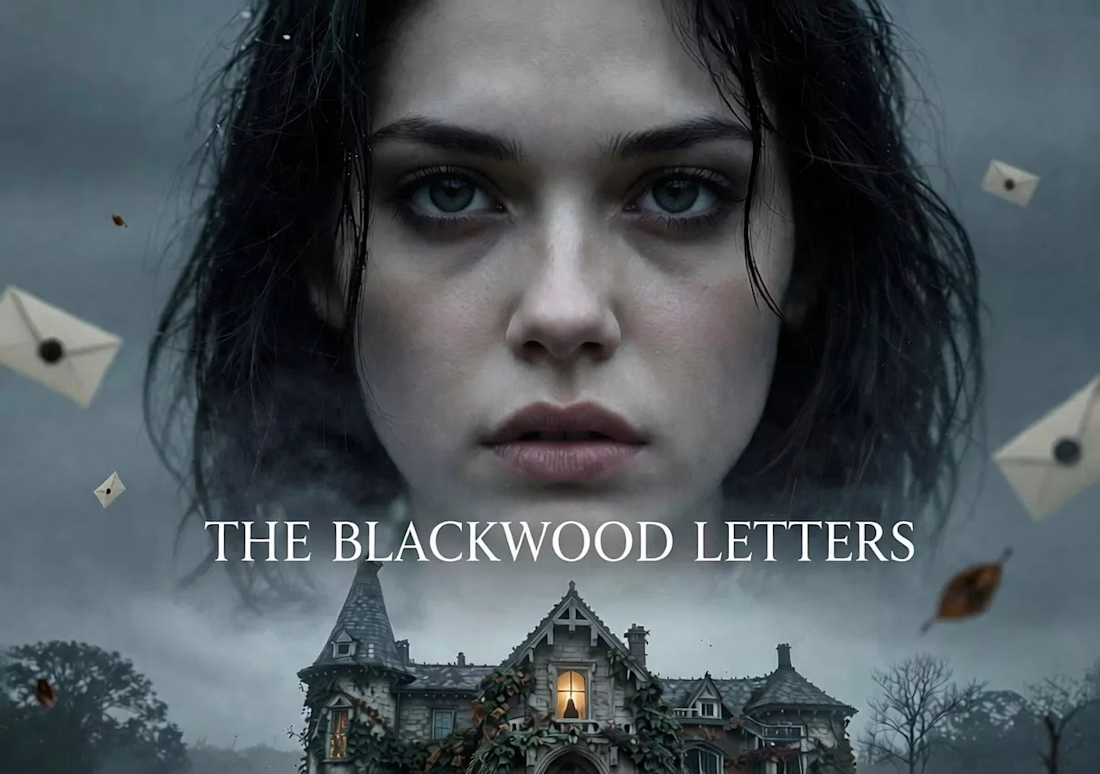
A walkthrough of the characters, costumes, objects, locations, images, script and videos I created—built entirely in Cantina, end-to-end.

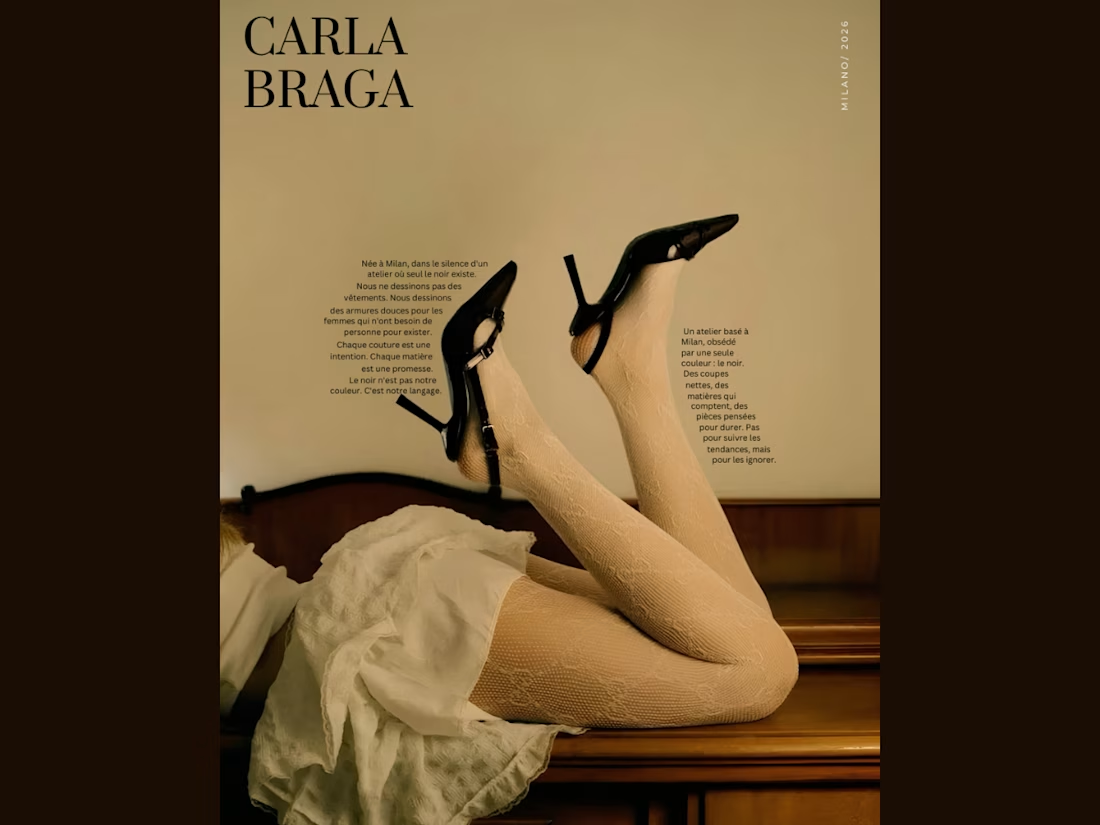
An editorial poster series I designed for CARLA BRAGA, exploring fashion through bold typography, vintage tones, and monochrome imagery. Each layout takes a different approach—from text following the contours of the image to oversized vertical lettering and layered font combinations. Black heels connect the series visually, while warm browns, soft neutrals, and spacious compositions create a cohesive luxury feel. Created in Canva with a focus on typography, contrast, and visual storytelling.



BEAUTIFUL WORK.