The network for creativity
Join 1.25M professional creatives like you
Connect with clients, get discovered, and run your business 100% commission-free
Creatives on Contra have earned over $150M and we are just getting started
Back to feedPost

Have an AI idea but don't know how to turn it into a working product?
That's exactly what I've been building.
I develop AI-powered web applications, AI assistants, automations, and custom AI integrations using Python, FastAPI, OpenAI, Gemini and LLM-based workflows.
From a simple AI feature to a complete MVP, I can help with the backend, APIs, AI integration and application logic.
I'm currently looking for a few projects to work on.
If you're a founder, startup, or business with an AI idea you'd like to build, DM me your idea.
Let's turn it into something users can actually use.
#AI #AIDevelopment #Python #FastAPI #LLM #GenerativeAI #MVP #Startups
The network for creativity
Join 1.25M professional creatives like you
Connect with clients, get discovered, and run your business 100% commission-free
Creatives on Contra have earned over $150M and we are just getting started


Related posts


I designed and built an interactive plan builder for an AI SaaS product. Instead of a traditional pricing table, users choose their workspace and their AI capacity separately, so they only pay for the AI usage they actually need.
The summary panel updates instantly as selections change. Each price change rolls digit by digit, plan names swap character by character, and the layout adjusts its width smoothly. The motion is built with GSAP and respects reduced-motion preferences, with accessible text kept for screen readers.
Design and front-end engineering, handled end to end.


Great work!

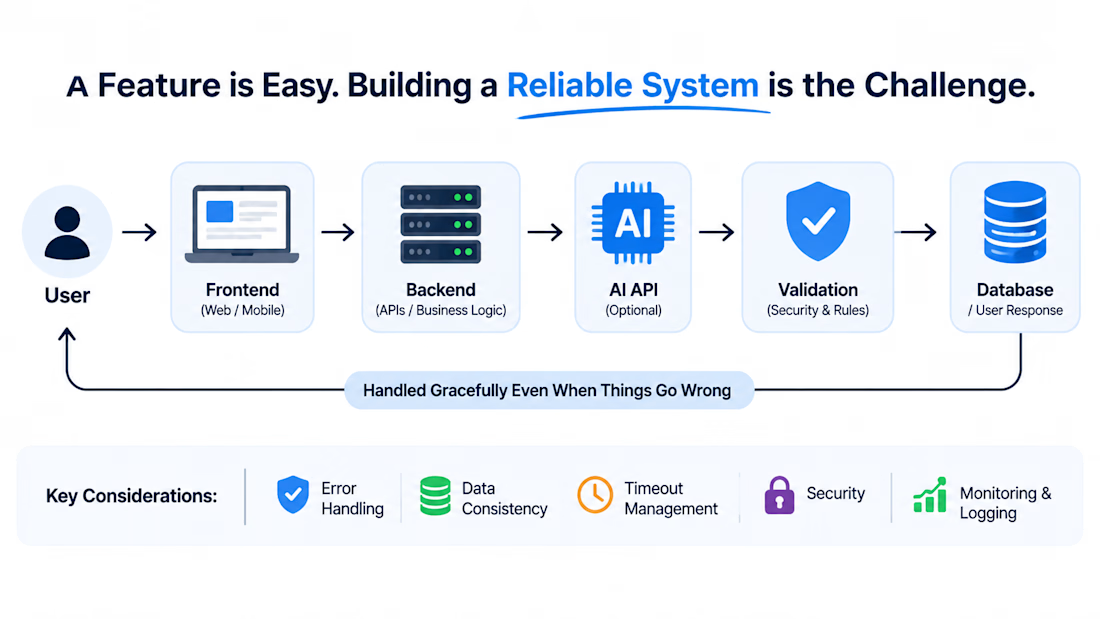
Adding AI to an application is relatively easy.
Making that AI feature reliable enough for real users is a different challenge.
When integrating AI into a web application, I think developers need to consider more than just the API call.
There are several important questions:
→ What happens when the model returns an unexpected response?
→ How do we handle timeouts and failed requests?
→ How do we protect sensitive user information?
→ Can users review or correct AI-generated results?
→ How do we monitor usage, cost and response quality?
An AI feature should fit naturally into the existing application architecture.
It needs proper backend validation, error handling, security and a clear fallback when something goes wrong.
I've worked across web applications, APIs and AI integrations, and I believe the real engineering challenge is making these pieces work together reliably.
AI should improve the product, not make the application unpredictable.


Validating model output as untrusted input is the right frame, and it catches shape and rule violations. The gap is the plausible-but-wrong answer: it passes schema and business rules and still misleads, because the rule set only knows what someone already thought to encode....

We designed and built the website for Nodezy, an AI startup with a node-based canvas for generating images, video and text.
The goal was a website that looks stylish and is interactive throughout. Getting there took many experiments and iterations, and much of it was crafted by hand, even though the tools available in 2026 could have automated a lot of it.
We built the design system first and refined it over several rounds before we brought it into the site.
We hold our own work to this standard, and we bring the same standard to every client project.


A node-based canvas product deserves a site that feels just as interactive, and you can tell a lot of iterations went into this, Vasily. Really nice result for Nodezy.


