The network for creativity
Join 1.25M professional creatives like you
Connect with clients, get discovered, and run your business 100% commission-free
Creatives on Contra have earned over $150M and we are just getting started
Back to feedPost
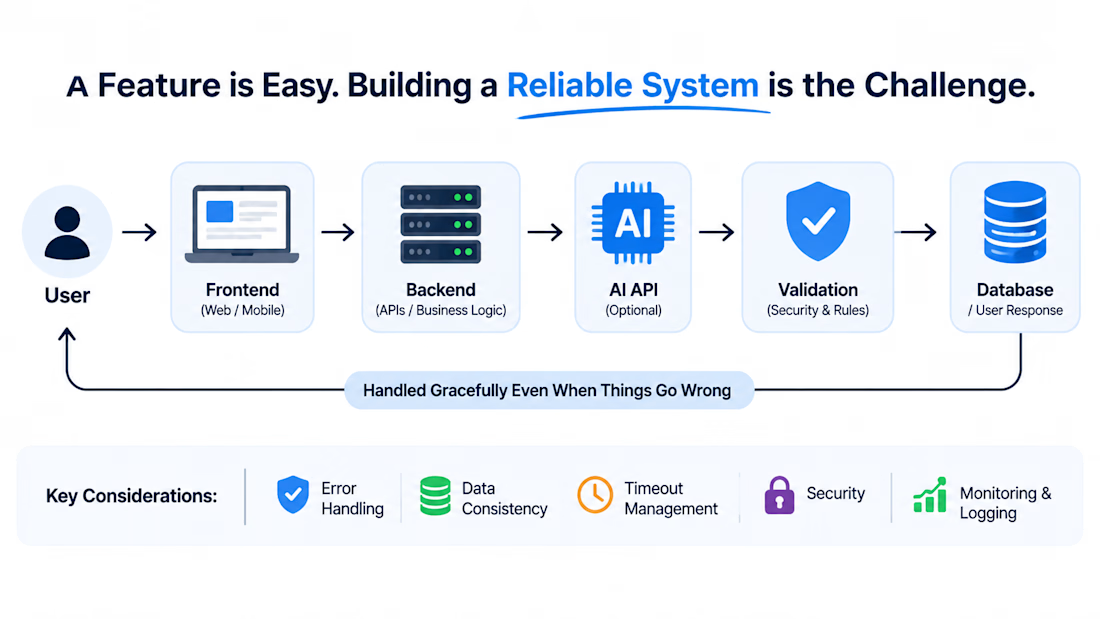
Adding AI to an application is relatively easy.
Making that AI feature reliable enough for real users is a different challenge.
When integrating AI into a web application, I think developers need to consider more than just the API call.
There are several important questions:
→ What happens when the model returns an unexpected response?
→ How do we handle timeouts and failed requests?
→ How do we protect sensitive user information?
→ Can users review or correct AI-generated results?
→ How do we monitor usage, cost and response quality?
An AI feature should fit naturally into the existing application architecture.
It needs proper backend validation, error handling, security and a clear fallback when something goes wrong.
I've worked across web applications, APIs and AI integrations, and I believe the real engineering challenge is making these pieces work together reliably.
AI should improve the product, not make the application unpredictable.


The fallback is where AI features quietly fail: teams handle a thrown exception and forget the case where the model returns a confident wrong answer. In my execution bots I treat the model as an untrusted component: hard timeout, a deterministic path when it misses the deadline,...

That's a very important distinction. I agree that handling exceptions alone isn't enough; an AI response can be technically successful but still be incorrect.
My approach is to treat model output as untrusted input. It should pass backend validation and business rules before...
Validating model output as untrusted input is the right frame, and it catches shape and rule violations. The gap is the plausible-but-wrong answer: it passes schema and business rules and still misleads, because the rule set only knows what someone already thought to encode....
The network for creativity
Join 1.25M professional creatives like you
Connect with clients, get discovered, and run your business 100% commission-free
Creatives on Contra have earned over $150M and we are just getting started


Related posts

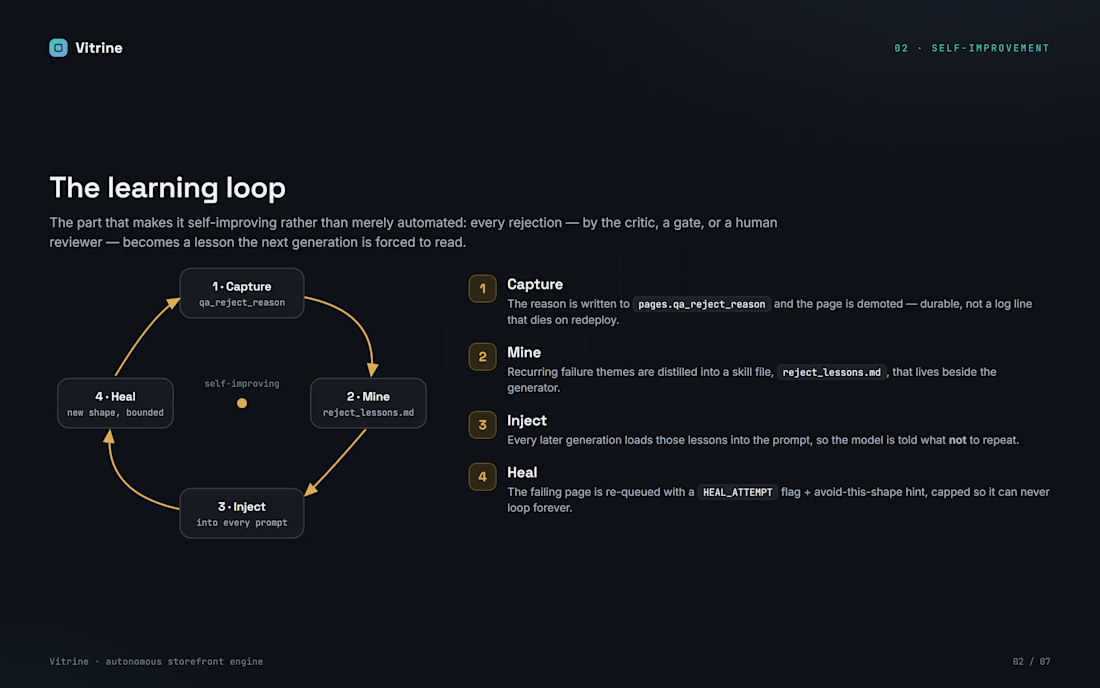
Autonomous backend that turns local merchants into bespoke landing pages with almost no human in the loop. Celery tasks discover businesses, an LLM designs each page, then two independent AI gates - an HTTP health oracle and a 5-axis design critic - validate it. Rejections are mined into lessons and re-injected, so the system self-heals and regenerates a better layout automatically. Qualified pages wait behind a signed preview link and a human approval gate; nothing ships without consent, payment and a global kill switch


What is a good motion concept to promote an AI assistant?
4 voted
50%
4 voted
50%
8 votes
Closed

The thread one for me. Showing the assistant actually handling a conversation explains the product faster than a floating 3D card

I woke up with an idea today.
After working with Design Systems for a couple of years, I've often used Claude to scale and refine components. But today, I wanted to try an experiment: What if Claude handled the foundations, documentation, components, and variables?
I want to see exactly how much of the Design System creation process AI can accurately handle, and where the human touch remains fundamentally necessary.
Would you like to see how this process unfolds?


Curious to see your process because this combo (Claude + Figma) is next level 👌.
What I can tell from my experience on a daily basis dealing with DS is that if you know to articulate really well your ideas/thoughts, then the sky is your limit!