The network for creativity
Join 1.25M professional creatives like you
Connect with clients, get discovered, and run your business 100% commission-free
Creatives on Contra have earned over $150M and we are just getting started
Back to feedPost

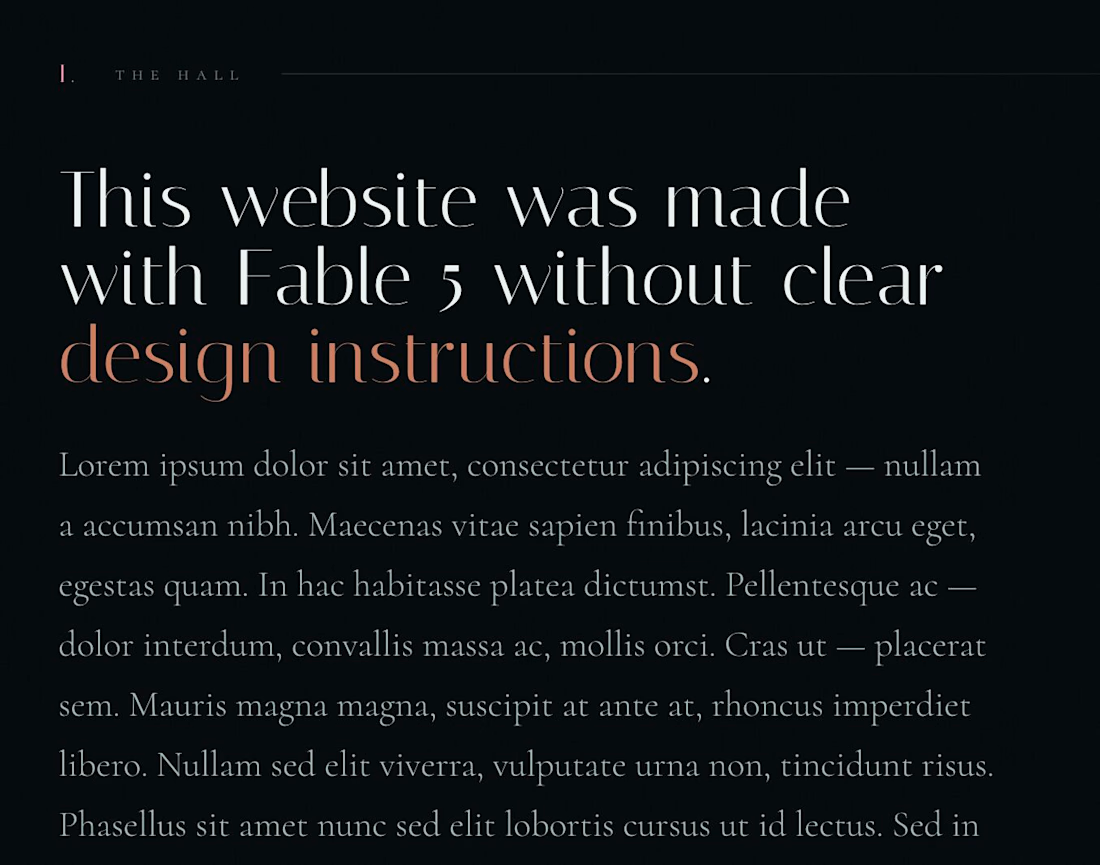
Have you noticed this font appearing everywhere on newly designed websites lately?
It is called "Italiana," and it has become a favorite choice of Claude Fable 5, despite its hard-to-read letterforms.
Fable 5 is an outstanding model for many use cases. However, like all AI models, it tends to produce generic and repetitive results if it is not properly prompted and guided by deliberate human design decisions.
When evaluating AI-generated creativity, this is the main reason behind the growing sea of content that looks and sounds like "slop" to us.
Humans are highly sensitive to novelty. When we encounter the same patterns too often, they stop feeling comfortable and start to feel boring or even irritating.
On top of that, what is mathematically optimal for an AI is not necessarily appealing to most human observers. This difficult-to-read font is a clear example, along with the excessive use of em dashes "—" which still frequently plague most AI-generated text.
So how do we fix this?
The first step is knowing what we want. Human taste is still far more refined than any AI system today; we just need to actively apply it. The second step is prompt engineering. Clear, focused, and structured instructions make a significant difference in output quality, which can compound when tested and repeated.
Yes, it takes more effort than simply asking to "generate a cool website," but the quality difference makes it a hard requirement for truly creative results.
While AI is excellent for objective and probabilistic tasks, human creativity and taste remain our exclusive non-negotiable advantages.
(At least for now).




Have you found any other fonts that balance style and readability well?
The network for creativity
Join 1.25M professional creatives like you
Connect with clients, get discovered, and run your business 100% commission-free
Creatives on Contra have earned over $150M and we are just getting started





Related posts

Then: 1 month, 1 template.
Now: 1 week, 15 templates.
Same designer, different workflow.
I wrote up how I built no-code.supply: fifteen website templates, each with its own brand, in HTML and React, and some in Framer too. Claude Code did most of the typing. I did the directing.
no-code.supply
How I built 15 website templates with an AI coding agent in a week
How I built 15 AI-ready website templates with Claude Code in a week: the workflow, the quality bar, and why a template is only the starting point.

Going from one template a month to fifteen a week is wild. How much of the design direction did you still do by hand?

Designed this interactive 3d dashboard with Opus 5.5 for an industrial company's vehicle and material tracking dashboard
A full 3D simulation of the plant, every truck tracked from gate to dock
Both modes are pixel precise. Which one you like?
4 voted
40%
6 voted
60%
10 votes
Closed

Voted Dark. On a dashboard watching trucks move from gate to dock all day, dark is easier on the eyes, and the 3D bars and route lines glow against it. Light is clean, but dark makes the live movement the focus.


Does an AI brand still need to look like an AI brand?
Lupr helps small and growing businesses adopt AI without the complexity, so the identity needed to do the same.
We built a clean, approachable system around movement, connection and continuous improvement, without leaning on the usual futuristic tech clichés.
The idea was simple: make AI feel like useful business infrastructure, not something you need to be an expert to understand.
As AI becomes part of everyday business, do you think brands still need to visibly signal “AI”?
Full case study below 👇


Great design it feels alive 🎉🎉❤️❤️


