The network for creativity
Join 1.25M professional creatives like you
Connect with clients, get discovered, and run your business 100% commission-free
Creatives on Contra have earned over $150M and we are just getting started
Back to feedPost
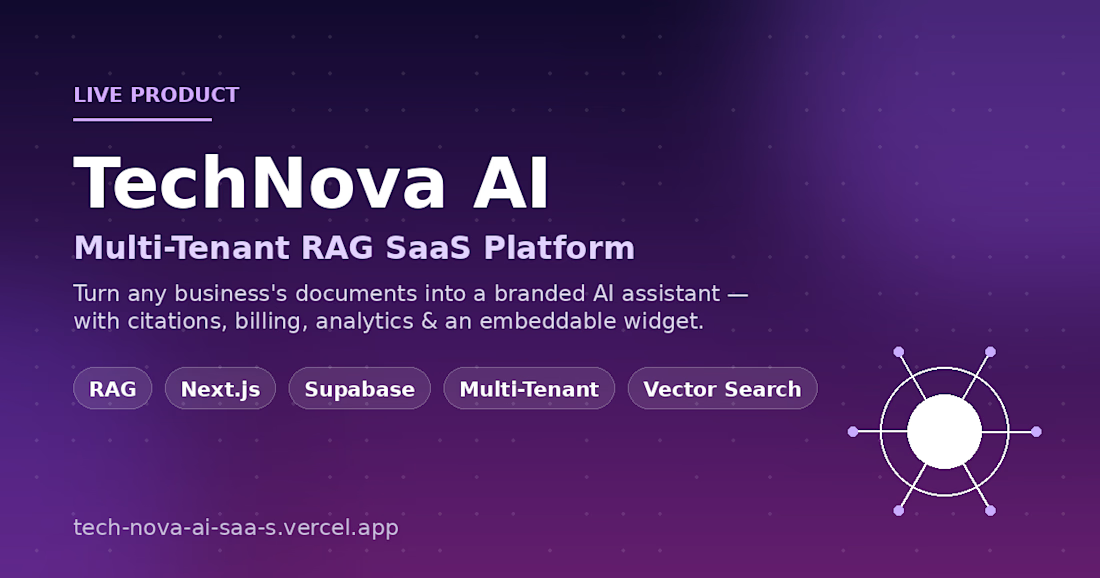
I built and launched a SaaS product on my own: TechNova AI. 🚀
Every business gets its own private AI assistant that answers customer questions using only that business's own documents.
What makes it different:
🔒 Every business has its own isolated workspace. Its documents, chat history and analytics are never mixed with anyone else's.
📄 Upload PDFs, Word docs or text files
📚 Every answer shows which document it came from, and if the answer isn't in your documents, the AI says so instead of guessing
🌍 Works in English, Urdu and Roman Urdu
💬 Add the assistant to your website with one line of code
📊 Analytics show what customers ask and where the AI falls short
Pricing:
• Free: 3 documents
• Standard: $19/month, 25 documents
• Premium: $49/month, unlimited documents
Built with Next.js, TypeScript, Supabase (pgvector), Groq and Vercel. The AI was the easy part. Tenant isolation, PDF parsing in serverless and Urdu retrieval quality took the real work.
I'm looking for my first few businesses to try the free plan and tell me honestly what to improve. If you answer the same customer questions again and again, message me.
#AI #RAG #SaaS #LLM #BuildInPublic #Pakistan #Startup



I’d test Urdu and Roman Urdu retrieval separately from English, especially when the same question has several spellings. How are you checking that the cited document actually supports each answer across those languages?

great point ! we are testing urdu /roman urdu seperately using using dedicated evolution datasets to ensure citation accuracy across spelling variations.
The network for creativity
Join 1.25M professional creatives like you
Connect with clients, get discovered, and run your business 100% commission-free
Creatives on Contra have earned over $150M and we are just getting started



Related posts

MOTIF — From Words to Pixels to Code
What if you could see your dream website before writing a single line of code, then turn that vision into something real?
That's why I built Motif, an AI-powered visual design and website creation studio, built on Base44.
We turn words into pixels. Then we turn those pixels into real HTML and CSS.
Most AI website builders take a prompt and immediately generate a website. You get what the AI decides, and often spend ages prompting, regenerating and fighting to get something that resembles what you originally imagined.
I wanted to change that.
Motif puts visual creativity before code.
You start by describing your idea in plain English. Motif explores different visual directions, generating concepts that let you actually see what's possible before committing to a design.
Once you find something you love, Motif transforms that approved visual into a real, responsive website built with HTML and CSS. Not a flattened image pretending to be a website, but actual editable elements.
And that's where Motif becomes more than an AI generator.
Inside the visual studio, you can select elements, change typography, colours, spacing, imagery and layouts, preview desktop and mobile versions, and refine the design without starting over.
One of my favourite features is Shuffle, which can dramatically reimagine a design's composition and styling, allowing you to explore new creative possibilities without writing another lengthy prompt.
I also wanted people to understand what Motif could do before signing up or waiting for AI generation. So I built a product-focused homepage featuring real application footage, an explainer video and editable sample projects visitors can explore.
Why I built it
I've spent years working across software development, 3D design and interactive experiences, and I've always been fascinated by the gap between having a creative vision and actually bringing it to life.
AI has made building software more accessible, but great design still requires exploration, experimentation and creative control.
I believe AI should expand your imagination, not replace your creativity.
Motif is my attempt to bring those worlds together: the freedom of visual design, the intelligence of AI and the flexibility of real web development.
It's designed for entrepreneurs, developers, designers and anyone who's ever had a great idea but struggled to make it look the way they imagined.
Built with Base44, Motif demonstrates how far a creative application can go beyond traditional no-code tools.
Motif isn't about generating another template. It's about making something unmistakably yours.
Imagine it. Shape it. Make it real.
#Base44Challenge


Great idea, great output Mellis - goated

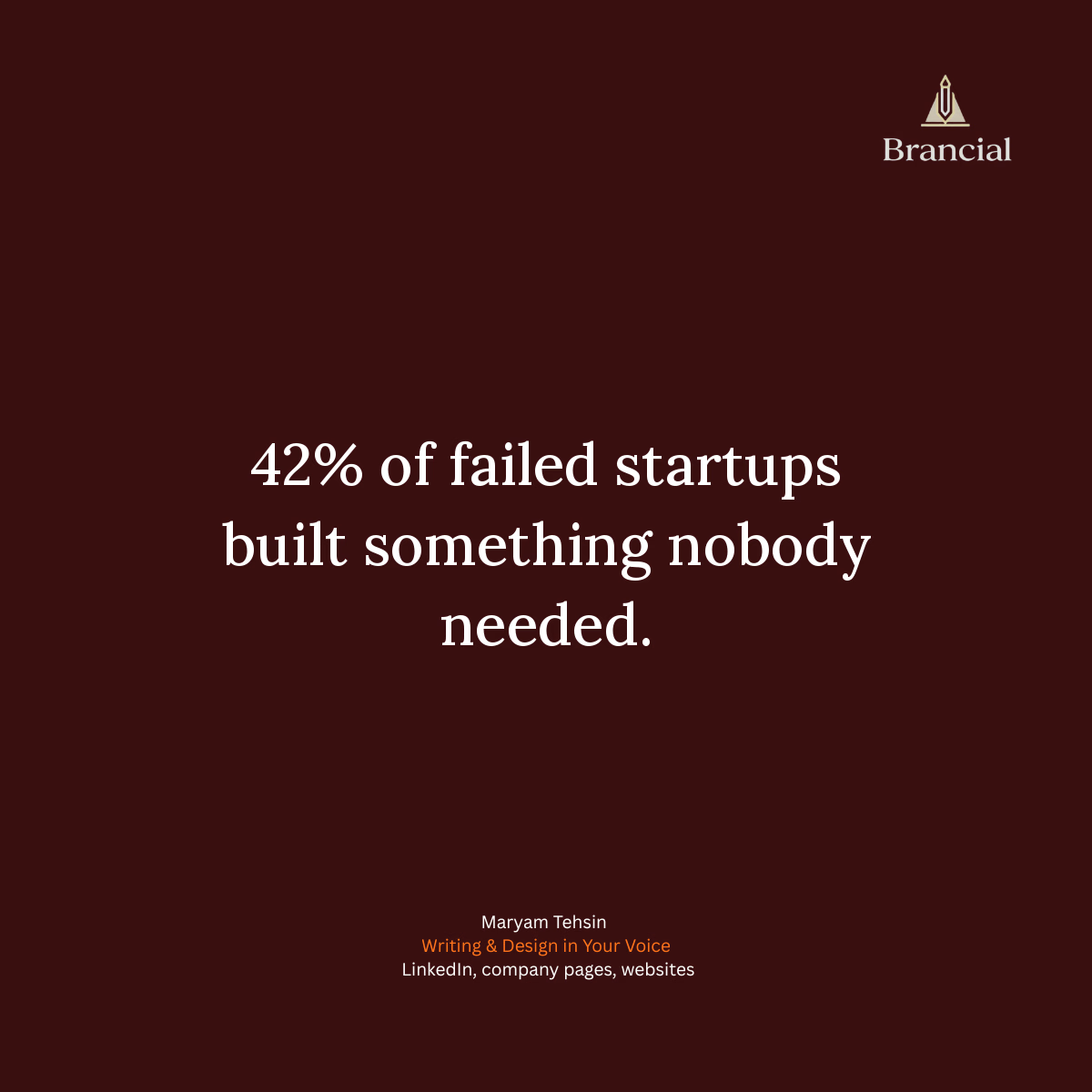
42% of failed startups built something nobody needed.
That is from one CB Insights analysis of 101 founder post-mortems.
Not bad code. Not bad luck. Nobody needed it.
If you are building an AI product...this is the cheapest fix you will ever make...
Ask these 5 questions BEFORE you build...
1. Who exactly has this problem?
Everyone is not an answer. Name a job title.
2. How are they solving it today?
If they are not solving it at all, it may not hurt enough.
3. What does it cost them?
Hours, money or missed deals. Get a number.
4. Would they pay for a fix this month?
Ask for a pre-order or a pilot, not a compliment.
5. Who have you talked to this week?
Aim for 5 real conversations before writing a line of code.
Copy-paste prompt to prepare your interviews:
I am building [product] for [job title]. Write 10 customer interview questions that uncover how they solve [problem] today, what it costs them, and what they have already paid for. No leading questions.
Compliments do not validate a product.
Payments and pilots do.
Save this before your next build sprint.
Follow me to meet again
Daily learn with me (Maryam Tehsin)


Such an important reminder! 👏 It's easy to focus on building a product, but understanding the customer's real problem should always come first. Real feedback is worth more than compliments!

Personal portfolio website: design and development
I designed and built my portfolio from scratch to show who I am and what I build, all in one scroll.
What’s in it
An animated network background that moves gently behind the page
A working terminal visitors can type into (try projects or joke)
Project cards that tell each story in four lines: goal, built, hurdle, fix
A responsive layout that looks just as good on a phone as on a laptop
Built with: HTML, CSS and JavaScript, no framework, so it loads fast. Deployed on Vercel.
🔗 Live: ankitagaikwad.vercel.app


