The network for creativity
Join 1.25M professional creatives like you
Connect with clients, get discovered, and run your business 100% commission-free
Creatives on Contra have earned over $150M and we are just getting started
Back to feedPost
I was talking to a prospective client for my bookkeeping business.
She asked what are the key benefits of hiring a bookkeeper. I was semi-prepared with an answer:
1. Saves Time - frees you from daily data entry, reconciliations, and invoice tracking so you can focus on growing your business.
2. Financial Accuracy - prevents calculation errors, misclassified expenses, and messy records that lead to lost tax deductions.
3. Better Cash Flow Management - tracks incoming and outgoing money to help you spot shortfalls early and pay bills on time.
4. Smoother Tax Preparation - keeps year-round records organized, making tax season faster and reducing audit risks.
5. Clearer Strategic Insights - generates clean financial reports (like P&L and balance sheets) that inform budgeting and hiring decisions.
6. Cost-Effective Scaling - outsourcing or hiring a part-time bookkeeper is often more affordable than maintaining a full-time in-house accounting department.
Wondering what I missed? What else do you tell your clients when they ask this question?

Solid list, Priyanka. Number 3 is the one most owners feel first, since cash flow surprises are what actually cause the panic. You were far more prepared than you think.

Thank you! I completely agree.

I’d add peace of mind! 😊 Business owners shouldn’t have to guess whether they can afford their next hire or investment. Good bookkeeping helps them make those decisions with confidence, not just keep track of what’s already happened.
yes its correct
The network for creativity
Join 1.25M professional creatives like you
Connect with clients, get discovered, and run your business 100% commission-free
Creatives on Contra have earned over $150M and we are just getting started











Related posts

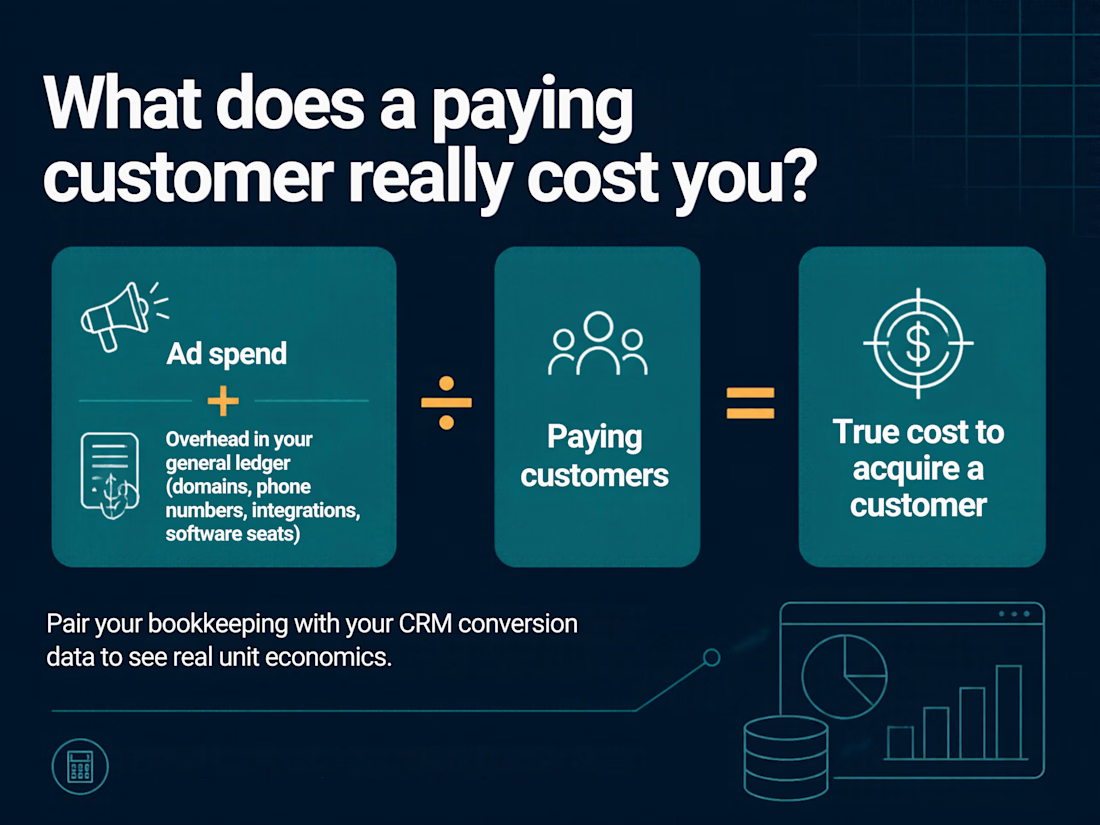
You know your cost per lead inside HighLevel down to the cent.
What about your true cost to acquire a paying customer?
Ad spend alone rarely tells the full story. You also pay for domain hosting, phone numbers, integration tools, and software seats. Those operational expenses sit in your general ledger under overhead.
Pairing your bookkeeping expenses with your CRM conversion metrics gives you real unit economics. You see exactly what you spend to earn every single dollar.
Episode 7: Your bank balance is not your income. 💸
As a designer, money reaches you from Stripe, PayPal, Wise, direct transfers and Contra. By the time it lands, fees, currency conversion and delays have already taken a cut, and some of it never gets recorded.
That’s why a monthly bank reconciliation matters. It means matching your bank statement to your books, line by line, so you can:
✅ Spot the client invoice that was never paid
✅ Catch the software subscription you forgot to cancel
✅ Find the processor fees nobody recorded
✅ Know your real profit per project
✅ Reach tax time with clean numbers instead of a panic
It takes about 30 minutes a month. A gap you catch in October is easy to fix. A gap you find a year later is expensive.
#bookkeeping #freelancedesigner #designbusiness #freelancefinance #smallbusiness


You are giving real concepts how finances can be handled
One Small Mistake Can Cost Your Business Thousands of Dollars!
Imagine your business receives two invoices:
📄 Invoice #4471
📄 Invoice #INV-4471
They look like two different invoices. But what if they’re actually the same bill?
If your bookkeeping system only checks for exact invoice number matches, it may treat these as separate invoices. The result? Your business could end up paying the same bill twice.
This is where smart bookkeeping makes a difference.
An effective Accounts Payable (AP) process should verify more than just invoice numbers:
✅ Vendor name and identity
✅ Invoice numbers with different formats
✅ Invoice amounts and dates
✅ Previous invoices and payment records
AI and automation can help detect these discrepancies before they turn into costly mistakes. However, proper verification and human oversight are still essential before releasing payments.
Remember, good bookkeeping isn't just about recording every transaction. It's also about protecting your business from paying twice for the same expense.
Has your business ever experienced a duplicate invoice or an accidental double payment? Share your experience in the comments!
#Bookkeeping #AccountsPayable #Accounting #AIinFinance #SmallBusiness