The network for creativity
Join 1.25M professional creatives like you
Connect with clients, get discovered, and run your business 100% commission-free
Creatives on Contra have earned over $150M and we are just getting started
Back to feedPost
Series 1 [Payment App, FinTech] : Post 2
Where UPI Payments Actually Break?
Most UPI payment flows don’t fail at the integration layer; they fail at state handling after transaction initiation.
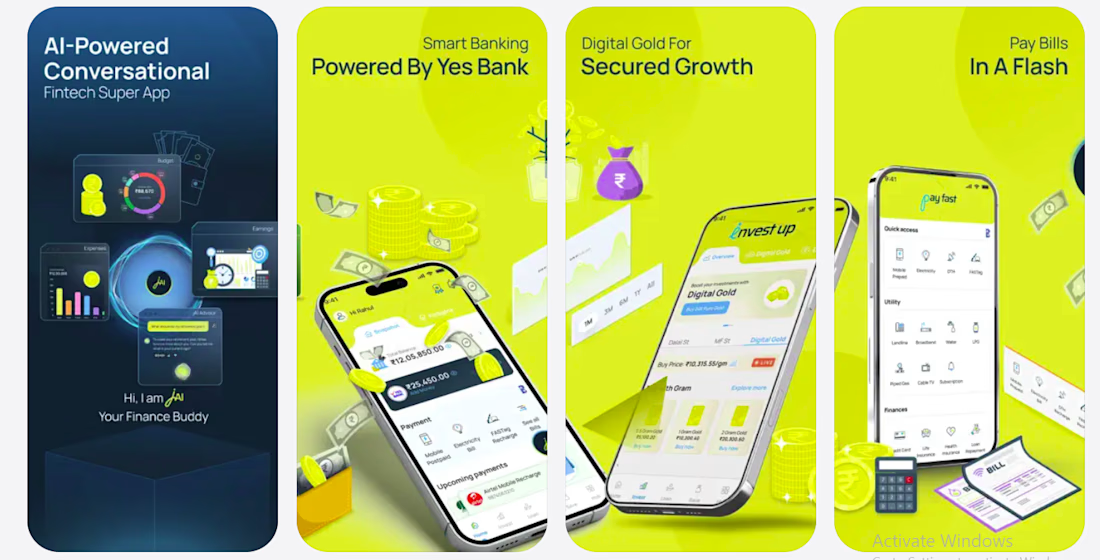
While working on the payment flow for JUMPP, one of the most critical scenarios was handling “pending” transactions correctly.
In a typical flow:
• User initiates payment
• Transaction is processed via UPI
• App waits for confirmation from backend/payment gateway
But in real-world usage, confirmation is not always immediate.
This creates a gap between:
User expectation (payment done)
System state (payment still pending)
If this state isn’t handled properly:
• Users retry payments → risk of duplicate transactions
• UI shows incorrect status → loss of trust
• Backend reconciliation becomes messy
The implementation focus here wasn’t just triggering payment; it was designing a reliable state transition flow:
pending ^ success / failure (with proper verification)
Along with:
• Controlled UI feedback during async confirmation
• Avoiding premature failure states
• Ensuring consistency between client and backend
This is where most payment flows break; not at integration, but at handling asynchronous transaction states correctly.
I’ll share another common failure point next around app flow and drop-offs during payment.
The network for creativity
Join 1.25M professional creatives like you
Connect with clients, get discovered, and run your business 100% commission-free
Creatives on Contra have earned over $150M and we are just getting started
Related posts

Recently working on implementing a UPI payment module in FinTech iOS app (JUMPP)
On the surface, payments seem like a small part of the app.
In reality, it’s one of the most critical because it directly affects trust with the App.
While creating such App, The experience should be feel controlled for its user within the application while still handling real transaction states in the background.
That changes the complexity completely. Because now it’s not just about triggering a payment it’s about managing what happens before, during, and after the transaction.
My focus during this work wasn’t just “adding UPI” it was making sure the flow actually works in real-world usage.
This involved:
• Handling smooth app-switch flow between UPI apps, government and bank rails and the iOS app
• Managing different transaction states with records across the switches (success, pending, failed)
During the development of such a vast module; One thing became very clear:
Even small inconsistencies here can lead to failed transactions or lost users.
I’ll be sharing a few specific challenges and patterns I noticed while working on this especially around where UPI flows tend to break in real-world
Keep connecting for series of UPI with me.


In-app animations I created for Paynura app.



Clean💫🔥

Looking at funnels from the outside often reveals issues.
But there’s another layer that’s less visible. There’s a specific kind of issue I keep running into when reviewing funnels.
Not the obvious ones.
The ones that technically work — but lead to the wrong outcome.
For example, an upsell that leads to a form which looks correct, but is tied to a different setup in the background.
No error.
No broken step.
From a user perspective, everything works as expected.
But internally, it affects how leads are tracked, attributed or evaluated later on.And it often goes unnoticed — at least until someone in sales starts questioning the numbers, or results don’t line up during a review.
These aren’t careless mistakes.
They usually happen because someone is very familiar with the system — and often moving quickly within it. When you build a flow yourself, you know how it’s supposed to work.
So when you test it, you naturally follow that logic.
You click the expected path.
You interpret outcomes in context.
And small inconsistencies are easy to miss — especially when they’re not visible in the interface.
In many cases, everything is configured exactly as set up.
It’s just that a small detail in the setup doesn’t match the intended logic anymore.
And that’s much harder to catch.
It usually takes someone looking at it from the outside, with a clear head, to spot these things.
Not more effort — just a different perspective.
Have you ever come across something like that in your own setups?



















Trending

Runway
AI video generation is exploding. What are you dreaming up in Runway?

Contra University
Learn from expert creatives how to earn more using next-gen AI tools.
creativeaiflow
Creative AI workflows are evolving. What tools do you use, and what are their strengths and weaknesses?
portfolioreview
The best portfolios tell a story, not just show a grid. Share yours for feedback.
freelancerlife
Freelancer life is wins, pivots, and everything in between. What’s yours right now?