The network for creativity
Join 1.25M professional creatives like you
Connect with clients, get discovered, and run your business 100% commission-free
Creatives on Contra have earned over $150M and we are just getting started
Back to feedPost

Everyone's spamming AI-generated blog posts for SEO. This financial advisory firm got $4.2M in AUM without publishing a single one.
Don't buy the hype that publishing 50 blog posts will get you clients. This financial advisory firm added $4.2M in AUM last quarter, and we didn't publish any new blog content.
We optimized their existing site architecture.
Here's how:
The client is a fee-only RIA in Austin specializing in tech executives and business owners post-exit. They had existing referral flow and inbound traffic, but their site wasn't converting it effectively.
The problem: They were trying to rank for everything at once: retirement planning, investment management, estate planning, tax strategies with no clear hierarchy.
Here's how we fixed it:
1. Focused the homepage on their most valuable audience
Changed from "Comprehensive wealth management for individuals and families" to "Financial planning for tech executives and business owners with $3M-$20M in liquid assets."
2. Created dedicated service pages for high value scenarios
Not generic "Retirement Planning." Instead:
"Business Exit Planning for $5M-$15M Sales"
"RSU & Stock Option Tax Strategies for Tech Executives"
"Post-Exit Wealth Management"
Each page targeted a specific situation clients actually search for.
3. Rebuilt heading hierarchy
H1: Main service + audience H2s: Specific situations H3s: Common questions and objections
Clear structure helps both search engines and prospects understand page focus.
4. Rewrote content as conversion pages, not educational posts
Old: "Retirement planning involves careful consideration of various factors..."
New: "Sold your company for $8M and want to retire at 52? Here's how we model whether your assets will last 40+ years."
5. Added localized trust signals
"Why Austin business owners choose us" section:
Local case studies (saved Round Rock SaaS founder $1.1M in capital gains)
Regional expertise (Prop 19 implications, Texas tax advantages)
Area partnerships (estate attorneys, CPAs)
6. Built FAQ sections covering branded and high-intent queries
Branded: "Does [Firm Name] work with clients under $2M?"
Unbranded: "How to minimize taxes when selling a business in Texas"
7. Optimized for discoverability in ChatGPT and Perplexity
We analyzed what phrases were getting cited in competitor results: "business exit tax planning," "RSU tax strategies," "QSBS exclusion."
Rewrote content to include these phrases in clear, structured formats.
Based on self-reported lead sources and CRM tagging, roughly 15-18% of qualified inquiries now mention finding them through ChatGPT or Perplexity.
The results (90 days, alongside existing referrals and inbound brand traffic):
Traffic: 580/month → 1,840/month
Top 3 keyword rankings: 12 → 47
Calls booked: 4/month → 16/month
Clients signed: 1-2/quarter → 9 in 90 days
New AUM: $4.2M
No new blog posts. Just optimized existing pages.
The lesson:
Before publishing more content, optimize what you have.
Most financial advisory sites have the right pages, they're just unfocused, generic, and poorly structured.
This firm didn't need 100 blog posts. They needed their core pages to actually work.
Clear hierarchy > more pages
Specific positioning > broad appeal
Conversion copy > educational tone
The foundation matters more than volume.
Fix what exists before adding more.
Are your existing pages optimized, or are you just adding content hoping something sticks?
The network for creativity
Join 1.25M professional creatives like you
Connect with clients, get discovered, and run your business 100% commission-free
Creatives on Contra have earned over $150M and we are just getting started
Related posts

Struggling to get traffic on your website? I help businesses improve their Google rankings through effective SEO strategies, keyword optimization, and on-page improvements. Let’s optimize your website to attract more organic visitors and grow your online presence. Feel free to connect.

Most "AI MVPs" stop at Figma flats and dotted-line user flows.
I built a real one — design system, working frontend, live AI pipeline, published output — in days.
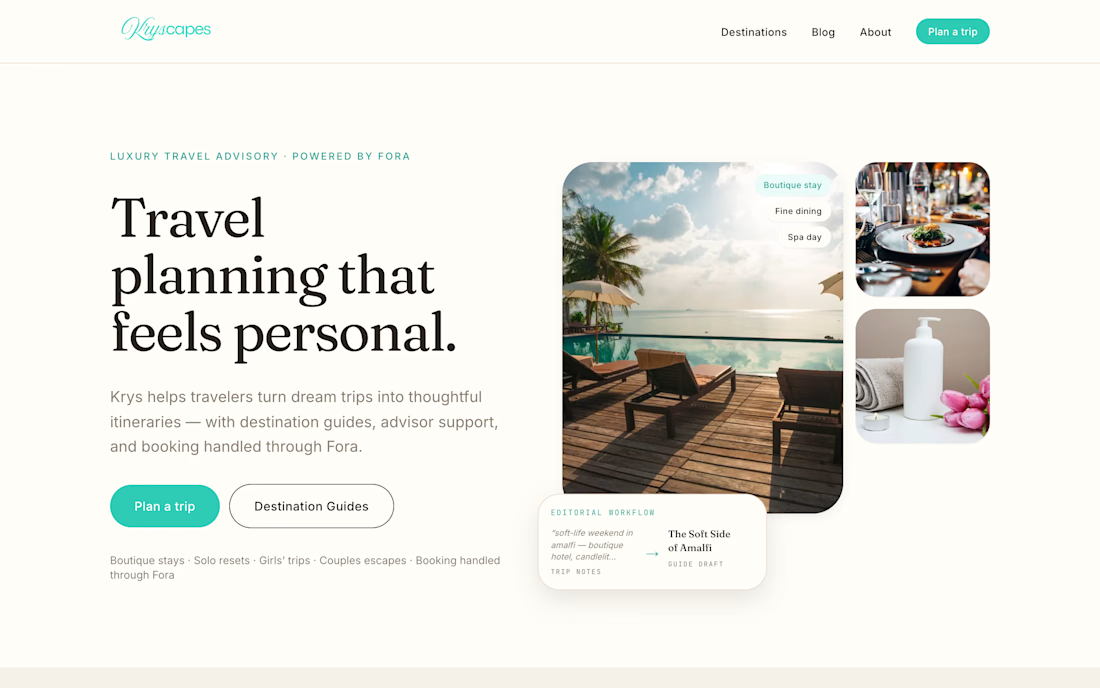
Kryscapes is a travel advisor's co-pilot. She records a voice note about a trip. The system writes a polished editorial guide — hotel block, affiliate items, SEO meta, social captions. She edits in place. Hits publish.
What's inside the case study:
→ PRD + DESIGN.md that scoped the build
→ Brand → Alias → Map token cascade in code
→ Three Supabase tables — narrow on purpose
→ AI pipeline with Zod-validated structured outputs and a deterministic fallback
→ Processing screen, draft review, published guide proof
You don't leave the sprint with a deck. You leave with a working artifact, the codebase, and a story you can use for pitching or fundraising.
Two ways to hire me:
— AI Product Design Sprint · $2,400 — strategy, UX, Figma, prototype, AI workflow map
— AI MVP Sprint · $6,500 — design sprint plus working MVP, database, AI pipeline, launch-ready handoff
Read the full case study: Check it out




top class work 🔝

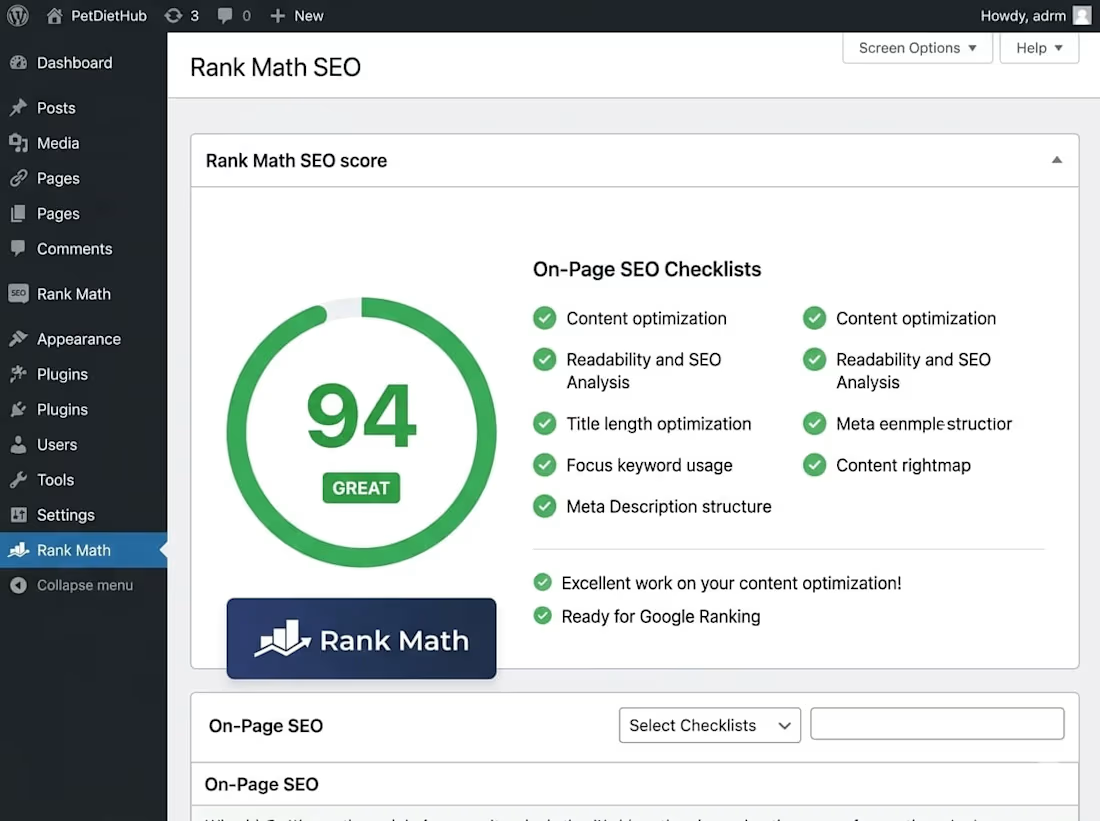
Mastering Search Engine Rankings: Achieving a 94/100 Rank Math Score!
Writing content is one thing, but making sure Google loves it is another! 📈
I’m excited to share a recent milestone from my project, PetDietHub. By focusing on deep keyword research and technical on-page SEO, I achieved a 94/100 SEO Score on Rank Math! (Check the proof in the screenshot below).Why does this matter for your business?
Higher SEO scores mean better visibility, more organic traffic, and higher authority in your niche. If your blog posts aren't reaching the first page, they aren't working for you.
What I offer:
✅ Perfect On-Page SEO: Guaranteed 90+ scores using Rank Math or Yoast.✅ Niche Expertise: Specialist in Pet Wellness and Automotive industries.✅ Strategic Keyword Placement: Natural integration of LSI and Focus keywords. Engagement-Driven Content: Articles that satisfy both readers and search engines.
Stop settling for "just content." Let’s create articles that actually rank and convert.
📩 Interested in boosting your blog's SEO? Send me a message or check out my services on Contra!
[Insert your Contra Profile Link here]
#SEOExpert #ContentStrategy #RankMath #FreelanceWriter #AroojFatima #DigitalMarketing











Trending

Claude
Claude has entered the design space. How are you using Claude Design?

Contra University
Learn from expert creatives how to earn more using next-gen AI tools.
creativeaiflow
Creative AI workflows are evolving. What tools do you use, and what are their strengths and weaknesses?
portfolioreview
The best portfolios tell a story, not just show a grid. Share yours for feedback.
freelancerlife
Freelancer life is wins, pivots, and everything in between. What’s yours right now?