The network for creativity
Join 1.25M professional creatives like you
Connect with clients, get discovered, and run your business 100% commission-free
Creatives on Contra have earned over $150M and we are just getting started
Back to feedPost

Building products is what excites me most.
I’m a backend-focused Full Stack Engineer working on scalable APIs, AI-powered workflows, automation systems, and modern SaaS products using Node.js, TypeScript, React, PostgreSQL, Redis, and AWS.
Recently, I’ve been building:
• DeepLock — focus & productivity platform for Android + Chrome
• AI-powered automation workflows
• Event-driven backend systems
• SaaS tools solving real-world workflow problems
• Job automation and AI agent systems
I enjoy fast-moving startup environments where ownership, execution, and product thinking matter as much as coding.
Currently open to:
• Full Stack Development opportunities
• Backend Engineering roles
• AI-native product engineering
• Startup and remote opportunities
Always excited to connect with builders, founders, and teams working on meaningful products.
The network for creativity
Join 1.25M professional creatives like you
Connect with clients, get discovered, and run your business 100% commission-free
Creatives on Contra have earned over $150M and we are just getting started

Challenges
View all


Related posts


My goal was to create a website that feels ambitious and technically capable without looking like a generic agency template. I used a deep midnight-blue visual direction with white typography, neon blue accents, subtle purple lighting, glass surfaces, and carefully controlled motion. This gives the site a modern, high-end feel while keeping the focus on the work itself.
The hero section is built around the idea of transformation. It begins with an outlined city and the message “Imagine the future,” then reveals a complete city with “Build the reality” as the visitor scrolls. This mirrors the way I approach projects: starting with an early concept, then turning it into a practical digital system that people can actually use. The scroll interaction creates an immediate reason to explore the site while making the opening feel more memorable than a standard static banner.
I structured the rest of the experience to guide attention naturally. The client ticker adds movement and credibility without distracting from the content. The services section uses a clean two-by-two layout so visitors can quickly understand my main areas of work, including AI systems, SaaS development, product design, and growth automation. Each card has enough visual detail to feel premium, but the information remains easy to scan.
The work section is designed as an interactive expanding gallery. When a visitor focuses on a project, it grows to reveal more context and a clear call to action. This creates a more engaging way to present projects while keeping the page visually clean. Instead of showing everything at once, the design lets each project earn attention individually.


Excellent

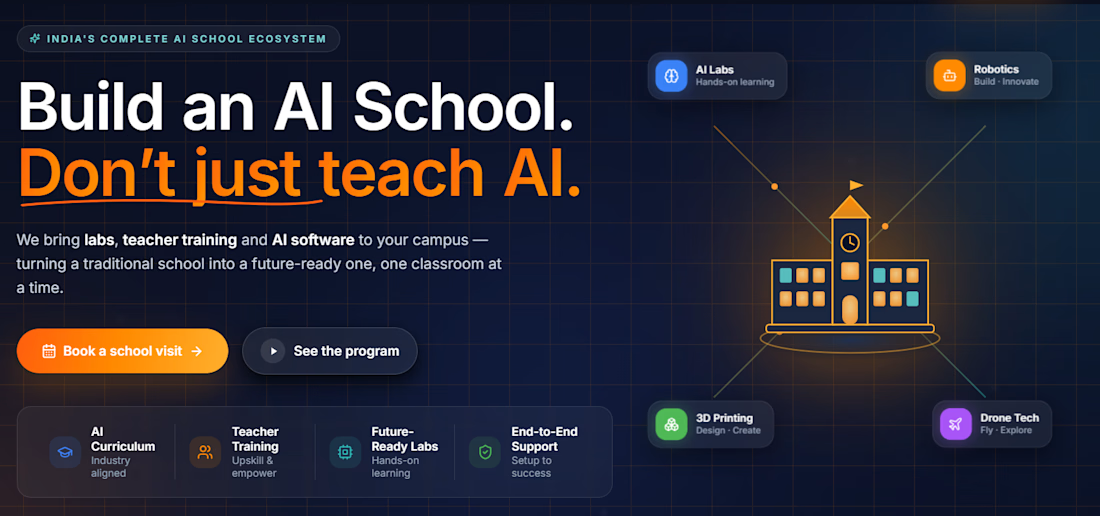
just shipped the core of Skillship — an AI-powered LMS built for schools.
One platform, many schools, and one rule that shaped every decision: School A must never see School B's data. Tenant-scoped models, filtered querysets at the base class, UUIDs everywhere.
Four AI features live:
— Career Pilot: personalised career paths for students
— Question generator: chapter PDF in, board-aligned MCQs out
— Adaptive quizzes: difficulty follows actual performance
— Semantic search: teachers ask in plain English, pgvector finds the material
Django + DRF for the LMS core, a separate FastAPI service for all AI work (Gemini + a pgvector RAG pipeline), Next.js 14 on the front. Django brokers every AI call — the AI layer never touches the browser.
The hard part wasn't the AI. It was making multi-tenancy boring enough that no future dev can leak a school's data by accident.
Open for new work — full-stack builds, AI integrations, RAG pipelines, multi-tenant SaaS. Send me a project.

The tenant boundary is where I'd put the first failure test. I'd try to make a user from one school retrieve another school's record before I trusted any of the AI features.


Continuous product development, together with a good use case — usually drives the business forward enough to reach out and make a signal to their prospects, via captivating but deliberate 'street-cred-bragging-rights' along side their new statistical hero and sound social proof block.
Ultimately leading to the lovely time of revealing a new website.
But before I do, have you checked out Lowkey.Club ♣️