The network for creativity
Join 1.25M professional creatives like you
Connect with clients, get discovered, and run your business 100% commission-free
Creatives on Contra have earned over $150M and we are just getting started
Back to feedPost

We recently built an AI Customer Support Agent, and one thing surprised us...
The chatbot wasn't the hardest part.
Getting the AI to understand the business was.
The quality of an AI assistant isn't determined by the model alone.
It's determined by the information you give it.
During development, we found that connecting the AI to the right documentation, FAQs, business rules, and workflows made a far bigger difference than switching between models.
Once the AI had the right context, responses became more accurate, consistent, and genuinely helpful.
It reinforced something we've been seeing across recent AI projects:
Businesses don't need another chatbot. They need an AI assistant that actually understands their business.
That's where the real value is.
Curious to see how other teams are approaching AI knowledge management. What's been your biggest challenge when building AI products?
#AI #ArtificialIntelligence #CustomerSupport #AIAgents #SaaS #ProductDevelopment #Automation #OpenAI #Claude #BusinessAI #TvaronTechnologies


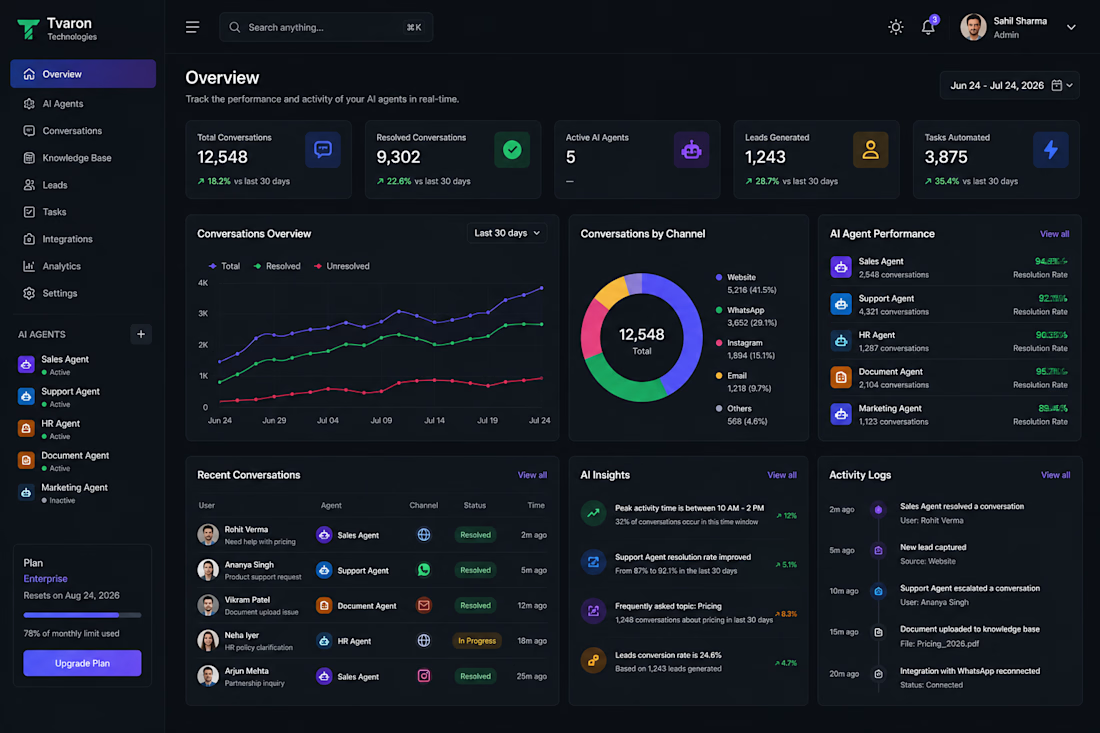
One thing we learned while building this dashboard: great AI products aren't just about the model, they're about presenting the right information in a way that teams can act on instantly.

One challenge after the knowledge layer is solved is proving the agent took the correct action—not just generated a plausible answer. I treat the path as a contract: grounded response → tool decision → explicit fallback → one server-side write/readback with an operation ID, so...
That's a great point. Generating the right answer is only half the problem being able to verify that the correct action actually happened is what builds trust. I like the idea of treating the execution path as a contract rather than assuming success from the model alone.
The network for creativity
Join 1.25M professional creatives like you
Connect with clients, get discovered, and run your business 100% commission-free
Creatives on Contra have earned over $150M and we are just getting started



Related posts

AI-Powered Physiotherapy Clinic Dashboard | Smart Appointment Scheduling
A modern AI-powered dashboard concept designed for physiotherapy clinics to simplify appointment scheduling, therapist management, and daily operations. The interface focuses on improving workflow efficiency with an intuitive calendar, smart booking experience, patient scheduling, and a clean visual system.
The design features an elegant and minimal UI, helping healthcare professionals manage appointments, therapists, and patient availability with ease. Every screen is crafted to deliver a fast, accessible, and user-friendly experience while maintaining a premium SaaS aesthetic.


so nice work

Hey everyone! 👋🏼
Curious to know what AI tools you guys use for image generation in art direction and creative projects.
I'm particularly interested in tools that can produce realistic, cinematic imagery, with strong control over lighting, textures, composition, and overall visual consistency.
Which tools have given you the best results? Would love to hear your recommendations and experiences! ✨

For Image gen, using magnefic and gemini pro.
I hear Higgsfield is insanely good for image gen, but it's costly though.

Resolve: an AI support agent that answers from a company’s own policies, looks up orders, and escalates weak matches to a human instead of guessing. A human approves replies before they go out.
Live demo: support-resolver.vercel.app


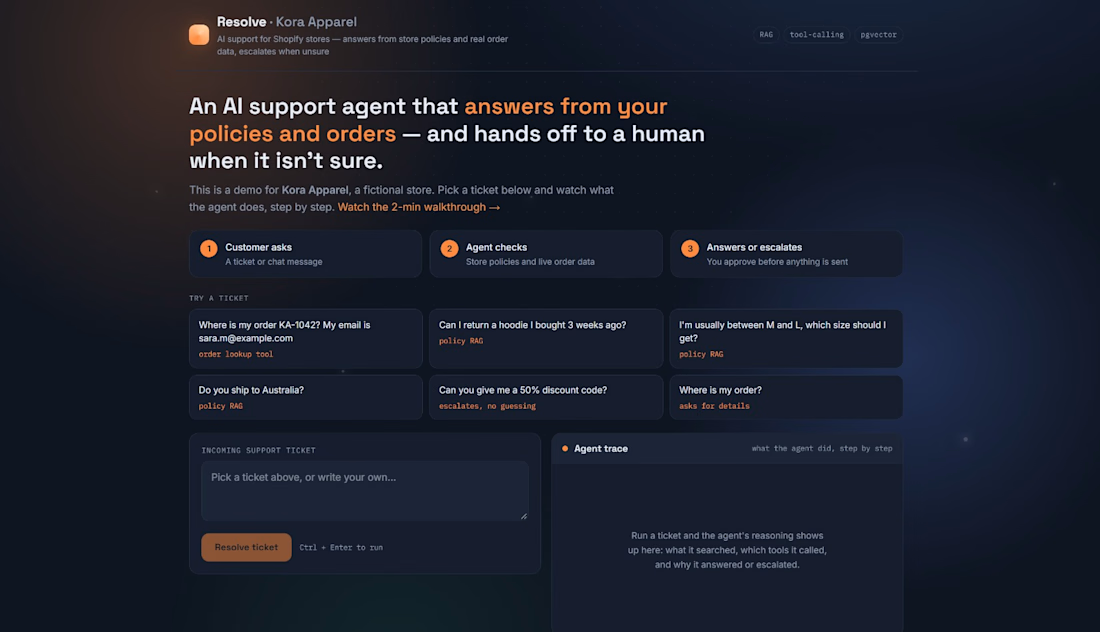

For the human approval step, I'd show the exact policy passage and its effective date beside the draft. Does Resolve flag a reply for re-review if the policy changes while it waits for approval?