The network for creativity
Join 1.25M professional creatives like you
Connect with clients, get discovered, and run your business 100% commission-free
Creatives on Contra have earned over $150M and we are just getting started
Back to feedPost

Tutorials teach you how to build an AI agent that works when the API is up.
They don't teach you what happens when the LLM hallucinates, the vector database times out, or the user asks something completely off-topic.
When I build RAG (Retrieval-Augmented Generation) support bots, the "happy path" is only 20% of the build. The other 80% is edge-case handling.
Here is the exact routing logic I use in n8n to keep AI systems from breaking silently in production:
🛡️ 1. The Guardrail Node:
Before the LLM even generates an answer, I check the similarity score from the vector database. If it’s below 0.8, the system is instructed not to guess. It immediately routes to a "I don't know" fallback. Zero hallucinations.
🔄 2. The JSON Validator Loop:
If I need the LLM to output structured data (like an order ID), I use a JSON validator node. If the LLM forgets a bracket or messes up the format, the workflow catches it, loops back, and feeds it a self-correction prompt.
👤 3. The Graceful Degradation (Human Handoff):
If the system fails 2 times in a row, it doesn't crash. It pauses the workflow, packages the user's entire chat history, and sends a Slack/Zendesk alert to the human ops team with the exact payload that failed.
Automation isn't just about making things run fast. It's about making sure they fail loudly and recover gracefully.
What is your go-to fallback strategy when LLM APIs act up in production? Let me know below 👇
#n8n #AIengineering #RAG #automation

I'd test the 0.8 cutoff against questions where a highly similar passage still lacks the requested fact. Do you validate that the passage supports the answer as well, or is similarity the only check before generation?
The network for creativity
Join 1.25M professional creatives like you
Connect with clients, get discovered, and run your business 100% commission-free
Creatives on Contra have earned over $150M and we are just getting started





Related posts

A strong specialist skill is useless if the wrong system gets invoked. Long-running AI work breaks in boring, expensive ways.
That is not a prompting problem. It is a routing and authority problem.
How I can help you:
I build project routers for teams using multiple AI workflows, agents, or specialist assistants so that they work with each other as a team.
I design source-of-truth resolutions so your agents retrieve the current rules instead of improvising or relying on assumptions or stale chat data.
I create reusable skill registries and specialist handoff logic hardened by determined and dedicated flow states reducing the need for model reliance on its own internal and displaced memory context.
I separate project states with individualized canonical states bound by rules living under essential model instructions and routed properly so unrelated workflows do not contaminate one another, but exist with awareness of the role each project plays, enabling a persistently growing ecosystem to develop organically.
I add governance wrappers, escalation hooks, and recovery mirrors around existing AI stacks so that trust is designed at the root, and variance is eliminated with rule based source archiving and implementation.
Trust means closing your eyes at night and sleeping soundly because your agents got your back. And I can put it all together for you, precision results sourced and undisputed because I got tired of doing things the hard way.
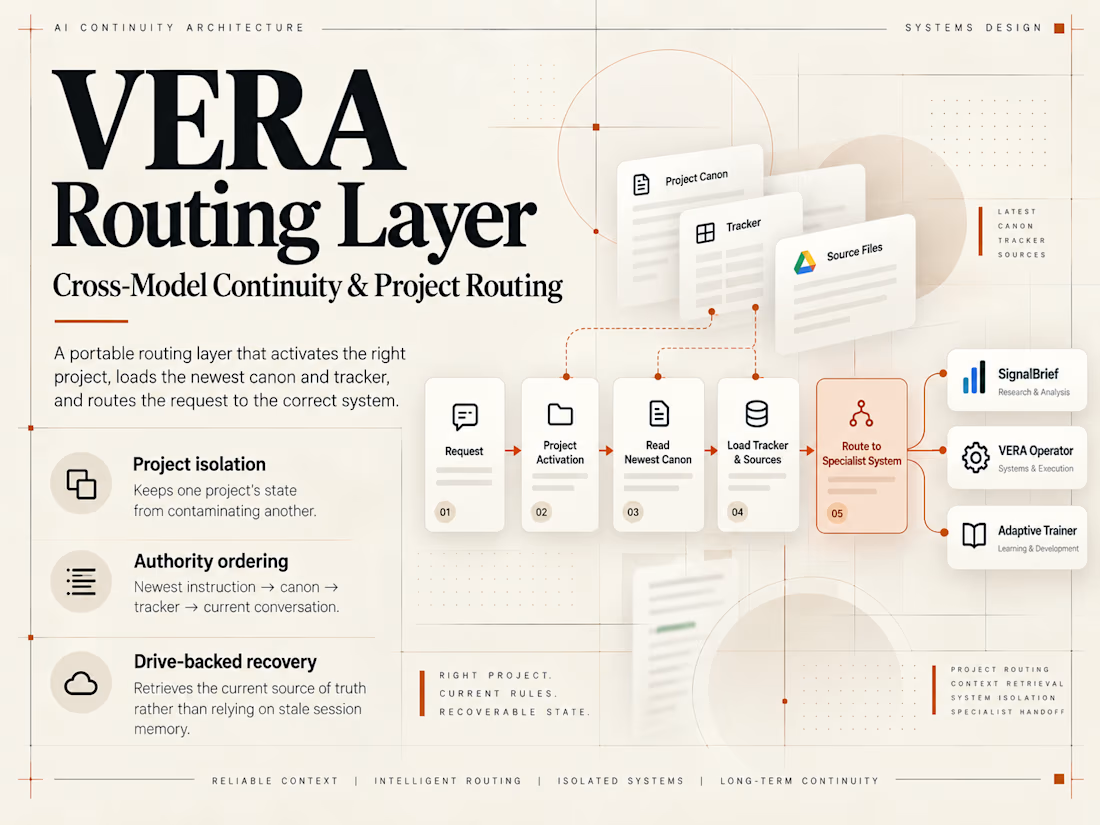

Phillip, agree that routing is where it breaks. In our builds the worst bugs came from an agent pulling an old rule from chat history instead of the current source. Pinning one source of truth per project fixed more than any prompt change did.


Turning complex AI workflows into a calm, monochrome experience, brought to life with motion. We'd love to hear your thoughts!


Then: 1 month, 1 template.
Now: 1 week, 15 templates.
Same designer, different workflow.
I wrote up how I built no-code.supply: fifteen website templates, each with its own brand, in HTML and React, and some in Framer too. Claude Code did most of the typing. I did the directing.

no-code.supply
How I built 15 website templates with an AI coding agent in a week
How I built 15 AI-ready website templates with Claude Code in a week: the workflow, the quality bar, and why a template is only the starting point.

Going from one template a month to fifteen a week is wild. How much of the design direction did you still do by hand?


