The network for creativity
Join 1.25M professional creatives like you
Connect with clients, get discovered, and run your business 100% commission-free
Creatives on Contra have earned over $150M and we are just getting started
Back to feedPost

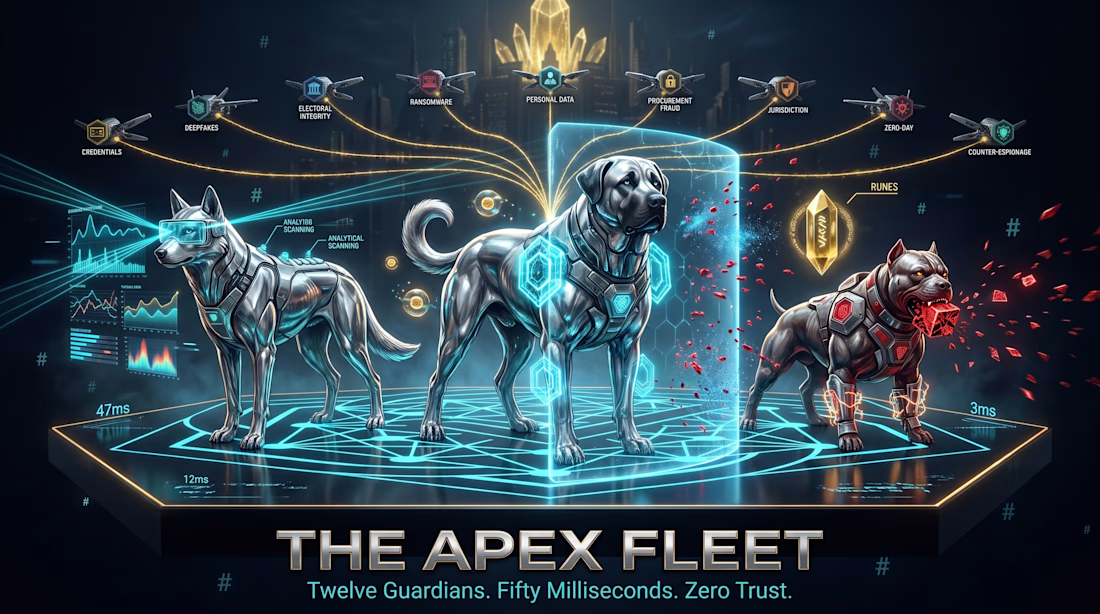
🐺 THE APEX FLEET — TWELVE GUARDIANS AT THE EDGE
Article 2 of 3: The active defense layer that watches, contains, and responds before the attack completes
WHEN GOVERNANCE IS NOT ENOUGH
The Certus Engine, described in Article 1, answers a fundamental question: what is allowed to happen? It is the sovereign kernel — the deterministic core that decides whether an operation may proceed, whether data may leave, whether an output may exist. Governance, in its purest form.
But governance alone does not win wars.
An institution operating artificial intelligence in production faces adversaries that do not respect policies. Attackers probe. Malicious actors inject. Compromised insiders exfiltrate. Automated bots crawl. Adversarial prompts arrive disguised as innocent requests. None of them ask permission — and none of them wait for the governance layer to convene.
This is the domain of the APEX Fleet: twelve specialized cybernetic guardian agents operating permanently at the edge of the infrastructure, with response latencies measured in milliseconds. Where the Engine decides what is legitimate, the Fleet ensures that what is illegitimate never gets the chance to try.
The Fleet is not a firewall. It is not an antivirus. It is not a monitoring dashboard that alerts humans who then react. It is an autonomous defense formation — detection, containment, isolation, evidence preservation, and recovery — executed in under fifty milliseconds, before the attack completes its first meaningful step.
THE PHILOSOPHY OF ACTIVE DEFENSE
Traditional security is passive. It builds walls and waits. When the wall is breached, the defenders discover the intrusion days, weeks, or months later — usually through a forensic investigation of damage already done.
The APEX Fleet inverts this model entirely. It assumes the perimeter will be tested continuously. It assumes some probes will succeed at the surface level. And it is architected so that surface success leads the attacker into a controlled environment where every movement is observed, every action is recorded, and every escalation is met by an autonomous guardian.
Three principles govern the Fleet:
First: observe behavior, not just signatures. Known attack patterns are trivial to evade. Behavior — the sequence, timing, and shape of actions — is far harder to disguise.
Second: never crash the mission. Defense that takes down production to stop an attacker has already lost. The Fleet contains threats without interrupting legitimate operations, even feeding deceptive information to advanced attackers while critical systems continue untouched.
Third: every response generates evidence. An attack that is stopped but not documented is an attack that will return. Every Fleet action produces signed, hashed, immutable records — feeding directly into the cryptographic audit chain described in Article 1.
WOLFDOG — THE BEHAVIORAL INTELLIGENCE SENTINEL
At the front of the formation stands Wolfdog: the analytical eye of the Fleet.
Wolfdog does not look for known malware or forbidden strings. Wolfdog learns. It builds a dynamic behavioral baseline for every user, every agent, every service in the institution — establishing what normal looks like for each identity, at each hour, in each context.
When a user who has never accessed administrative endpoints suddenly requests a bulk export at three in the morning, Wolfdog sees it. Not as a rule violation — as a behavioral deviation. When a series of individually harmless requests forms a slow, methodical exfiltration campaign spread across hours, Wolfdog correlates the sequence and recognizes the shape of the attack long before any single event would trigger an alarm.
Its specialties are pattern recognition, temporal correlation, and sequence analysis. It connects events that appear unrelated — a failed login here, an unusual API call there, an access at an impossible hour — into a single coherent picture of hostile intent.
Wolfdog rarely acts alone. It observes, concludes, and then commands: when its analysis crosses the confidence threshold, it hands the target to the next guardian in the formation.
KANGAL — THE PERIMITER GUARDIAN
If Wolfdog is the intelligence, Kangal is the shield.
Kangal is the force of immediate containment. Operating in under fifty milliseconds, it stands at every entry point — APIs, message queues, prompt interfaces, file uploads — and physically rejects what must not pass.
Its most famous capability is the malformed payload cage: a validation structure that destroys badly formed or maliciously crafted data at the edge, before it consumes processing resources, before it reaches any language model, and before it can trigger the interpreter vulnerabilities that so many AI pipelines inherit. Attackers send poison; the cage dissolves it at the door.
Kangal also specializes in prompt injection defense — the art of detecting instructions hidden inside seemingly innocent user input, designed to hijack the model's behavior. It recognizes the linguistic fingerprints of poisoning attempts and blocks them before they ever touch the governance layer.
But Kangal's most sophisticated tool is deception. It deploys honeytokens — fake credentials, synthetic records, simulated administrative endpoints — scattered deliberately across the environment. When an attacker touches one, two things happen instantly: the intrusion is confirmed beyond doubt, and the attacker's identity, method, and position are revealed. The honeytoken is not a trap that catches mice; it is a flare that illuminates the entire invasion route.
And against the most dangerous category of adversary — the advanced persistent threat already inside the walls — Kangal operates shadow mode. Instead of blocking the intruder and revealing that the defense knows, it feeds the attacker false logic, fabricated data, and simulated successes, keeping mission-critical systems running untouched while the real battle is observed, recorded, and understood.
PITBULL — THE INCIDENT EXECUTOR
Behind the intelligence and the shield stands the executor: Pitbull.
Pitbull activates only when the threat is confirmed. When Wolfdog's behavioral analysis converges with Kangal's containment evidence, Pitbull executes the response — decisively, irreversibly, and without hesitation.
Its actions are surgical. A compromised node is isolated from the fleet in milliseconds. Stolen or exposed credentials are revoked in cascade — not just the one key, but every derived token, session, and permission connected to it. The affected segment is frozen while the rest of the infrastructure continues operating normally.
Before isolation completes, Pitbull triggers the forensic snapshot: a complete, cryptographically sealed image of the compromised state — memory, logs, network position, attacker artifacts — preserved immutably for later analysis and legal proceedings. Evidence is never destroyed in the heat of response. It is captured first, contained second.
Finally, Pitbull notifies. The chief information security officer, the data protection officer, and the incident response chain receive encrypted, signed alerts through pre-established channels, carrying not raw telemetry but a structured incident report: what was detected, what was contained, what was preserved, and what requires human decision.
The complete five-step doctrine of the Fleet — detect, contain, isolate, preserve, notify — executes as a single continuous motion. Humans are informed of the outcome, not consulted during the emergency. By the time the notification arrives, the attack is already over.
THE NINE SPECIALISTS — DEPTH BEYOND THE TRINITY
Wolfdog, Kangal, and Pitbull form the command trinity — but the Fleet's full strength lies in its nine specialized agents, each dedicated to a specific class of institutional threat:
The credential guardian hunts theft of API keys and secrets, detecting their misuse in under fifty milliseconds regardless of where in the world they resurface.
The authenticity sentinel confronts governmental deepfakes — synthetic media impersonating public officials — verifying provenance through cryptographic identity proofs and coordinating takedown evidence.
The electoral integrity agent watches for manipulation of voting logs and civic records, protecting the chain of custody of democratic data.
The ransomware responder maintains the failover reflexes that keep institutions breathing when extortion attempts strike, ensuring continuity even during total primary system compromise.
The personal data guardian reacts to leakage attempts involving citizen identifiers and personal records, reinforcing the privacy shield at the exact moment it is under attack.
The procurement fraud analyst detects artificial intelligence being weaponized to rig public bidding processes — identifying synthetic patterns in proposals, pricing, and documentation that human auditors would need weeks to find.
The jurisdiction enforcer guards cross-border data flows, ensuring that information never migrates to a provider, region, or pipeline that violates the legal territory it belongs to.
The zero-day hunter manages cryptographic quarantine for previously unknown AI vulnerabilities, isolating unpatched attack surfaces until remediation is proven.
The counter-espionage operator runs active deception campaigns against corporate espionage, turning intelligence-gathering intruders into sources of misinformation about their own operation.
Each specialist operates with the same doctrine as the trinity: observe behavior, contain without crashing, preserve evidence, respond autonomously. Each communicates through zero-trust channels — every message mutually authenticated, every transmission encrypted end to end, every interaction recorded in the audit layer.
THE FLEET AS A SINGLE ORGANISM
The true power of the APEX Fleet is not any single agent. It is the formation.
The guardians do not operate as independent tools bolted together. They share a common nervous system: behavioral intelligence flows from Wolfdog to every specialist; containment capacity from Kangal backs every response; execution authority from Pitbull finalizes every confirmed engagement. A threat detected by the credential guardian is analyzed with Wolfdog's behavioral history, contained with Kangal's edge authority, and executed under Pitbull's doctrine — in one continuous motion, faster than any human team could coordinate.
And above all of it, every action — every observation, every block, every isolation, every deception — is signed and anchored into the cryptographic evidence chain of the governance kernel described in Article 1. The Fleet does not just defend. It testifies.
In the architecture of sovereign AI control, the Engine is the constitution. The Fleet is the enforcement. And together, they answer the question every regulated institution must ask before trusting artificial intelligence with its most sensitive operations:
Not "is the AI smart?" — but "who is guarding it, and can you prove what happened?"
The APEX Fleet is the answer. Twelve guardians. Fifty milliseconds. Zero trust. Complete evidence.
#Cybersecurity #AIGovernance #ActiveDefense #ZeroTrust #ThreatDetection #IncidentResponse #DataPrivacy #SovereignAI #InfoSec #DigitalSovereignty
This is Article 2 of 3. Article 1 covered the Certus Engine — the Sovereign Kernel. Article 3 will cover OMNI MATRIX V3 — the sovereign operating system that unifies the entire ecosystem.
© 2026 Certus Engine — Educatech AI Digital Sovereign
The network for creativity
Join 1.25M professional creatives like you
Connect with clients, get discovered, and run your business 100% commission-free
Creatives on Contra have earned over $150M and we are just getting started
Trending
retrofuturism
Share your favorite designs from the past exploring the distant future. Or your own take on the aesthetic 🚀
halftone
Dots. Texture. Grain. Let's see your designs using the halftone technique.

Midjourney
Creatives are showing off what they're making with Midjourney.
colorgrade
Video editors sound off: How do you enhance the mood of your video in color grading?





Related posts


Infrastructure security hero concept [alternative version]




Looking great with distorted art visual behind!

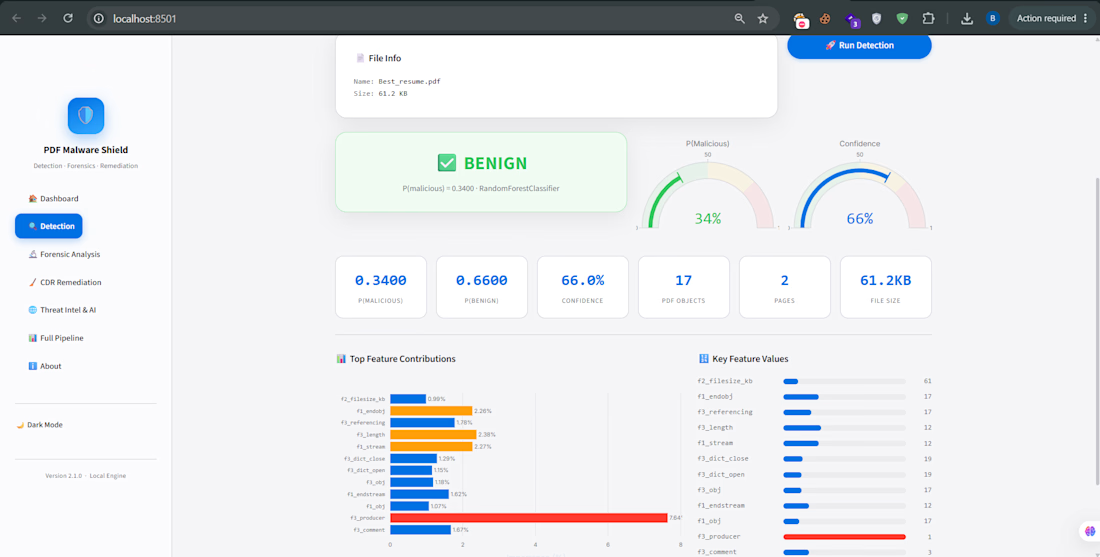
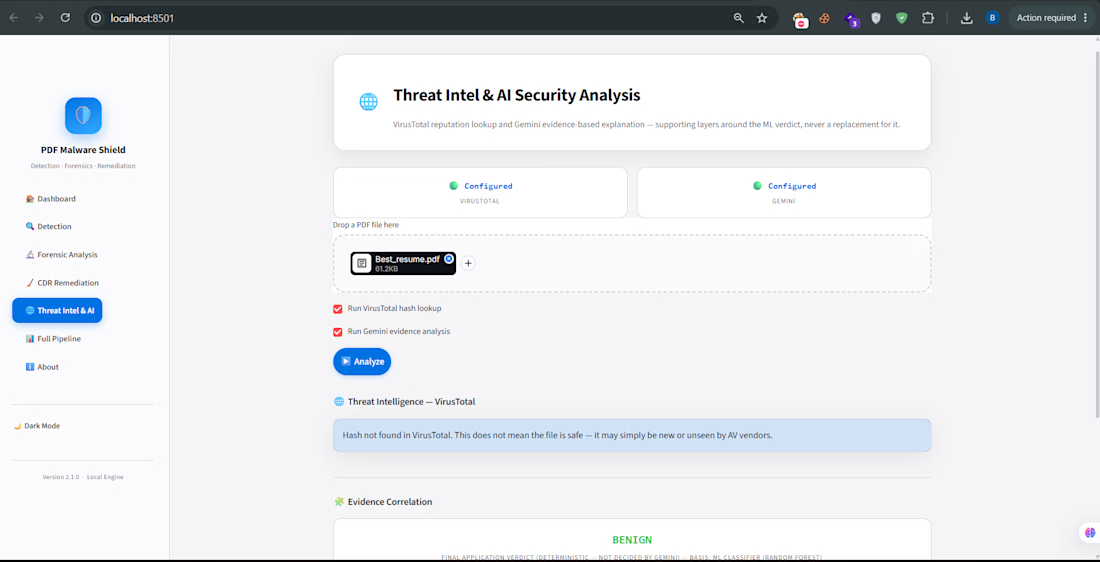
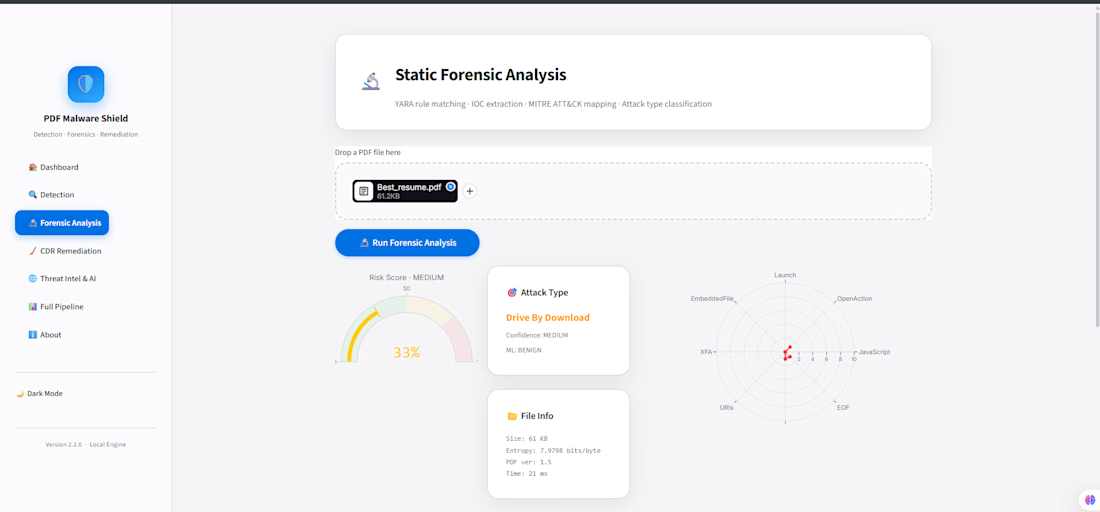
Exploring AI + Cybersecurity: Detecting Malicious PDFs
I'm currently working on an AI-based approach for detecting and analyzing malicious PDF files.
The project combines:
🔹 Machine Learning for malware classification
🔹 Feature extraction from PDF documents
🔹 Digital forensics and malware analysis
🔹 Explainable AI (SHAP) to understand why a model makes a prediction
One of the most interesting parts is making ML predictions more interpretable. Instead of simply saying a PDF is “malicious,” Explainable AI can help identify which features contributed to that decision.
I'm also building my skills in VAPT, penetration testing, SOC operations, SIEM, and threat detection.
Always learning, building, and looking for opportunities to apply cybersecurity in real-world projects.
#Cybersecurity #MalwareAnalysis #MachineLearning #ThreatDetection #VAPT #SIEM #AI