The network for creativity
Join 1.25M professional creatives like you
Connect with clients, get discovered, and run your business 100% commission-free
Creatives on Contra have earned over $150M and we are just getting started
Back to feedPost

The Leader’s Blind Spot: Why Most Organizations Fail at Strategic Alignment
"Strategic alignment is the most overused phrase in business and the least understood. Most leaders assume alignment is a natural byproduct of a good strategy. It isn’t. In fact, the default state of any organization is misalignment—and it spreads silently until it kills execution."
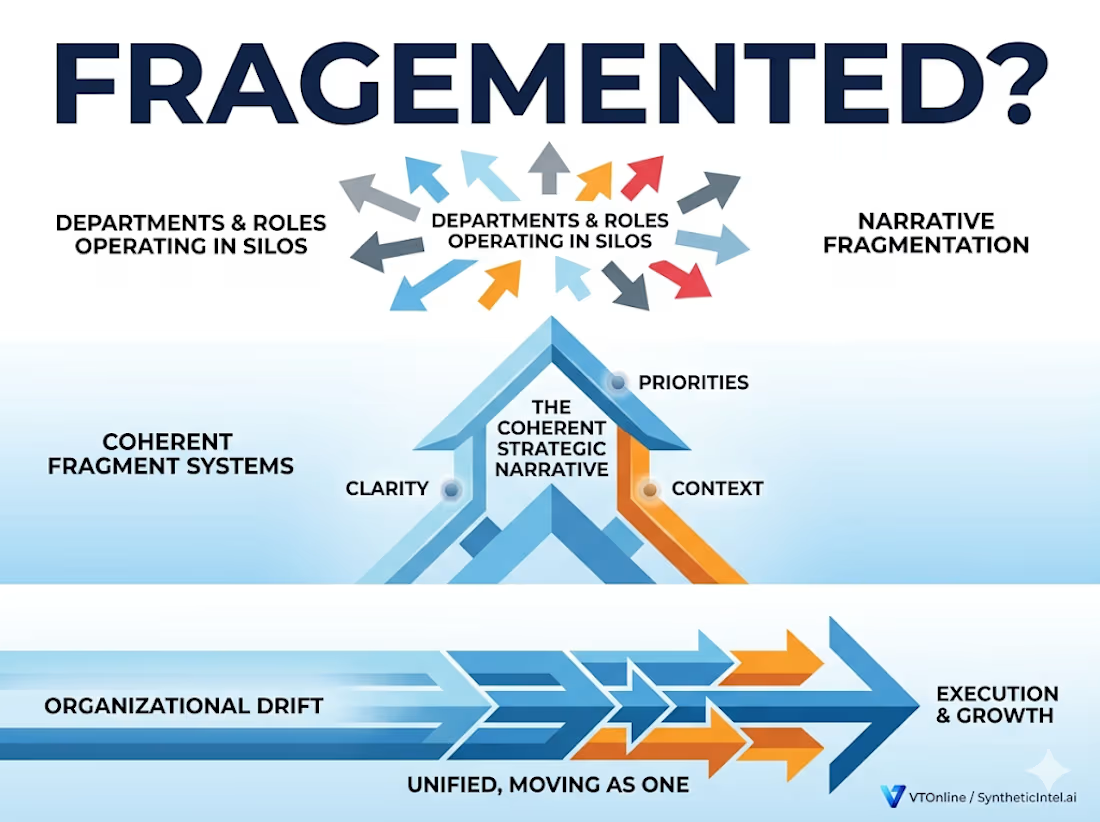
We’ve all seen it: Finance tells a story of cost control while Product tells a story of experimentation. When your teams are operating on fragmented narratives, your strategy becomes mere noise. You aren't failing because the plan is bad; you're failing because your organization is a narrative battleground of competing priorities.
" Alignment isn't a kick-off meeting; it’s a weekly discipline of Contextual Stitching. I’ve architected a deep dive into the "Leader’s Blind Spot," revealing how to move from the illusion of shared understanding to a unified strategic narrative that scales."
It is not passive. It is not the default state of an organization. In fact, the default state is misalignment — and most leaders don’t realize how quickly it spreads, how quietly it compounds, or how deeply it undermines execution.
The uncomfortable truth is this: organizations rarely fail because of poor strategy. They fail because of poor alignment around the strategy. And the root cause is almost always the same — a leadership blind spot around how humans interpret information, incentives, and narrative.
1. The Illusion of Shared Understanding
Most leaders assume that once a strategy is communicated, it is understood. But communication is not comprehension. A strategy that feels obvious to the executive team often feels abstract, distant, or irrelevant to frontline employees. The further a message travels down the hierarchy, the more it fragments.
This is not because employees are disengaged — it’s because humans interpret information through the lens of their role, pressures, and incentives. A product manager hears the strategy differently than a sales director. A customer success lead hears it differently than a finance analyst. Without deliberate translation, the strategy becomes a collection of competing interpretations rather than a shared mental model.
Leaders underestimate how much contextual stitching is required to turn a strategic idea into a unified organizational narrative.
2. Narrative Fragmentation: The Silent Killer of Alignment
Organizations are storytelling ecosystems. Every team tells a story about what matters, what success looks like, and how decisions should be made. When these stories conflict, alignment collapses.
A company may claim to prioritize innovation, but if:
Finance tells a story about cost control
Operations tells a story about risk avoidance
Marketing tells a story about speed
Product tells a story about experimentation
…then the organization becomes a narrative battleground.
Alignment requires one coherent story — a strategic narrative that every team can translate into their own context without distorting the core message. Without narrative coherence, even the best strategy becomes noise.
3. The Priority Paradox: When Everything Matters, Nothing Does
One of the most common leadership blind spots is the belief that more priorities create more progress. In reality, more priorities create more fragmentation.
When leaders articulate too many priorities, teams default to local optimization:
“What helps my department?”
“What protects my metrics?”
“What keeps my team safe?”
This is how organizations drift — not through dramatic failures, but through thousands of micro‑decisions made in isolation.
Alignment requires ruthless prioritization. Leaders must define:
What matters most
What matters next
What doesn’t matter at all
Without this clarity, teams fill the ambiguity with their own assumptions, and alignment dissolves.
4. The Missing Feedback Loop
Most organizations treat strategy as a one‑way broadcast: leadership speaks, the organization listens. But alignment is not a speech — it’s a conversation.
High‑alignment organizations build feedback loops that surface misalignment early:
Are teams interpreting the strategy correctly?
Are priorities understood the same way across functions?
Are decisions being made in alignment with the narrative?
Are incentives reinforcing or undermining the strategy?
Without feedback loops, leaders operate in an echo chamber. They assume alignment because no one is telling them otherwise. But silence is not alignment — silence is a lack of psychological safety.
5. Cognitive Bias: The Leader’s Hidden Enemy
Leaders often assume their perspective is the organization’s perspective. They underestimate how much context they possess and how little context others have. This creates a gap between intention and interpretation.
Leaders think in frameworks. Teams think in tasks. Leaders think in horizons. Teams think in deadlines. Leaders think in narratives. Teams think in deliverables.
Alignment is not achieved when leaders think clearly — it is achieved when everyone thinks clearly. And that requires leaders to decentralize understanding, not just delegate execution.
6. The Organizations That Get Alignment Right
The companies that master alignment share three traits:
A. They communicate strategy as a narrative, not a document.
They don’t rely on slides. They rely on story. They articulate:
the problem
the stakes
the opportunity
the path forward
the role each team plays
Narrative creates coherence. Coherence creates alignment.
B. They operationalize priorities with precision.
They don’t say “everything is important.”
They say “this is what matters now.”
They define:
the one priority that drives the next 90 days
the metrics that matter
the trade‑offs they are willing to make
This eliminates ambiguity and accelerates execution.
C. They build alignment as a continuous practice.
Alignment is not a kickoff meeting.
It is not a quarterly ritual.
It is a weekly discipline.
High‑alignment organizations:
revisit priorities
recalibrate narratives
reinforce context
adjust based on feedback
communicate relentlessly
Alignment is maintained through rhythm, not intensity.
7. The Leadership Imperative
In a world where complexity is rising and attention is shrinking, alignment is no longer a “nice to have.” It is a competitive advantage. It determines:
speed
clarity
execution quality
employee engagement
customer experience
organizational resilience
Leaders who master alignment build organizations that move as one — fast, focused, and confident. Leaders who ignore alignment build organizations that move in fragments — slow, confused, and reactive.
The difference is not strategy.
The difference is clarity.
The difference is narrative.
The difference is leadership.
SHARE or forward the full Executive White Paper: [Insert Bitly Link]
strategiccopywritingfintechdesignagenticarchitectureAI Agent EngineerAI AutomationAI Fact CheckingGoogle GeminiMuralsynthflow Ai




The network for creativity
Join 1.25M professional creatives like you
Connect with clients, get discovered, and run your business 100% commission-free
Creatives on Contra have earned over $150M and we are just getting started
Related posts


I created a Solana-focused crypto wallet app designed to make managing digital assets feel clearer, calmer, and more premium. The app lets users track their portfolio, view live market prices, swap tokens via Jupiter, and send or receive assets, with real-time data powered by Alchemy, CoinMarketCap, and Helius.
A big part of my process was using @mobbin for inspiration and UI research. I studied premium fintech patterns, interaction flows, and visual hierarchy, then translated those ideas into a product that feels polished, intuitive, and trustworthy.
Building it with @Anything made the process much faster and smoother, and the final result is fully responsive.
Really enjoyed this one 💛
Project: https://crypto-wealth-management-ap-502.created.app



Impressive work!!

Brands like Gap are showing that the strongest content today does more than showcase products, it turns fashion into entertainment.
I explored that idea by making a spec piece on my Super 8 camera, not just as a camera, but as an extension sitting at the intersection of tech, style, nostalgia, and utility.
But the bigger point for me as a creative strategist is this: good content direction is not about choosing what looks cool, it is about choosing what communicates best. Knowing when a concept calls for something cinematic, elevated, and story-led vs when it should feel lo-fi and socially native, goes a long way. Creative that performs is rarely accidental. The visual language, tone, pacing, and format all shape how a brand is perceived and how a viewer feels. When those choices are intentional, the message gets stronger.


The Super 8 as a creative extension not just a camera tool — that framing is everything. Intentional creative direction is what separates content that performs from content that just exists.


Brand awareness is not your problem
Every week I talk to a founder who tells me "We need more brand awareness." And every week I ask the same question: "What happens when someone actually lands on your site?"
Silence. Or worse is they already know the answer. The site looks like it was built by a different company than the one they describe on sales calls.
If you're Series A to C your problem is what happens after they find you. The credibility gap, where your product has outgrown your brand, and every surface a prospect touches (like your site, your deck, your onboarding) quietly undermines the trust your sales team just spent 45 minutes building.
Pouring money into awareness when these surfaces don't convert attention into trust is like turning up the volume on a broken speaker.
Fix the gap first


Real great Example of viewing the problem from a structural angle... Love the last analogy "Turning up the volume of a broken speaker"...
















Trending


Figma Make
Go from idea to prototype in minutes. What are you designing?
brandguidelines
Brand guidelines are becoming living systems, not static documents. What are you building for your clients?
aivideo
AI video tools are moving at warp speed. Which ones are you experimenting with?
illustration
Handcrafted illustration is bubbling up across the web. What are you drawing lately?
freelancerlife
Freelancer life is wins, pivots, and everything in between. What’s yours right now?