The network for creativity
Join 1.25M professional creatives like you
Connect with clients, get discovered, and run your business 100% commission-free
Creatives on Contra have earned over $150M and we are just getting started
Back to feedPost

"Product designer" is quietly splitting into two different jobs.
One delivers screens. Beautiful, well-organized, on-brand screens — handed off to someone else to figure out if they were the right screens at all.
The other delivers judgment, with proof attached: the research behind the decision, the prototype that tests it, sometimes the code that ships it.
For most of my career, the first job was enough. I don't think it is anymore.
So over the past year I rebuilt how I work. AI in my research workflow — not to generate designs, but to synthesize signals I'd never have time to read manually. Prototyping in code.
And speculative work: this year I redesigned Linear's project architecture without anyone asking — research across community threads and 74 G2 reviews, three redesigned surfaces, and an honest list of what I'd still need to validate.
Not because Linear needed my help. Because "trust me, I'm a designer" stopped working — and showing your judgment on a real problem is the only alternative I know.
If you're hiring a designer: this split is already happening. Decide which one you're actually looking for — and write the brief for that one.
Full Linear case study: https://bozenabulat.com/projects/scaling-linear-project-architecture
bozenabulat.com
Scaling Linear’s Project Architecture
A speculative case study using AI-augmented research to diagnose and address a systemic scalability problem in Linear’s project architecture.
The network for creativity
Join 1.25M professional creatives like you
Connect with clients, get discovered, and run your business 100% commission-free
Creatives on Contra have earned over $150M and we are just getting started







Related posts

This is the kind of AI workflow that gets me excited as an independent developer.
Faster ideation, faster prototyping, and more room to focus on turning ideas into real products. 🚀


What does sketch to shippable actually look like in real time? 🎥
Honestly, I went in doubting it, and came out convinced, for early concepting at least. 🤔 I recorded the whole process, doodle to final.
Calling all desginers to run it on your own idea and drop the result below....

Being an independent designer means you're also your own toughest critic – no one else is going to catch it if you don't.
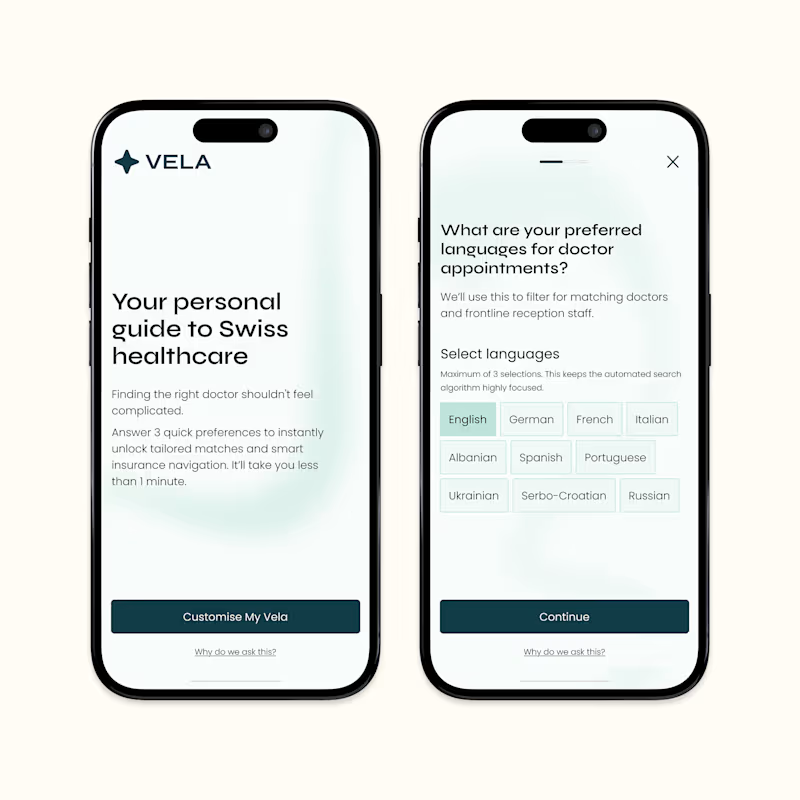
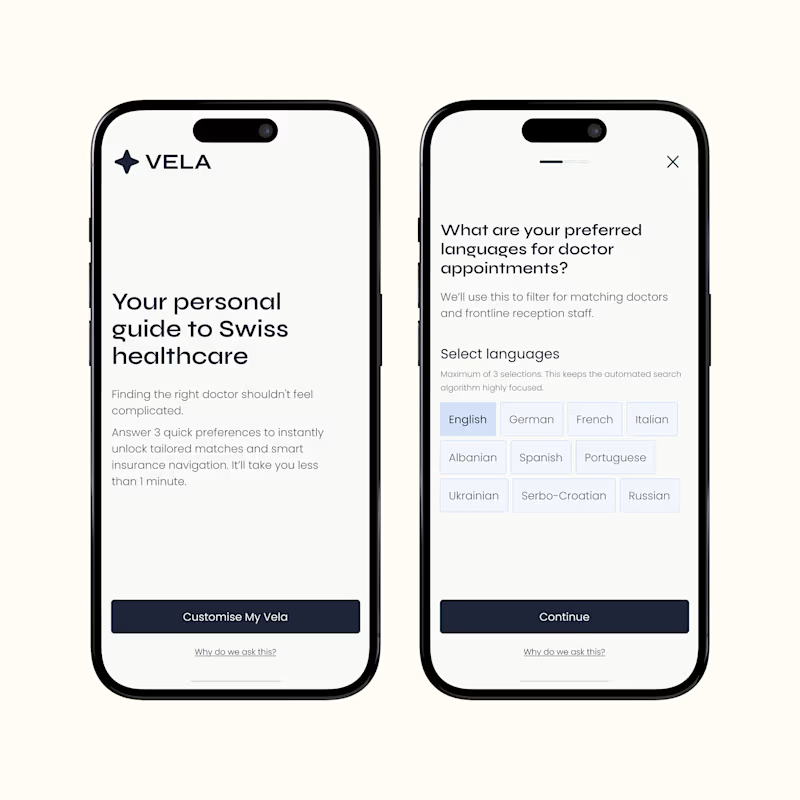
Self-initiated projects give you all the freedom, meaning you can create close-to-perfect work that you think people would love to use. Vela is an app for making doctor appointments and getting insurance guidance with AI assistant. When I started designing it, I wanted it to feel trustworthy and knowledgeable, but also warm, like a friend who explains things without judging you.
Looking back at the initial teal version, I think it landed closer to "doctor's office" than that. Tried a version with less clinical colour, more personality, leaning towards "tech" rather than "health".
Curious what actually reads as more trustworthy to you: A or B?
7 voted
50%
7 voted
50%
14 votes
Closed

version B