The network for creativity
Join 1.25M professional creatives like you
Connect with clients, get discovered, and run your business 100% commission-free
Creatives on Contra have earned over $150M and we are just getting started
Back to feedPost

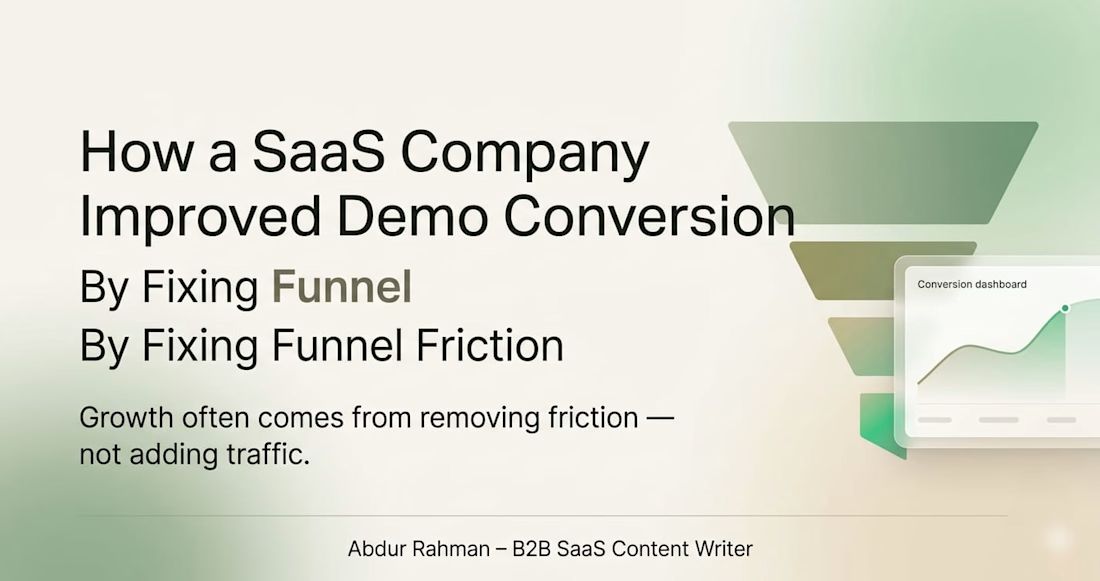
How a SaaS Company Improved Demo Conversion by Fixing Funnel Friction
For many SaaS companies, weak demo conversion is often blamed on traffic quality.
The assumption is simple.
●Bring in better leads.
●Increase ad spend.
●Generate more demand.
But sometimes the problem is not demand.
■It is friction.
And friction inside the funnel can quietly suppress growth.
This case study explores how improving conversion often comes less from finding more traffic and more from fixing what happens after prospects arrive.
The Challenge
A growing SaaS company was generating consistent inbound traffic.
●Traffic volume was not the issue.
●Interest existed.
●The concern was what happened next.
●Demo requests underperformed relative to traffic.
●Pipeline growth was slower than expected.
●Customer acquisition costs were rising.
●Leadership initially considered increasing acquisition spend.
But a closer look suggested the problem might sit deeper in the funnel.
Diagnosing the Friction
Rather than assume lead quality was weak, the team audited conversion friction.
Three issues surfaced.
Demo Booking Form Complexity The request form asked for too much. ●Multiple fields. ●Unnecessary information. ●Additional steps.
Prospects were dropping before submission.
The team suspected the form itself was suppressing intent.
Weak Proof Near Conversion The demo page explained features. It did little to build confidence.
●Limited proof.
●Few trust signals.
●Minimal customer validation.
For higher-consideration purchases, that mattered.
Slow Follow-Up After Inquiries Even submitted requests were not always handled quickly. Momentum was often lost after initial interest. That created hidden leakage.
The Optimization Strategy
The company focused on improving friction rather than increasing traffic.
Change One: Simplifying the Demo Form
The form was reduced to essential fields.
●Fewer steps.
●Less resistance.
●Clearer path to action.
A relatively small operational change.
Potentially meaningful impact.
Change Two: Strengthening Trust Signals
The team added:
Customer proof
Outcome-focused messaging
Stronger social validation
The goal was simple.
Reduce uncertainty.
Change Three: Improving Response Speed
Follow-up processes were tightened.
●Lead handoff became faster.
●Response lag decreased.
●The team treated speed as part of conversion.
●Not a separate operational issue.
That shift mattered.
What Happened
Over the optimization cycle, demo conversion improved.
Pipeline quality improved.
Acquisition efficiency improved.
Importantly, those gains came before increasing paid spend.
Same demand.
Better performance.
Why This Worked
Because the problem was not primarily traffic.
It was friction.
And friction often hides in ordinary places.
1.Forms.
2.Messaging.
3.Process delays.
Things teams overlook because they seem small.
Yet they can materially affect economics.
Broader Lesson for SaaS Teams
Many companies treat growth as an acquisition problem first.
Sometimes it is a conversion problem first.
1.That distinction matters.
2.If funnel friction suppresses demand capture, buying more traffic can simply scale inefficiency.
3.Fixing friction first often creates leverage.
Areas Worth Auditing in Your Funnel
If demo conversion feels weak, review:
Form complexity
Conversion page messaging
Trust signals
Response speed
Follow-up consistency
Often the opportunity is hidden in one of those places.
Common Mistake
One mistake growth teams make is assuming underperformance always signals weak traffic.
1.Sometimes the traffic is good.
2.The system handling that traffic is weak.
3.Those are different problems.
4.And they require different solutions.
Final Takeaway
This case reinforces a simple principle.
1)Growth does not always come from more demand.
2)Sometimes it comes from capturing existing demand more effectively.
3)And in SaaS, small reductions in friction can create disproportionate impact.
That is often where meaningful growth begins.


The network for creativity
Join 1.25M professional creatives like you
Connect with clients, get discovered, and run your business 100% commission-free
Creatives on Contra have earned over $150M and we are just getting started
Trending
retrofuturism
Share your favorite designs from the past exploring the distant future. Or your own take on the aesthetic 🚀
halftone
Dots. Texture. Grain. Let's see your designs using the halftone technique.

Midjourney
Creatives are showing off what they're making with Midjourney.
colorgrade
Video editors sound off: How do you enhance the mood of your video in color grading?




Related posts


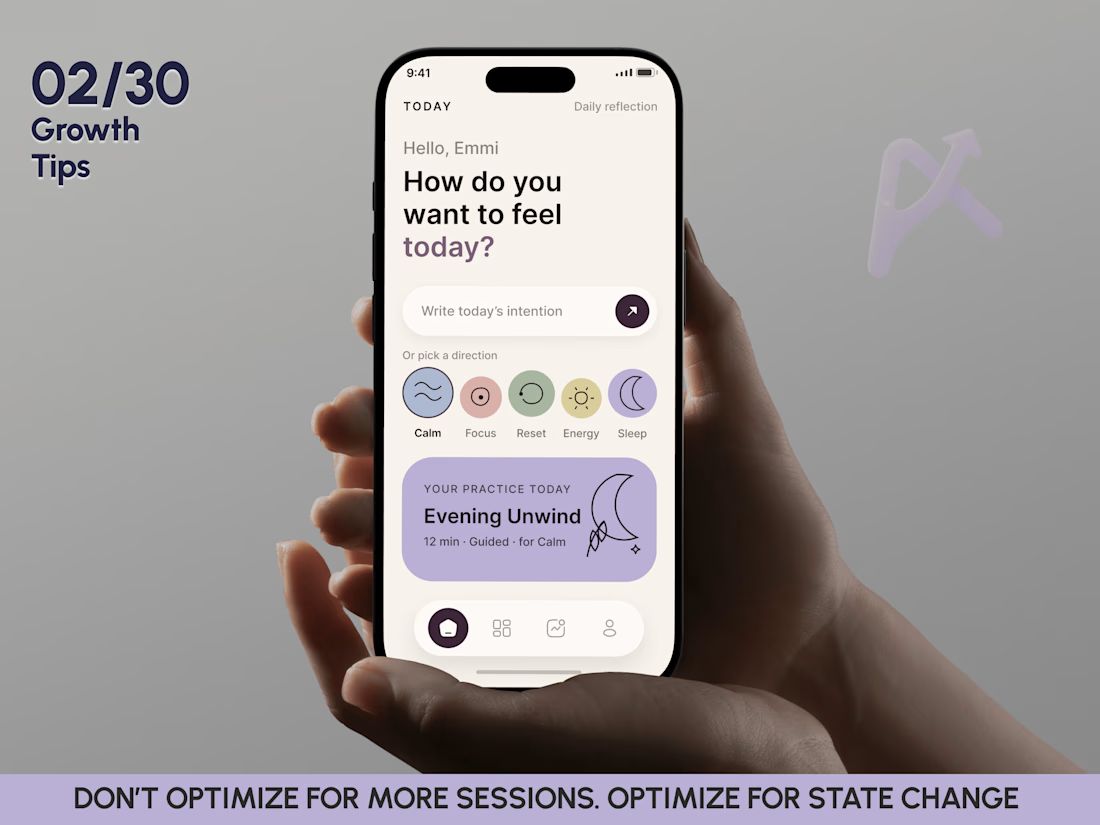
🧠 GROWTH TIP 02/30: OPTIMIZE FOR STATE CHANGE, NOT SESSION COMPLETION
A meditation session can be completed and still create zero product value. For this wellness product, we changed the growth logic from content consumption to state change.
The framework:
Signal → Selection → Shift → Proof → Adaptation
SIGNAL
We identified what the user actually needed in the moment.Calm. Focus. Reset. Energy. Sleep.
SELECTION
Instead of pushing users into a library of sessions, we reduced choice friction and surfaced one relevant next action.
SHIFT
We measured whether the recommended practice actually moved the user toward the desired state.
The key metric became: State Shift Rate Successful desired state changes divided by completed recommended sessions.
PROOF
I showed users what was actually working for them.
Stress ↓18% after Evening Unwind
Best time: 8:30 PM
Insights stopped being passive analytics and became part of the retention loop.
ADAPTATION
Every completed outcome improved the next recommendation.
The loop became:
Intent → Recommendation → State Change → Proof → Better Recommendation → Repeat Use
📈 RESULTS
35% faster Time to Confident Choice
25% higher recommendation acceptance
20% higher repeat practice rate
15% lift in 30 day retention
25%+ improvement in successful state shifts as personalization learned
💡 GROWTH INSIGHT 02
The biggest shift was not getting users to complete more sessions It was increasing the percentage of sessions that actually delivered the outcome users came for.
More sessions did not create the growth. Better outcomes did.
That is when a wellness app stops behaving like a content library and starts becoming a product that learns what actually works for each user.
#MobileAppGrowth #ProductGrowth #WellnessApp #MeditationApp #Retention #Personalization #BehavioralDesign #MobileUX #ProductStrategy #AsolDesign


Nice App

Developed a high-end promo visual presentation for a luxury lipstick collection. The main objective was to showcase product shades and texture while pairing them with compelling, emotion-driven product descriptions designed to drive engagement and visual appeal.
Scope of Work & Strategy
Persuasive Copywriting: Authored elegant, benefit-focused messaging highlighting formula quality, skin versatility, and confidence.
Visual Styling & Art Direction: Curated a sophisticated color story using deep burgundy and soft rose silk textures to communicate luxury.
Content Presentation: Structured high-impact visual slides featuring real-life shade swatches and textured product shots.


we recently shipped for CraftedStays
most teams would've turned this into a straightforward feature walkthrough
we took a different approach
before touching a single frame, we went deep into the product
not just what it does, but why it needed to exist
that's the part clients rarely see- the research, the back-and-forth, and the process of truly understanding a product
that's also how we onboard every client
it's part of why our client onboarding success rate sits at 90%
understanding the product deeply enough to explain it simply


Love your videos😍