The network for creativity
Join 1.25M professional creatives like you
Connect with clients, get discovered, and run your business 100% commission-free
Creatives on Contra have earned over $150M and we are just getting started
Back to feedPost

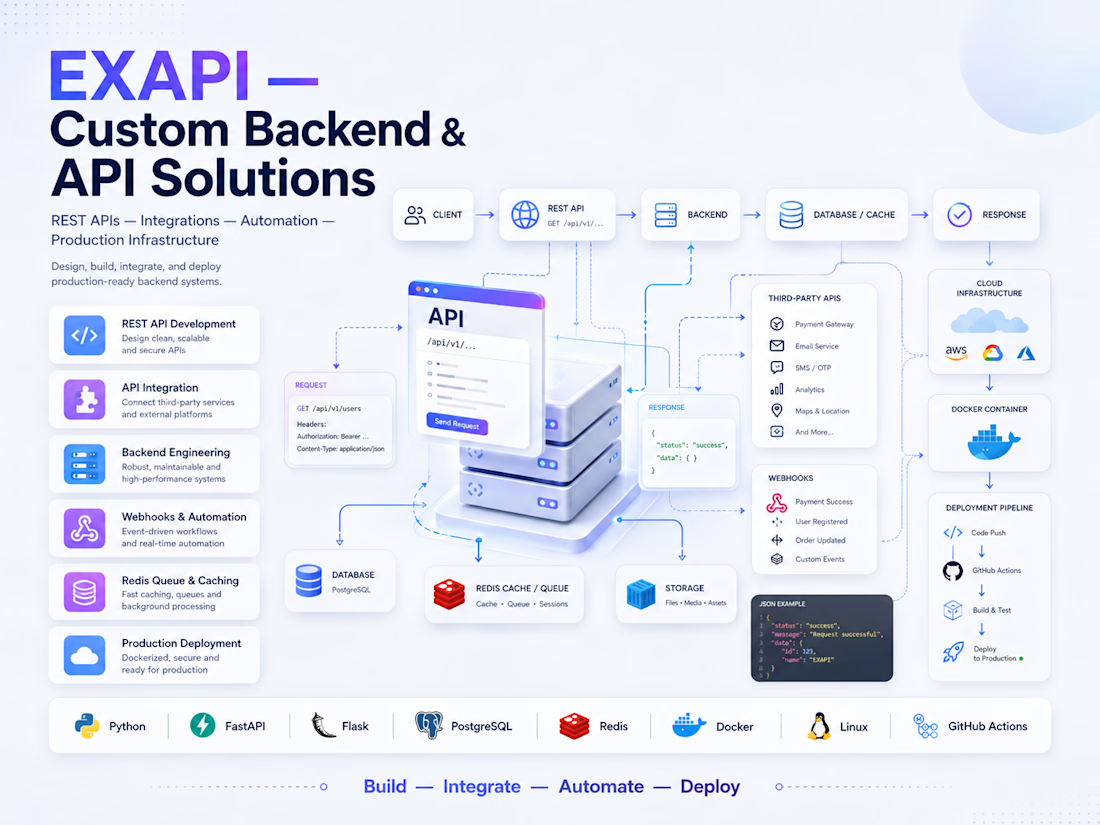
EXAPI - Public Media Processing API with Sub-100ms Global Response Times
I built and maintain EXAPI, a public REST API that lets developers download and process media from major platforms through a single, unified endpoint, with live, interactive documentation so anyone can test it directly from the docs, no separate playground needed.
Platforms supported:
Instagram, TikTok, Smule, Spotify, X (Twitter), Facebook, Threads, and CocoFun.
What makes it production-grade:
Lightning fast - sub-100ms response times globally, achieved through an API-based architecture I re-engineered from an earlier, less stable headless-browser automation approach.
Bank-grade security - enterprise-level protection on every call, including Bearer token authentication.
Infinite scale - built to handle high-volume traffic without breaking, backed by a Redis-based message queue and dispatch system that prevents message/data loss under load.
Under the hood: Python, FastAPI/Flask, PostgreSQL, Redis, deployed on production Linux VPS infrastructure with Nginx, Docker, and CI/CD via GitHub Actions, monitored and maintained by me directly for uptime and incident response.
Proof it works at scale: EXAPI is the same infrastructure powering three of my self-funded consumer products (TikTok, Smule, and Starmaker downloaders), serving real user traffic, not just a demo API.
Full interactive docs: docs.execross.com


The network for creativity
Join 1.25M professional creatives like you
Connect with clients, get discovered, and run your business 100% commission-free
Creatives on Contra have earned over $150M and we are just getting started



Related posts

Resolve: an AI support agent that answers from a company’s own policies, looks up orders, and escalates weak matches to a human instead of guessing. A human approves replies before they go out.
Live demo: support-resolver.vercel.app




For the human approval step, I'd show the exact policy passage and its effective date beside the draft. Does Resolve flag a reply for re-review if the policy changes while it waits for approval?

🚀 The Future of Web Design Is Here! 💻✨
Modern websites are more than just good looks — they combine clean UI, smooth animations, responsive layouts, interactive features, and a great user experience.
🔥 Features that make a website stand out:
✅ Modern and clean design
✅ Smooth scrolling animations
✅ Fully responsive layouts
✅ Interactive buttons and cards
✅ Dark and light mode
✅ Fast, user-friendly experiences
At TechGroup, I’m focused on building clean, responsive websites that help modern businesses stand out online.
💼 Need a professional website for your business? Let's connect!
#WebDevelopment #FrontendDeveloper #WebDesign #JavaScript #ResponsiveDesign #TechGroup #Portfolio #UIDesign



Is this AI generated?

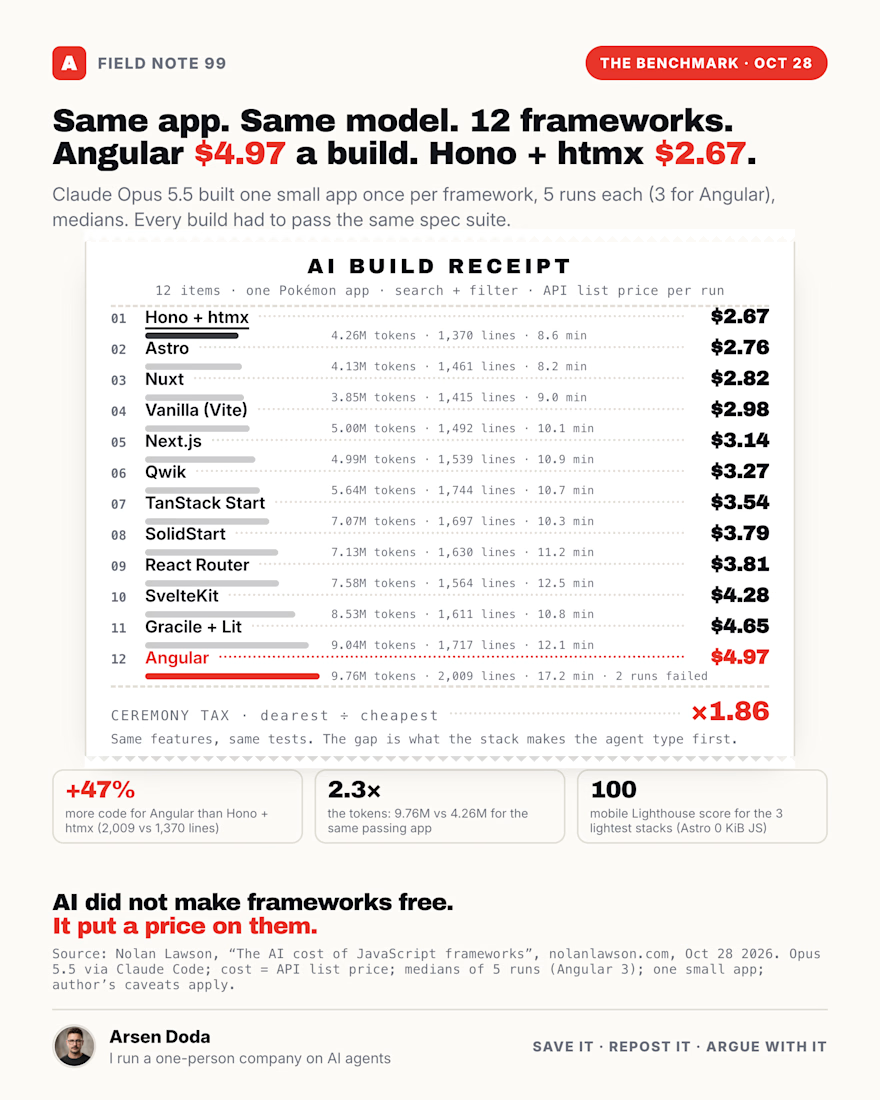
Same app. Same model. Same spec.
Built with Angular, it cost $4.97 per run. Built with Hono + htmx, $2.67.
The framework you pick is now a line on your AI bill.
Nobody budgets for this yet. Here is the data.
Nolan Lawson (engineer at Socket, the PouchDB maintainer) had Claude Opus 5.5 build the same small Pokémon app 12 times over, once per framework, 5 runs each (3 for Angular), medians reported.
Every build had to pass the same spec suite.
→ Cheapest: Hono + htmx, $2.67, 4.26M tokens, 1,370 lines, 8.6 min
→ Astro $2.76 · Nuxt $2.82 · plain Vite $2.98
→ Next.js $3.14 · React Router $3.81 · SvelteKit $4.28
→ Most expensive: Angular, $4.97, 9.76M tokens, 2,009 lines, 17.2 min
→ Source: nolanlawson.com, Oct 28 2026. Two Angular runs failed the spec and were counted as failures.
The gap is not the model. It is the ceremony.
Angular made the agent write 47% more code for the same features. More code costs tokens twice: once to write it, once to re-read it on the next change.
Plain Vite was not the cheapest. No framework means no conventions, so the agent invents its own, and that costs tokens too.
The cheap column was also the fast column. Astro, Hono + htmx and Lit all scored 100 on mobile Lighthouse with almost no JavaScript shipped.
Why it works that way:
An agent pays for every file it opens.
Config, boilerplate, framework docs, a second read after each error.
Less ceremony is fewer pages before the first useful line.
Call it the ceremony tax: everything your stack makes the agent type before it ships a feature.
I run a one-person company on AI agents. Most of my code is written by them now, and I watch tokens per task the way I used to watch cloud bills. The same feature costs me very different amounts depending on which codebase the agent is standing in.
If agents write your code, the framework is no longer a developer-experience choice. It is a unit cost.
Rule 1: Measure tokens per task, not per month. A monthly bill hides which stack is burning it.
Rule 2: Pick the stack the agent types least in. Fewer lines written today is fewer lines re-read tomorrow.
Rule 3: Cheap must still pass the spec. Every run here cleared the same tests and Lighthouse; cheaper and better landed in the same column.
One small app, one model, one author's benchmark, and the author says so himself. Treat it as a pattern, not a law. The direction matches what I see every day.
Angular is good software. I mean that. It was built for teams of humans.
AI did not make frameworks free.
It put a price on them.
For an agent-built app, would you go Minimal or Batteries? One word is enough. 👇