The network for creativity
Join 1.25M professional creatives like you
Connect with clients, get discovered, and run your business 100% commission-free
Creatives on Contra have earned over $150M and we are just getting started
Back to feedPost

Most React/Next.js apps become slow after six months, due to scalablity and architecture decesions.
I have came across for the same on Enterprise STC project and helped to ship from 12s to 4s using Web Optimization Technique
They usually come from small decisions that accumulate over time:
1. Unoptimized rendering
2. Large component trees
3. Unnecessary API requests
4. Heavy client-side bundles
5. Inconsistent state management
6. Unuesed techniques of React Perrformance
7. CDN and Caching
8. Bundler & Core web vitals
On one enterprise telecom platform serving over 2 million users, I help team to reduced page load time from around 12 seconds to about 4 seconds by focusing on architecture, rendering strategy, and bundle optimization rather than chasing micro optimizations.
Good frontend performance is usually the result of dozens of small engineering decisions, not a single optimization.
If you are scaling a React or Next.js application, performance should be part of the architecture, not an afterthought.
I would like to connect.
Here is link - https://contra.com/p/6FELo2MA-enterprise-telecom-platform-or-stc-kuwait-or-nextjs-and-react?referralExperimentNid=DEFAULT_REFERRAL_PROGRAM&referrerUsername=amit_maurya_oulsg93o


The network for creativity
Join 1.25M professional creatives like you
Connect with clients, get discovered, and run your business 100% commission-free
Creatives on Contra have earned over $150M and we are just getting started











Related posts


How fast can a template get without changing a single pixel?
⠀
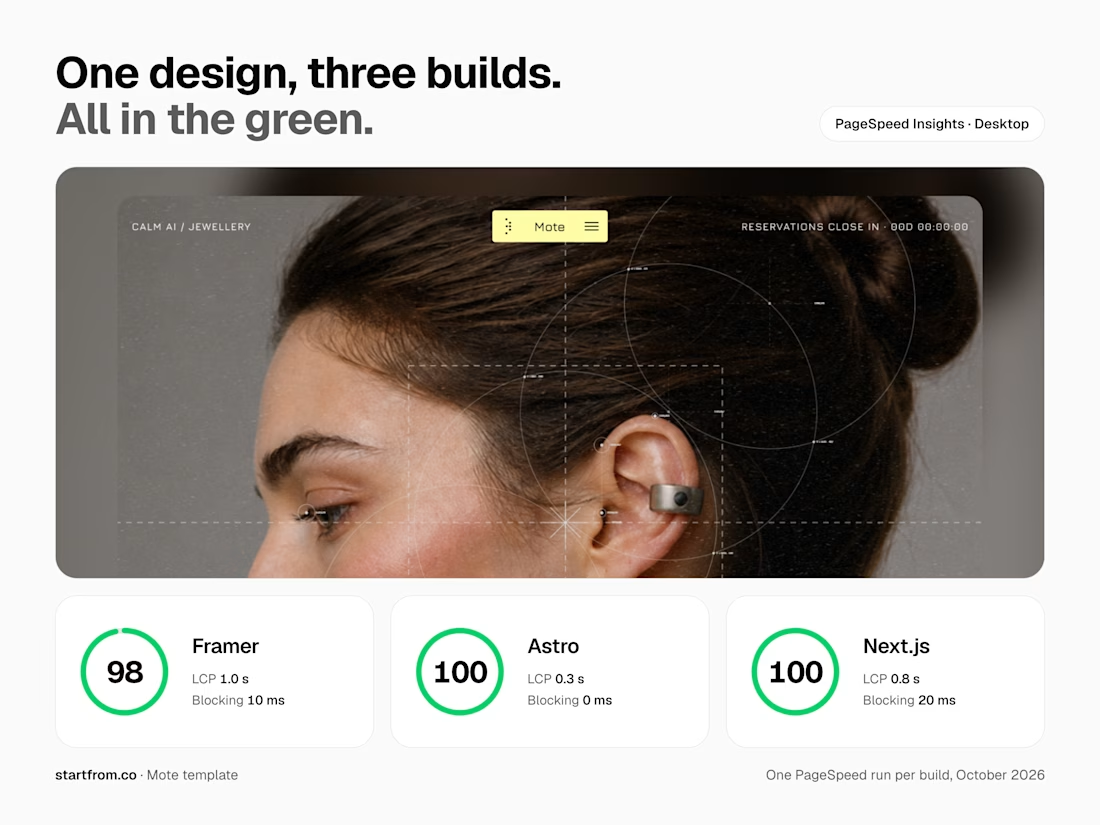
We just optimized 11 of our templates in Framer, Astro and Next.js. The rule was simple: nothing visible changes, only how things load.
⠀
What we changed: CSS inside the page, fonts from our own domain instead of Google Fonts, WebP images with phone-sized copies, videos that load when you scroll near them, heavy videos re-encoded without visible loss (one template went from about 20 MB of video to 2.4 MB), WebGL that starts near the screen, and analytics after the page. Every page was checked pixel by pixel at three widths before and after.
⠀
Mobile PageSpeed now, Astro / Next.js:
Sunbeam 100 / 100
Auria 100 / 96
Lapse 97 / 98, up from 64 / 66
Parley 97 / 94
Nova Quinn 93 / 92 ⠀
On desktop, Mote scores 98 in Framer and 100 in Astro and Next.js.
More posts on the individual fixes coming.



Nothing visible changes, only how things load is such a good rule. Speed work like this is underrated, buyers feel it even if they can't see it.

This is my biggest client success story of my carreer.
It's hard to capture 3+ years of work into a single use case page.
Though I gave it a try (it's never perfect 😉)
Read the use case here and let me know what you think of the work. Thanks!🤙🏻

Distilling three years of multidisciplinary work into one use case page is the real craft here, Tim. Long-term client relationships are the best portfolio proof there is. Congrats on the DeFi brand journey.


Nobody wakes up excited to measure a room 😂. At least we tried to make it look good while you do it. Did we succeed?


