The network for creativity
Join 1.25M professional creatives like you
Connect with clients, get discovered, and run your business 100% commission-free
Creatives on Contra have earned over $150M and we are just getting started
Back to feedPost

New case study: Prefill
I used Claude Code + Paper.design to generate an MVP for a software that autofills job applications using multi-profile data. Functional in hours. But functional isn't designed.
The AI added a sidebar for 2 pages (21% of screen space, wasted), required 30+ clicks for a 15-field form, and opened full pages for single-field additions.
I stripped all of it back. Removed the sidebar, scoped every action to its context, and built a browser extension on top: 3 clicks to fill any form, regardless of field count.
Full breakdown here: Prefill — Autofill That Understands Who You Are
The network for creativity
Join 1.25M professional creatives like you
Connect with clients, get discovered, and run your business 100% commission-free
Creatives on Contra have earned over $150M and we are just getting started



Related posts

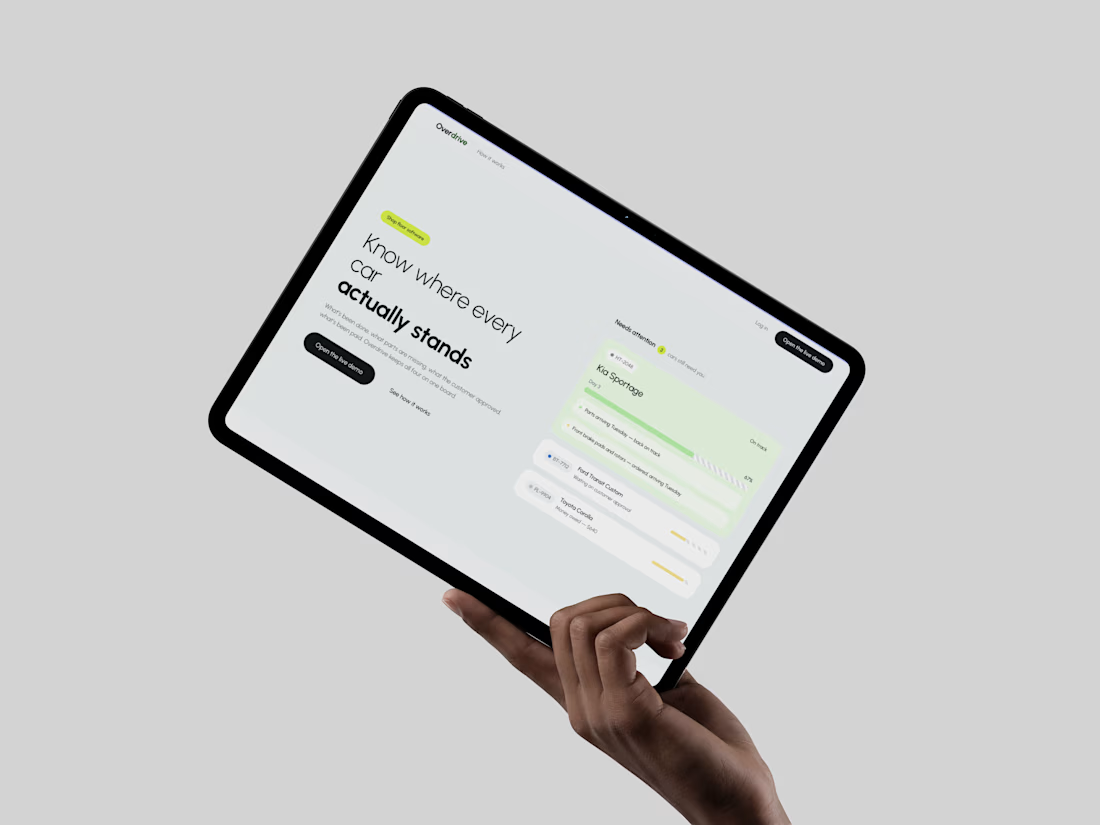
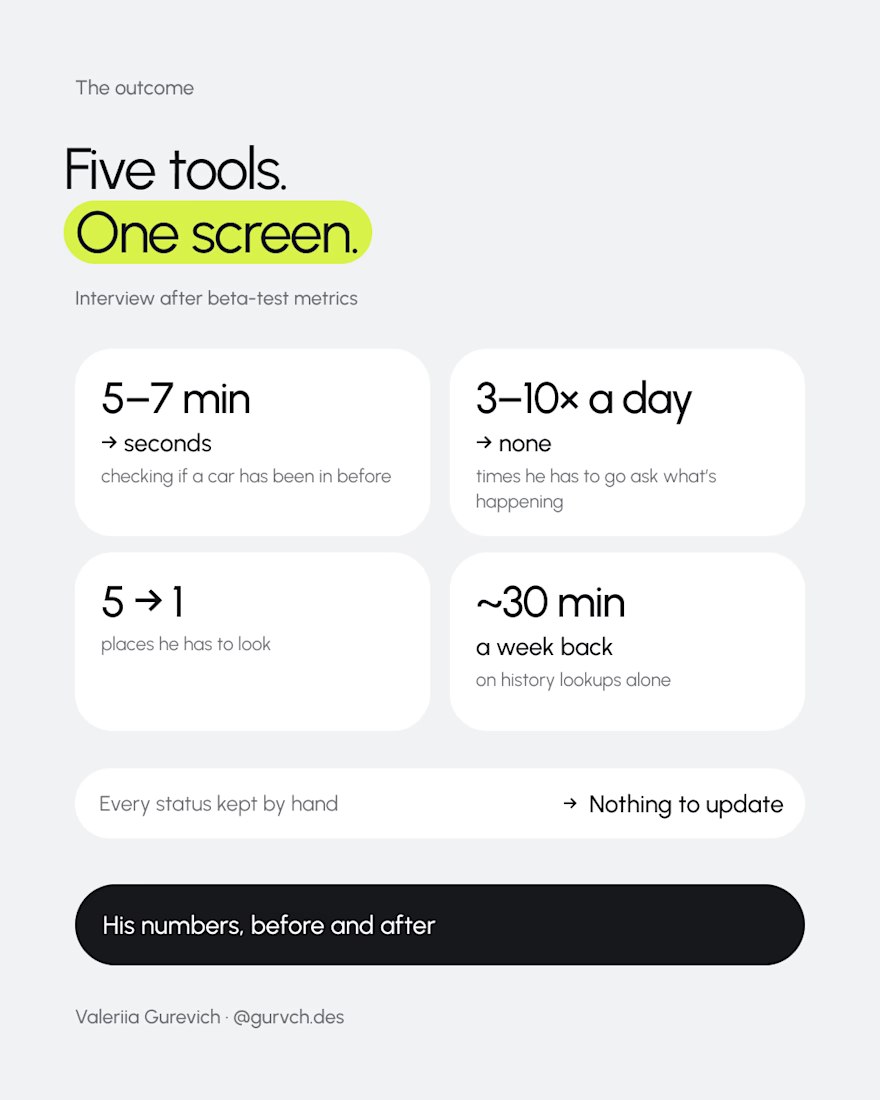
1 designer + base44 + 3 days without proper sleep = Overdrive🤍
A job tracking system for a car repair shop.
✱ One board showing every car on the floor, where each one stands and what’s holding it up.
Add a car, assign the work, and from there it tracks itself- what’s late, which parts have landed, who’s in today. Visit history, receipts, and a widget that tells you the next free slot you can offer someone.
Three days. Not smooth ones. But it’s live❗️
✱ Now the why, because none of those features were my idea.
My client owns the shop. Four mechanics, up to seven cars a day, no front desk. For months he’d complain about the same stuff whenever we talked: parts he ordered and forgot about, mechanics starting one car and getting pulled onto another, people asking when they can bring a car in and him not knowing what to say.
It was never a brief, of course, he was just talking. But one day I asked him properly: what do you need to see the moment you walk in?
✱ He said four things. And those four made sense as widgets, naturally.
Nothing on the job board gets typed in by a person. For example, a car shows as blocked because the mechanic who has it is off today- the board works that out and writes the reason on the card. He doesn’t walk around the shop asking anyone, he can just see it now.
✱ And the part nobody puts in these posts😅
→ It is my first time ever (!) using Base44 and I started without a paid plan, so I had a hard limit on how many prompts I got.
You can’t iterate your way to something like that. Every prompt had to arrive already correct, which meant almost all of the work happened before I typed anything. I designed every screen and every state in Figma first, then worked out exactly what to ask for and in what order.
I spent hours with Claude and Google figuring out how to phrase things, what would break, what to check before changing anything. I’d write a prompt and then throw it away and write a better one, because a wasted prompt cost more than the time did 🤷🏻♀️
Honestly, the constraint made it better. No aimless tinkering. Every change had a reason before it was made, and I still got every core feature I wanted in there.
✸Research: https://miro.com/app/board/uXjVEWOXy9k=/?share_link_id=813311021448
✸Walkthrough: https://www.loom.com/share/69ffa2d58ca24e7bb10676be5173cdc2
✸Overdrive live demo: https://overdrive-shop-flow.base44.app
✸X thread: https://x.com/gurvchler/status/2114517480152740121?s=20
✸LinkedIn post: https://lnkd.in/p/dysRmrNw


Well done!
And love the "no proper sleep" detail - sounds so familiar 😂

I built a little hotel you can explore.
With an AI teammate that turns guest requests into action.
Meet SuiteDesk, my entry for the #Base44Challenge, built with @Base44.
It’s an AI concierge and service workspace for boutique hotels.
The idea started with a small moment:
“Could we have two extra towels?”
A simple request still needs to reach the right person, get handled, and get back to the guest. SuiteDesk connects those steps.
Mira captures the room request.
Housekeeping receives the task.
A team member picks it up and completes it.
The guest receives an update
* Mira is the AI agent persona in SuiteDesk, trained on the hotel's specific service policies and local recommendations
What she does:
- Answers guest questions using only the hotel's own approved details: Wi-Fi, breakfast hours, amenities, policies.
- Turns a sentence like "we need towels" into a real request: it lands on your board, and the guest follows its status in the conversation.
- Recommends places and activities around the hotel, researched live.
- Writes in the guest's own language and always speaks to them as a guest, never as staff.
Guests ask from their phones. Staff manage the work from a shared service desk.
I wanted that experience to feel as welcoming as the hotel itself.
So I built an illustrated world around it: a courtyard, rooms, a spa, and Mira waiting to help.
The design gives you places to explore and ways to try the service.
Inside Base44, I worked on the agents, their instructions, hotel knowledge, and request workflow.
I kept reworking the artwork, copy, and navigation until the hotel helped explain the product.
The walkthrough shows both sides: the interactive experience and a labelled test request moving through the live service desk.
My goal was to give boutique hotel teams less to chase, while keeping hospitality personal.
Watch the build, then step inside:
https://elite-stay-stream-flow.base44.app/guestbook

Starting from "two extra towels" is such a good way to frame it. The guest seeing the status update is the part hotels usually miss.

Denty — From Consultation to Signed Consent. Built with Base44.
For this #Base44Challenge, I wanted to showcase something beyond a landing page or a beautiful prototype.
A real product. Solving a real problem.
Meet Denty, an AI-powered dental platform designed to simplify clinical documentation and patient consent workflows.
Here's what makes it different.
Instead of manually preparing everything after a consultation, a dentist can upload a transcript and let AI extract the relevant patient information.
The clinician remains in control, reviewing and editing the extracted details before preparing documents.
From there, Denty supports treatment planning, consent form generation, clinical document management, secure signature requests, and downloadable signed PDFs.
It also supports multi-clinic operations, team management, and activity tracking.
Why Base44?
I wanted to move quickly without compromising the product experience.
Base44 helped with application development, data integration, and AI features. But building a usable product required much more than prompts: thoughtful UX, careful design, testing, debugging, and repeated improvements.
Why a 6-minute video instead of 30 seconds?
Because I wanted to demonstrate the product rather than simply show it.
30 seconds can introduce an idea. It cannot meaningfully demonstrate every step of a workflow like this.
In the full recording, you'll see Denty create structured information from a consultation, generate documents, send a signature request, and demonstrate the patient signing process.
This is a functional product, developed for a real-world use case, shared with my client's approval.
We're preparing to launch on Monday.
Full product walkthrough:
https://www.tella.tv/video/startup-design-and-development-project-fo5h9gwr
Built with @Base44.
#Base44Challenge
I'd love feedback from the Contra community, especially on the product experience and clinical workflow.
tella.tv
Startup Design and Development Project 🚀 — Tella
Ans, a designer and developer helping startups build digital products, introduces a very special new project.

Incredible project great job Ans