The network for creativity
Join 1.25M professional creatives like you
Connect with clients, get discovered, and run your business 100% commission-free
Creatives on Contra have earned over $150M and we are just getting started
Back to feedPost

Access Atlas
Reimagining how people understand accessibility.
Every day, people with different accessibility needs choose not to visit places they want to explore because they are uncertain whether those spaces will actually work for them.
Not because they do not want to go.
But because they do not have enough confidence to know if they can.
Access Atlas was created to reduce that uncertainty.
It is a personalized accessibility platform that helps users understand how accessible a place will be for their specific needs before making the effort to visit.
Through personalized accessibility profiles, accessibility snapshots, AI-assisted discovery, and immersive accessibility previews, Access Atlas transforms accessibility from a generic label into something personal and actionable.
Building with the Figma Ecosystem
This project became an opportunity to explore how different parts of the Figma ecosystem can work together as one connected workflow.
Figma MCP → Research & Discovery
The process started with understanding the problem before designing the solution.
Using Figma MCP, I gathered references, researched accessibility patterns, explored existing experiences, collected inspiration, and organized insights into a structured discovery process.
This phase helped identify an important gap:
Accessibility information exists, but it is often fragmented, generic, and rarely personalized.
That insight became the foundation of Access Atlas.
Figma Design Agent → Design Exploration & Iteration
Design Agent became my creative companion throughout the project.
I used it across the entire workflow:
• Converting rough sketches and low fidelity wireframes into polished interfaces
• Generating and exploring multiple design directions
• Building and expanding the design system
• Applying visual changes across multiple screens simultaneously
• Replacing placeholders with actual visual content
• Accelerating iteration while maintaining intentional design decisions
Rather than designing for me, Design Agent allowed me to spend more time refining ideas and less time repeating tasks.
Figma Weave → Workflow Acceleration & Visual Creation
Figma Weave unlocked an entirely new way of creating.
I used Weave to build AI-powered workflows that made the process significantly faster and more flexible.
Using Weave, I:
• Created a complete icon system from scratch
• Generated graphical assets and supporting visual elements
• Experimented with multiple creative directions simultaneously
• Refined compositions and visual details
• Improved lighting and polish across graphical elements
• Explored outputs across different LLM workflows to accelerate decision-making
Instead of interrupting momentum with repetitive production work, Weave allowed me to stay focused on creating and iterating.
Figma Make → Turning the Concept into an Experience
Once the design system and flows were established, Figma Make helped transform the idea into something interactive.
Using Figma Make, I created a working concept that moved beyond static screens and into a more tangible product experience.
This allowed me to validate interactions, communicate the vision more clearly, and prototype how personalized accessibility could feel in practice.
Access Atlas started as a question:
What if people could understand accessibility before they arrived?
And evolved into a product vision focused on confidence, inclusion, and helping more people experience the world on their own terms.
Built for Config Makeathon ✨
Live Prototype - https://bone-upload-19206385.figma.site
Figma Make - https://www.figma.com/make/xmqLxan90ZlzkArGzT6FTw/Access-Atlas?t=atxpp7BmtS08txUN-1&preview-route=%2Flocation%2Fp1%2Fexperience
Figma File - https://www.figma.com/design/jDsm0EfkC6qJngxqJB3EZm/Config-Makeathon?node-id=27-2&t=nkWof38p08ZuxVa9-1
#Config2026 #ConfigMakeathon #Figma
:



Great work!

Loved it !!

The core reframe is smart. Accessibility right now is a binary label, a place either 'is' or 'isn't' accessible. But that's useless if you don't know what features matter for your specific needs. Personalizing the profile so users know what to expect for them specifically is a much more actionable design approach.
The network for creativity
Join 1.25M professional creatives like you
Connect with clients, get discovered, and run your business 100% commission-free
Creatives on Contra have earned over $150M and we are just getting started
Related posts

CreatorSetup
Helping content creators achieve professional results with the gear they already own.
Content creation has never been more accessible. Every day, creators invest in cameras, tripods, microphones, lights, gimbals, and other equipment to improve their content.
However, owning equipment doesn't automatically translate into great results.
Most creators struggle with questions like:
Where should I place my lights?
What camera angle works best for my space?
How should I position my equipment?
What kind of outcome can I realistically achieve with the gear I already have?
Current solutions often rely on generic tutorials that fail to account for individual environments, available equipment, and content goals.
The Problem
Creators spend hours experimenting with setups, watching tutorials, and rearranging equipment before finding something that works. This creates a significant barrier for beginners and slows down the creative process.
The Solution
CreatorSetup is an AI-powered setup planning experience that helps creators generate personalized content creation setups based on:
Their content type
Their workspace
Their available equipment
Their desired outcome
Users select their content category, define or upload their workspace, choose the equipment they already own, and receive a customized setup recommendation showing how to position equipment and what results they can expect.
The goal is not to recommend more purchases.
The goal is to help creators maximize the equipment they already have and achieve professional-looking results regardless of their experience level.
Built with Figma Make & Figma Weave
This project was created using Figma's latest ecosystem of tools.
Figma Make was used to rapidly transform ideas into an interactive product experience, allowing me to design, prototype, iterate, and refine the complete user journey from onboarding to setup generation.
Figma Weave was used to create and generate visual assets, helping bring the product experience to life through high-quality imagery and creative exploration. These assets were integrated throughout the experience to better communicate setup recommendations and expected outcomes.
The workflow included:
Problem discovery and solution framing
User flow design
Interactive prototyping with Figma Make
Visual asset generation with Figma Weave
Recommendation system design
Experience refinement and iteration
By combining Make and Weave, I was able to move from concept to working prototype while maintaining a cohesive visual experience.
Impact
CreatorSetup lowers the barrier to entry for content creation by giving creators practical, personalized guidance instead of generic advice.
By removing the guesswork from equipment placement and setup planning, creators can spend less time troubleshooting and more time creating.
Project Links
Live Prototype: https://creme-arrow-06022670.figma.site
Figma Community File: https://www.figma.com/community/file/1648729863850302682/creatorsetup

Awesome project. Actually very useful.
But how did you do your video? 😊

Excited to submit "soundchecksf" a new and organic way to discovery live music.
Link: https://soundchecksf.figma.site/
Community file: https://www.figma.com/community/file/1647490463683801916
Why this idea...I believe discovering new music these days is far too algorithmic. That said, taking a chance on seeing a live band you've never heard of has its own issues too. So I thought, what if I could build an experience that would simulate what it is like walking through an area only to hear a sound that pulls you in and creates a memory forever? This was very much inspired by what happened to me a few years back.
Enter...soundchecksf where you can take a stroll through a neighborhood and hear ACTUAL live music that's coming to a place near you! This updates every night 4amPST so you're bound to discover a new sound every time you come back.
How I built this...started with basically pen and paper (aka an app and Apple pen) quickly followed by planning and building a prototype with Claude. Then I used Figma Weave to build some assets and went into Figma Make to build key parts of this experience, one-by-one. After multiple rounds of polishing the UX, UI, the mobile experience, and ensuring I had accurate and functioning backend support...what has come out of all of this is something I'm proud to share.
Let me know what you think and wishing best of luck to all the other participants!
P.s For feasibility, UX, and credit reasons, I had to limit this to a few venues throughout certain neighborhoods in the Bay Area. Also, the artwork is loosely inspired by the place it's respresenting. I can't wait to build this out more, add more polish and yes, more cities!


Impressive

Hello everyone 🎉
I'm Viktoriia, a UX/UI Designer from Ukraine with 4+ years of experience creating websites and digital products.
My work spans SaaS, e-commerce, real estate, education, wellness, and nonprofit projects — from UX research and user flows to polished UI and design systems.
Lately, I've been actively exploring how AI can support the design process. I use AI tools to support research, explore ideas, challenge assumptions, and streamline workflows while keeping human-centred design at the core.
Excited to connect with fellow designers, founders, and creative professionals here on Contra. ✨

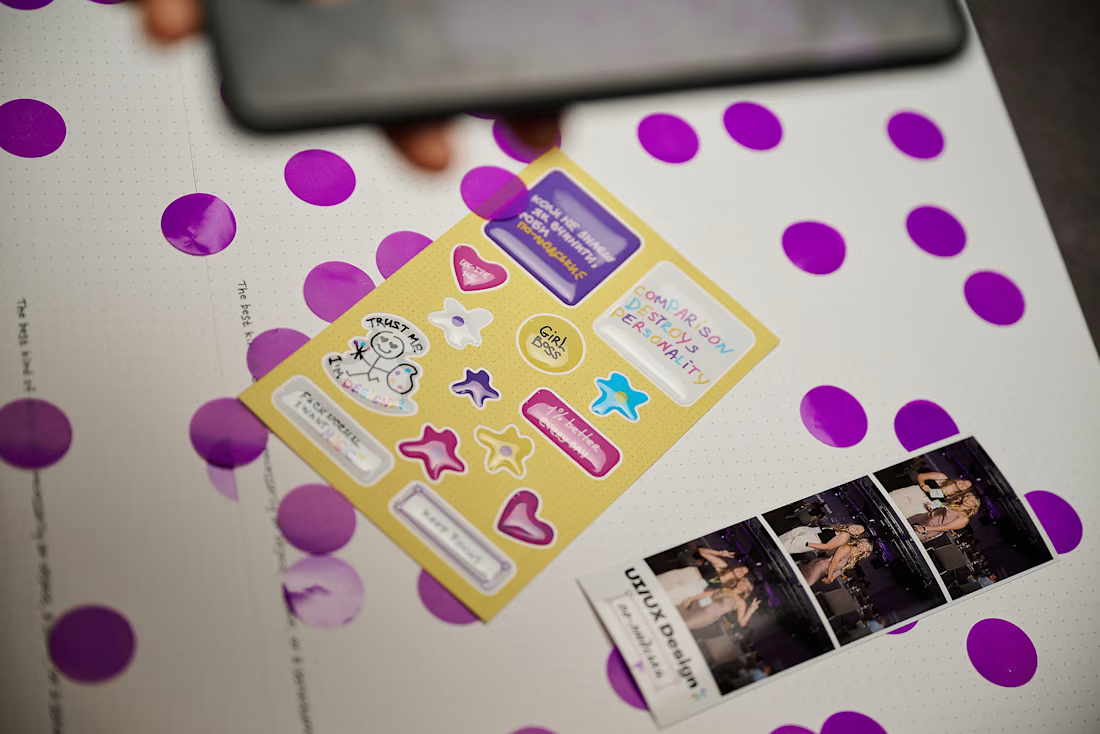

lovely stikers 😍😍😍 Welcome to Contra 🎉












Trending

Claude
Claude has entered the design space. How are you using Claude Design?

Contra University
Learn from expert creatives how to earn more using next-gen AI tools.

MagicPath
The canvas is infinite, and exploration is becoming the workflow. How are you using MagicPath?
creativeaiflow
Creative AI workflows are evolving. What tools do you use, and what are their strengths and weaknesses?
freelancerlife
Freelancer life is wins, pivots, and everything in between. What’s yours right now?