The network for creativity
Join 1.25M professional creatives like you
Connect with clients, get discovered, and run your business 100% commission-free
Creatives on Contra have earned over $150M and we are just getting started
Back to feedPost


"Just let the AI query the database" is how you build a data breach.
I do let an LLM write SQL against a customer's database. It's genuinely useful — "how many patients missed follow-ups last month?" answered in plain English. But a model that can emit arbitrary SQL against live customer data is one hallucinated DROP TABLE, or one cross-tenant SELECT, away from a disaster.
The fix isn't a better prompt. It's never trusting the model in the first place.
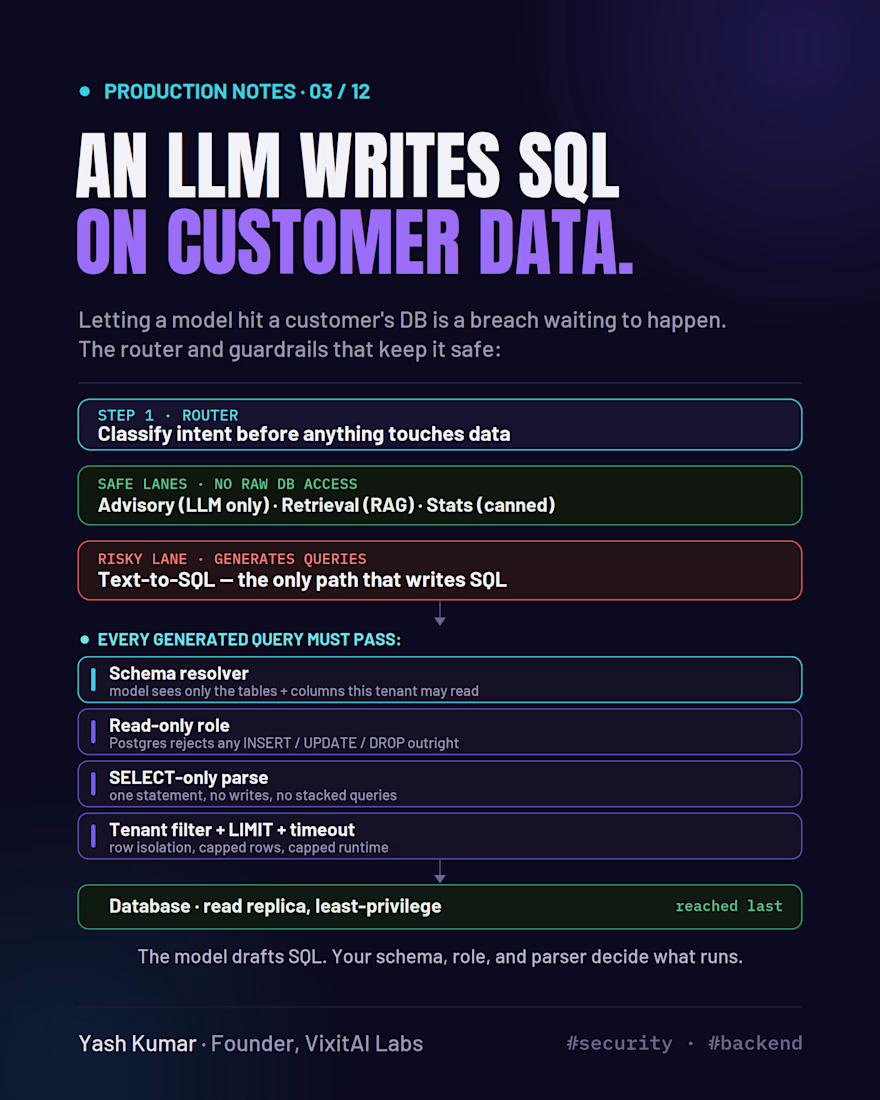
Step 1 — a router, not a text-to-SQL box.
Most questions don't need generated SQL. Before anything touches data, classify intent:
Advisory: answer from the model alone. No DB.
Retrieval: semantic search over documents. No DB.
Stats: a canned, reviewed query. Parameterized, not generated.
Text-to-SQL: only genuine ad-hoc data questions land here. Three of four lanes never touch raw SQL. You've shrunk the attack surface to one path before writing a single guardrail.
Step 2 — that one path runs a gauntlet.
Every generated query must pass, in order:
Schema resolver — the model only ever sees the tables and columns this tenant is allowed to read. It can't reference what it can't see, and it can't see another tenant's data. This is the big one.
Read-only role — the query runs as a Postgres role that physically cannot INSERT, UPDATE, or DROP. A malicious query isn't rejected by my code; it's rejected by the database.
SELECT-only parse — parse the SQL before running it. One statement, no writes, no stacked "; DROP ..." payloads.
Tenant filter + LIMIT + statement_timeout — row-level isolation enforced, rows capped, runtime capped. No query leaks across tenants or runs away with the DB.
Only after all four does anything reach a read replica.
The principle underneath all of it: the model proposes, the system disposes. Treat generated SQL exactly like untrusted user input — because that's what it is. Even if the model does something insane, three other layers still have to fail before a customer's data is at risk.
If your text-to-SQL feature is "the prompt says please only SELECT," you don't have a feature. You have an incident waiting for a date.
How are you sandboxing LLM database access — or are you keeping it away from the DB entirely?
#security #backend #AI #systemdesign #databases
The network for creativity
Join 1.25M professional creatives like you
Connect with clients, get discovered, and run your business 100% commission-free
Creatives on Contra have earned over $150M and we are just getting started





Related posts

This project focused on building and testing a practical AI security assessment lab for evaluating LLM defenses against prompt injection and jailbreak attacks.
I integrated Spikee by Reversec with a locally hosted cybersecurity model running through LM Studio, then added NVIDIA NeMo Guardrails to compare model behavior under three conditions: no guardrails, input filtering, and combined input/output protection.
The work included configuring the local model environment, building a custom FastAPI gateway, integrating NeMo Guardrails, troubleshooting model latency and timeout issues, creating a reusable Spikee target, and analyzing attack results using Spikee’s built-in reporting tools.
The project also explored different adversarial testing approaches, including prompt injection datasets, obfuscation, encoded attacks, Best-of-N testing, synthetic canary leakage tests, and structured benchmark comparisons.
The objective was to measure how much the guardrails reduced successful attacks while keeping the model, dataset, and testing conditions consistent.
Tools used: Spikee, NVIDIA NeMo Guardrails, LM Studio, Python, FastAPI, PowerShell, Parrot OS, local LLMs, JSONL datasets, and custom security testing scripts.
This project demonstrates a hands-on approach to LLM red teaming, AI safety testing, prompt-injection assessment, and guardrail validation for organizations deploying generative AI systems.


pretty cool tbh. testing the same attacks with different guardrail setups makes the results way more interesting.


What if anyone on your team could ask your data a question and get a live dashboard back in under a minute?
That was the brief. Business users were locked out of their own data. Every question waited on someone who could write SQL, data sat across disconnected systems, and security teams refused to send sensitive records to third-party AI tools.
So we flipped the model. Instead of moving enterprise data to an AI product, we moved the AI analytics product into the customer's AWS account.
What we built:
• Natural-language querying that turns plain-English questions into governed dashboards in under 60 seconds
• Federated queries across SQL and NoSQL sources through Trino
• AI query generation on AWS Bedrock Agents, with Bedrock Guardrails keeping model output in bounds
• Dashboards generated with Apache Superset, plus proactive anomaly and trend alerts
• A white-label React widget that embeds in any product
• Role-based access, row-level security and enterprise SSO enforced at every layer
The result:
Zero data egress. The whole platform deploys inside the customer's VPC and is live on AWS Marketplace.
Building AI features for a data-heavy or regulated product? Let's talk about doing it without your data leaving your cloud.


"Can I book with you?" shouldn't take 15 messages to answer. But for one business owner, it did, every single time.
He runs a home-help business in PAKISTAN (Islamabad & Rawalpindi), moving crews, with no real system. Every inquiry came in as a vague message. He'd read it, figure out what was needed, check who's free, negotiate a time, confirm, and follow up manually every time. Evenings and weekends were chaos. No-shows cost him. He is a team of one, juggling everyone.
So I rebuilt his booking process as ● MADAD, Urdu for "help."
Customers don't pick a category, they just describe the problem: "Want to move home furniture from DHA phase 2 to Bahria" MADAD understands it, matches a crew, and books it—no back-and-forth. The owner isn't coordinating anymore. He's just informed.
From "Can I book with you?" to "You're booked" with almost nothing left for him to manually do.
Built end-to-end in @Lovable for the #lovablechallenge https://madad-home-help.lovable.app
➡️Added the ADMIN side for judges to view what minimum actions the admin could take. He will just change status; the customer has nothing to do with the admin side.
I will upload a step-by-step BTS soon. Demo below ↓


One of the most thoughtful and practical concept I've seen this far.... it truly deserves appreciation and recognition