The network for creativity
Join 1.25M professional creatives like you
Connect with clients, get discovered, and run your business 100% commission-free
Creatives on Contra have earned over $150M and we are just getting started
Back to feedPost
This project focused on building and testing a practical AI security assessment lab for evaluating LLM defenses against prompt injection and jailbreak attacks.
I integrated Spikee by Reversec with a locally hosted cybersecurity model running through LM Studio, then added NVIDIA NeMo Guardrails to compare model behavior under three conditions: no guardrails, input filtering, and combined input/output protection.
The work included configuring the local model environment, building a custom FastAPI gateway, integrating NeMo Guardrails, troubleshooting model latency and timeout issues, creating a reusable Spikee target, and analyzing attack results using Spikee’s built-in reporting tools.
The project also explored different adversarial testing approaches, including prompt injection datasets, obfuscation, encoded attacks, Best-of-N testing, synthetic canary leakage tests, and structured benchmark comparisons.
The objective was to measure how much the guardrails reduced successful attacks while keeping the model, dataset, and testing conditions consistent.
Tools used: Spikee, NVIDIA NeMo Guardrails, LM Studio, Python, FastAPI, PowerShell, Parrot OS, local LLMs, JSONL datasets, and custom security testing scripts.
This project demonstrates a hands-on approach to LLM red teaming, AI safety testing, prompt-injection assessment, and guardrail validation for organizations deploying generative AI systems.


love that you actually red-team it instead of shipping and praying 😅

Even with the guardrails enforced, some attacks still bypassed it

pretty cool tbh. testing the same attacks with different guardrail setups makes the results way more interesting.
Yes, it does. The focus next is experimenting with different attacks and seeing how the guardrails work
Yeah, that sounds like a good direction. Would be interesting which attacks still get through once you start pushing the guardrails harder.

Holding the model and attack set constant makes this comparison useful. Since some attacks still got through, did you also measure false positives on legitimate requests and latency for each guardrail setup? Those two numbers often decide whether a defense survives production traffic.
Thanks for the insight. Will do that
The network for creativity
Join 1.25M professional creatives like you
Connect with clients, get discovered, and run your business 100% commission-free
Creatives on Contra have earned over $150M and we are just getting started











Related posts

CrowdVision AI – Real-Time Crowd Monitoring & Intelligence System
An AI-powered computer vision platform that detects and counts people in real time, monitors crowd density and occupancy, tracks entry and exit movements, and provides actionable crowd intelligence through a live monitoring dashboard.
Overview
CrowdVision AI is an intelligent crowd monitoring and safety analytics platform designed to help organisations monitor public spaces, understand crowd behaviour, and identify potentially unsafe crowd conditions.
The system uses computer vision and machine learning inference to analyse camera feeds and video streams, detect people, estimate occupancy, classify crowd density, and monitor movement across designated zones.
The Problem:
Monitoring crowded environments manually can be difficult, time-consuming, and inefficient. Security personnel may struggle to maintain accurate occupancy counts, monitor multiple zones, and identify unusual crowd conditions quickly.
CrowdVision AI was developed to explore how computer vision and real-time analytics could improve crowd visibility and monitoring.
My Solution:
I developed a computer vision system integrating a pretrained YOLO object-detection model with OpenCV for video processing.
The platform includes:
Real-time people detection and counting.
Crowd occupancy estimation.
Crowd-density classification.
Entry and exit line counting.
Zone-based monitoring.
Incident and anomaly monitoring workflows.
Camera health and tamper monitoring.
Evidence management and reporting.
Telegram alert notifications.
Remote edge camera processing.
Live monitoring dashboard.
Technical Implementation:
Machine Learning & Computer Vision
Python
YOLO / Ultralytics
OpenCV
NumPy
Pandas
Backend:
Python
FastAPI
REST API
Frontend:
React
Vite
JavaScript
Other Technologies
Git
GitHub
Telegram Bot API
JSON/CSV data storage
My Role
Founder & Full-Stack Machine Learning Developer


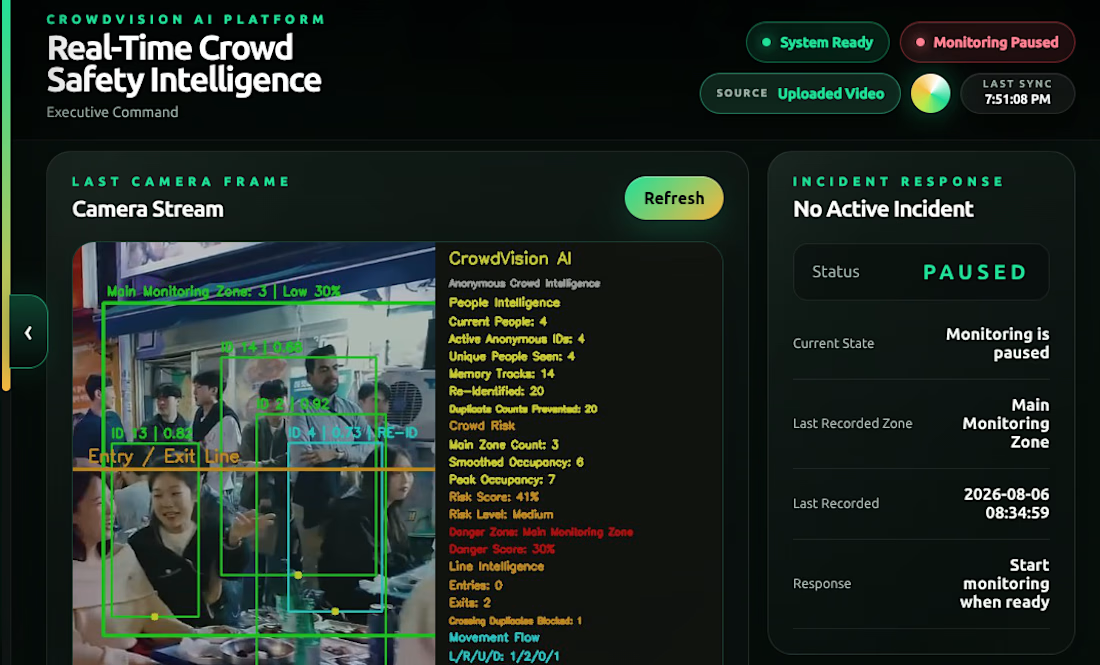

For entry/exit line counting, I'd test someone pausing on the boundary and stepping back without entering. Do you require a track to move fully between two zones before recording an entry, so small position changes don't become extra visits?

Anima is a self-initiated type design project inspired by vintage print, worn ink and analog photography.
The collection includes two experimental serif typefaces: Anima Editorial, with elegant proportions and contrasting strokes, and Anima Retro, with softer, bolder shapes. Both feature grain built into the letterforms.
I developed the creative direction, custom fonts and promotional artwork, combining AI-assisted exploration with font development. The campaign pairs textured typography with motion-blurred photography to capture a warm, nostalgic mood. FREE DOWNLOAD AT https://twaperdigital.com/anima-retro






Great job Denisa the font style background and it's effects are great 🎉🎉🎉🎉
keep going Denisa🔥🔥🔥🔥
I created this font & it is free to download and use in your free or paid projects. Enjoy 🚀 find it at https://twaperdigital.com/anima-editorial





I like this font