The network for creativity
Join 1.25M professional creatives like you
Connect with clients, get discovered, and run your business 100% commission-free
Creatives on Contra have earned over $150M and we are just getting started
Back to feedPost

Why am I building a quantitative trading system?
Because I don't want trading to depend on spending hours staring at charts, making repetitive decisions manually, missing opportunities, or letting emotions and inconsistency affect execution.
For retail and independent traders, the difficult part isn't just finding a strategy.
It's knowing whether the strategy actually works, why it works, and why it fails.
That's what I'm trying to solve with my Quantitative Systems Platform.
Recently, I found a major bottleneck in my research.
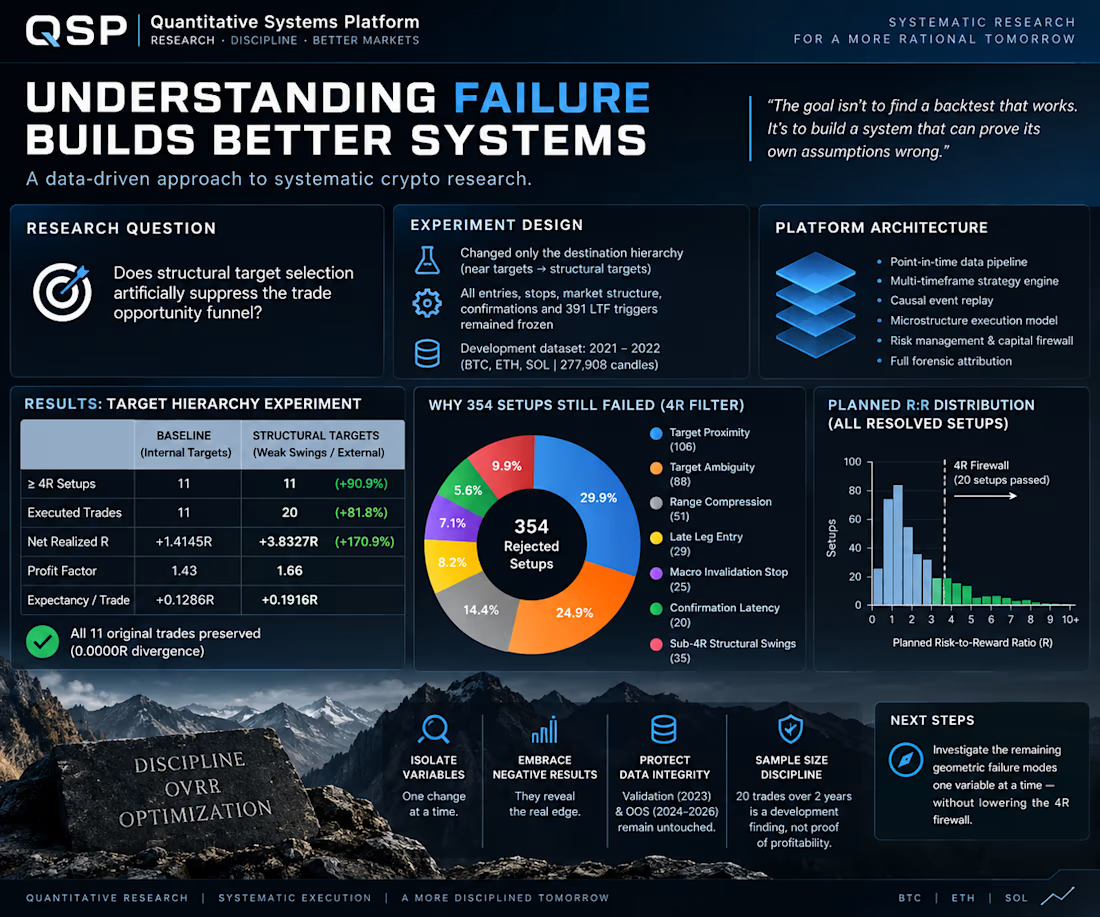
Out of 387 target-resolved setups, only 11 met my ≥4R requirement.
Instead of lowering the requirement to create more trades, I asked:
Was the system choosing the wrong structural target?
I ran a controlled experiment where I changed only the target-selection hierarchy. Entries, stops, market structure, confirmations and the 391 LTF-confirmed triggers stayed frozen.
On the 2021–2022 development dataset:
≥4R setups: 11 → 21
Executed trades: 11 → 20
Net realized: +1.4145R → +3.8327R
Profit Factor: 1.43 → 1.66
All 11 original trades were preserved with 0.0000R divergence.
But the most important part wasn't the improvement.
I investigated the 354 setups that still failed the 4R firewall.
They revealed multiple failure modes:
target proximity, compressed ranges, late entries, wide structural stops, confirmation latency, target ambiguity — and 35 structurally healthy-looking setups that still fell between 1.5R and 3.9R.
So the answer isn't simply:
“Lower 4R.”
The real research problem is understanding the interaction between entry geometry, available expansion, structural risk, confirmation timing and destination selection.
That's why I'm building this platform.
Not to create another black-box trading bot.
I want a system that can tell me:
Why did this trade qualify?
Why did another fail?
Which assumption caused it?
Can I isolate that assumption?
Can I reproduce the result?
Does it survive unseen data?
The long-term objective is straightforward:
Less manual trading. Less inconsistency. More systematic research. More reproducible execution. And eventually, if the evidence earns it, automation.
This experiment is still a development finding, not proof of profitability or production readiness. Validation and out-of-sample data remain protected.
The next step is to investigate the remaining failure modes one variable at a time.
I'm not trying to build a system that only proves itself right.
I'm building one capable of proving itself wrong.
🔗 Project: Quantitative Systems Platform — GitHub
#QuantitativeFinance #QuantitativeResearch #SystematicTrading #AlgorithmicTrading #TradingSystems #Python #FinTech #RiskManagement #Crypto


The network for creativity
Join 1.25M professional creatives like you
Connect with clients, get discovered, and run your business 100% commission-free
Creatives on Contra have earned over $150M and we are just getting started








Related posts

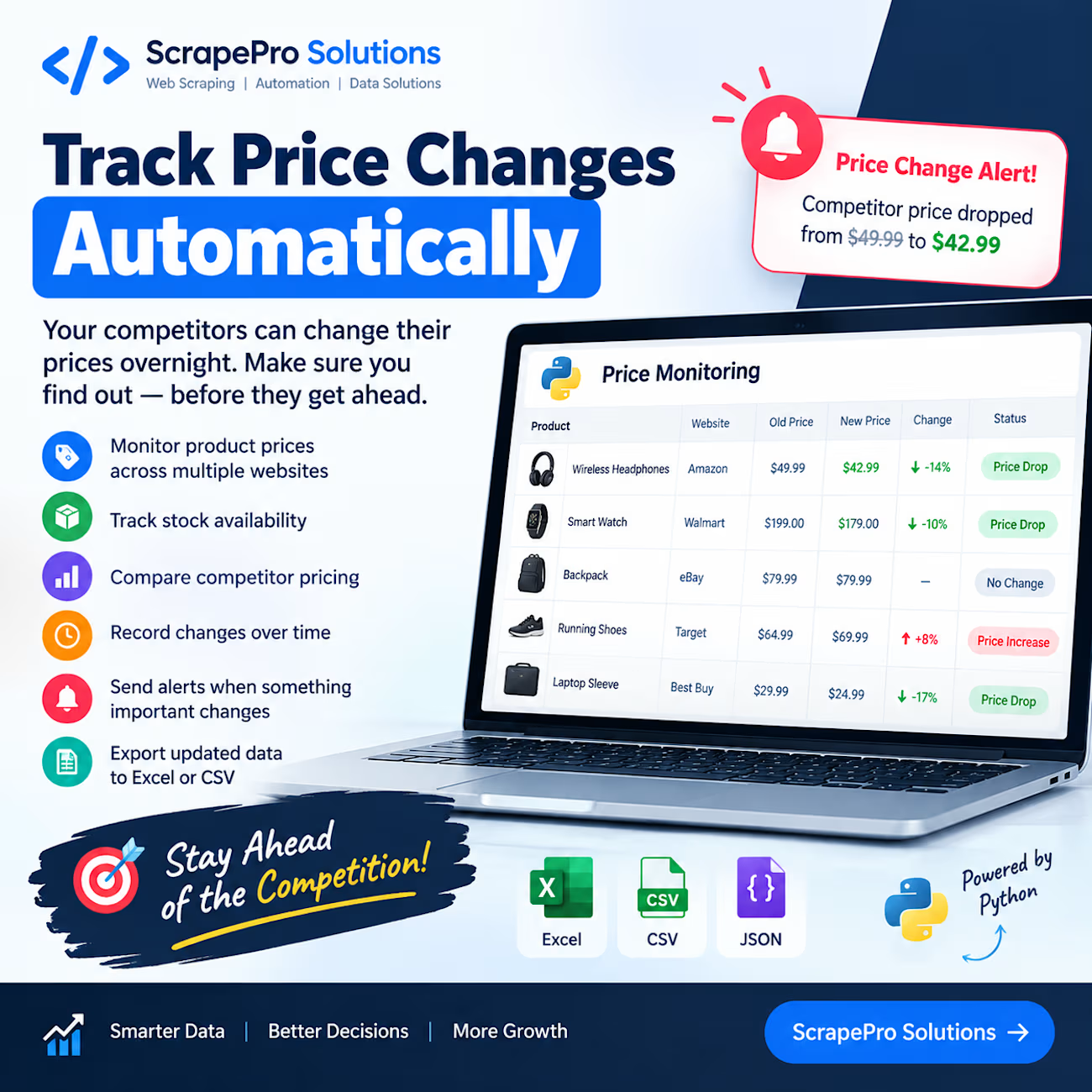
Your competitors can change their prices overnight. Your data collection system shouldn't miss it. 📊
Imagine checking 50 product pages every morning just to find out which prices have changed.
Now imagine getting that information automatically.
With Python web scraping and automation, businesses can build systems that:
→ Monitor product prices across multiple websites
→ Track stock availability
→ Compare competitor pricing
→ Record changes over time
→ Send alerts when something important changes
→ Export updated data to Excel or CSV
Instead of repeatedly checking websites, you get organized information that helps you make better business decisions.
This can be especially useful for e-commerce businesses, online retailers, and teams that regularly research competitors.
At ScrapePro Solutions, I build custom Python scraping and automation solutions tailored to specific business needs.
A quick question for e-commerce business owners:
If a competitor changed their product price today, how would you find out — manual checking or automatic alerts?
💬 Share your answer in the comments.


Two things bit me while building a price tracker. A page can come back "successful" but empty (in my case, compressed content the client couldn't decode), and saving that blindly overwrites good data. So I refuse any page with no title and no price, and only record a change when...

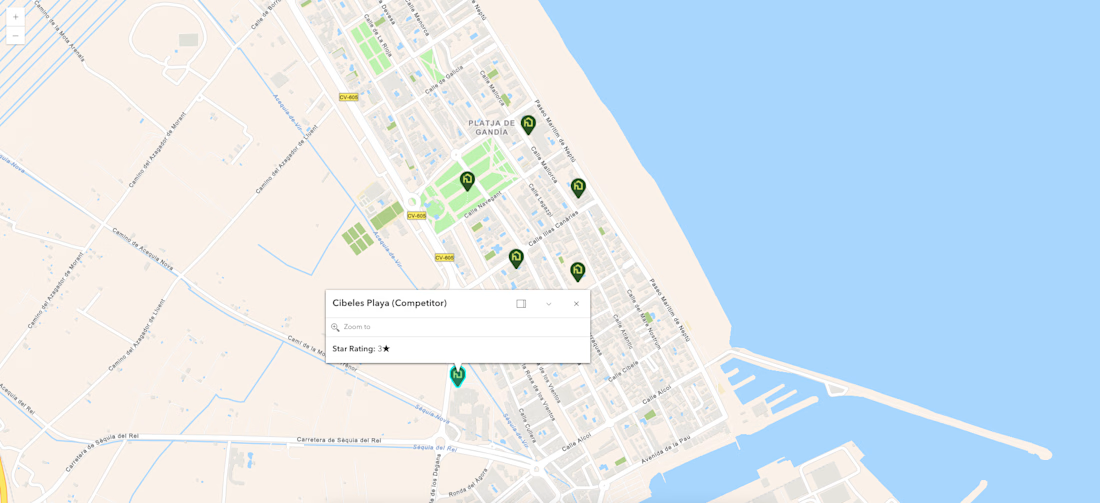
🗺️ Map design is where technical GIS data meets user adoption. For this ArcGIS API project, we engineered a dynamic spatial intelligence tool—featuring custom polygon territories, real-time geocoded competitor benchmarking with interactive popups, and clean SVG pin UI layers. Result? Clients turn complex competitor metrics into clear, actionable site selection insights instantly ⚡


When refining UI I try to:
Eliminate redundancy
Reduce cognitive load
Consolidate layouts
Less explanatory text
I started with a simple prompt and HTML file and refined from there.

this is so satisfying :)