The network for creativity
Join 1.25M professional creatives like you
Connect with clients, get discovered, and run your business 100% commission-free
Creatives on Contra have earned over $150M and we are just getting started
Back to feedPost

if you are looking for ml\ai engineer to connect llm to rag, i am active
The network for creativity
Join 1.25M professional creatives like you
Connect with clients, get discovered, and run your business 100% commission-free
Creatives on Contra have earned over $150M and we are just getting started



Related posts

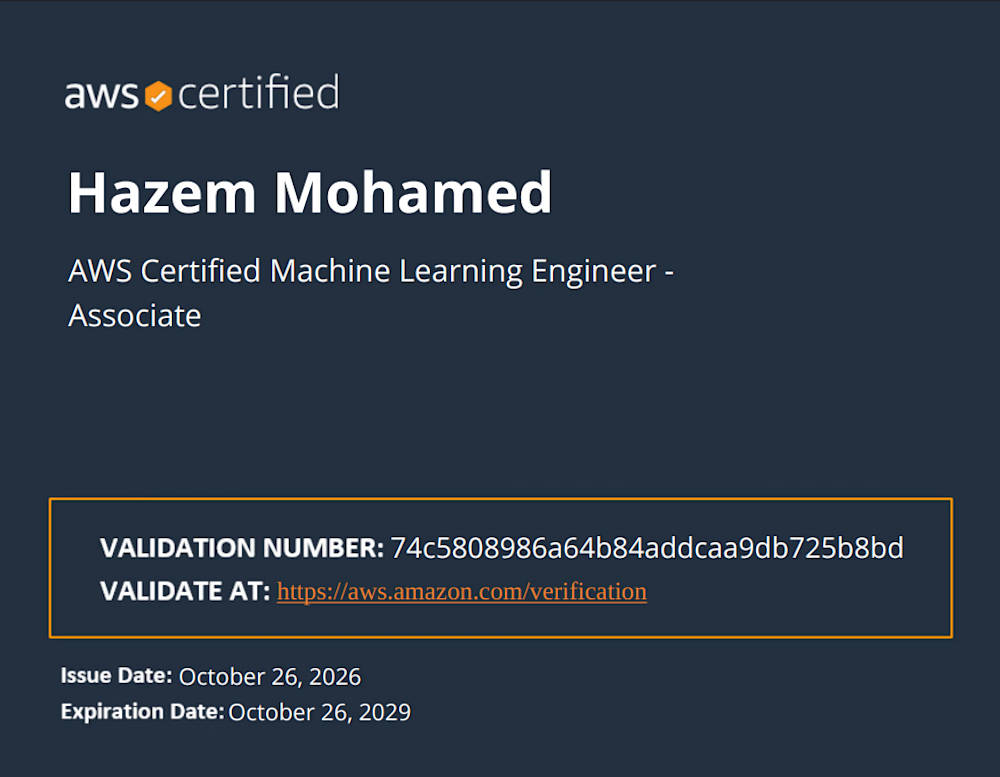
Proud to officially add the AWS Certified Machine Learning Engineer - Associate certification to my toolkit!
Building robust machine learning pipelines and scaling AI workloads securely on the cloud has always been a key focus of mine. Earning this certification has been a great deep-dive into mastering AWS ML infrastructure, MLOps best practices, and production-grade architectures.
Ready to bring these advanced capabilities to upcoming data science and engineering projects! Let's build something impactful. 💡💪
🔗 Verify Certificate:
Validation Number: 74c5808986a64b84addcaa9db725b8bd
Verification Link: https://aws.amazon.com/verification
#AWS #MachineLearning #AI #CloudComputing #DataAnalysis #MLOps



Congratulations on earning the AWS Machine Learning Engineer certification, Hazem khaled! Robust pipelines and cloud automation make all the difference for production-grade AI systems.

Ai generated, for entertainment purposes


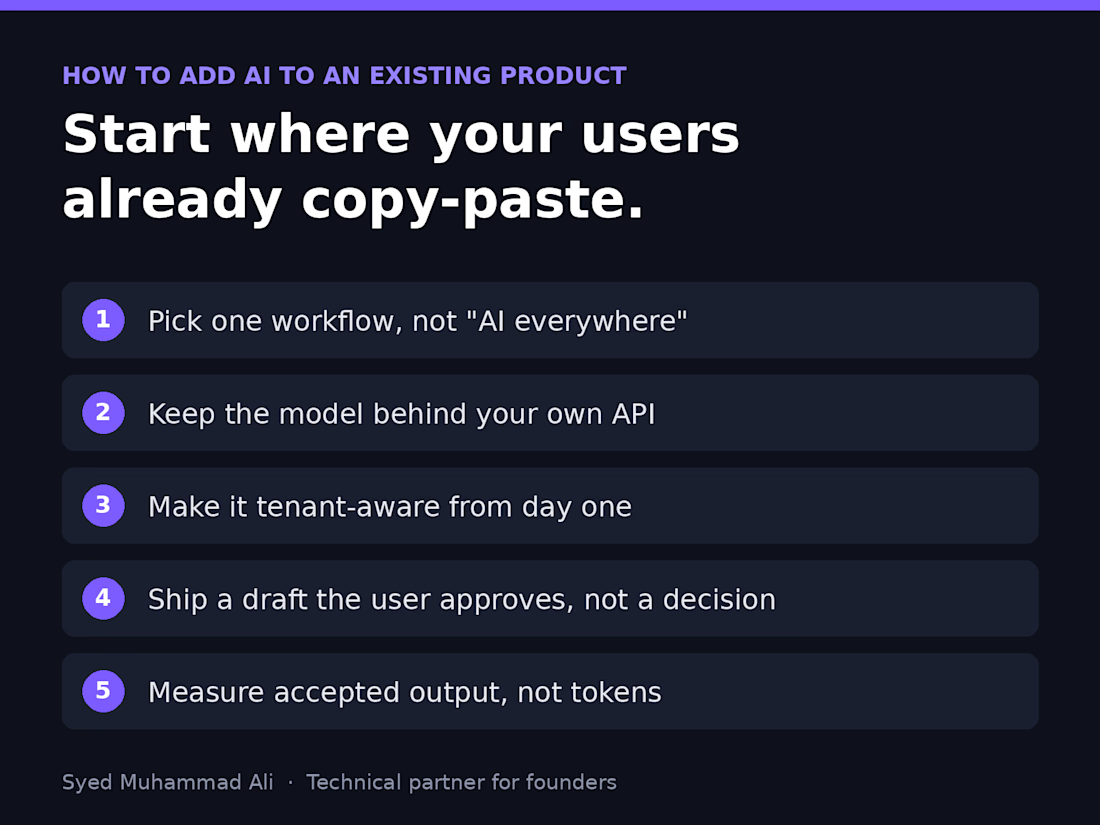
Before you add AI to your product, find the screen where your users already copy and paste.
That's usually where the real AI feature lives. Not a chatbot in the corner, but a step people already do by hand: summarising a ticket, drafting a reply, tagging an upload, pulling fields out of a PDF.
Here's the order I follow when a founder asks me to add AI to an existing SaaS:
1. Pick one workflow, not "AI everywhere." Watch where users leave your app to paste something into ChatGPT and come back. That round trip is your feature.
2. Keep the model behind your own API. One service owns prompts, retries, logging and cost limits, so you can switch providers without touching the frontend.
3. Make it tenant-aware from day one. Each customer's data, prompts and usage stay scoped to their account, or the first enterprise security review will stop you.
4. Ship a draft, not a decision. Let the AI suggest and the user approve. You earn trust and get real feedback before you automate anything.
5. Measure accepted output, not tokens. If users rewrite most of what it produces, the prompt or the context is wrong, and that's your real roadmap.
Most AI features that flop didn't fail because of the model. They were bolted onto the wrong step.
What's the one task your users still copy into ChatGPT?

Watching where users paste into ChatGPT and come back is such a practical way to find the real feature. Most teams start with the chatbot instead.