The network for creativity
Join 1.25M professional creatives like you
Connect with clients, get discovered, and run your business 100% commission-free
Creatives on Contra have earned over $150M and we are just getting started
Back to feedPost

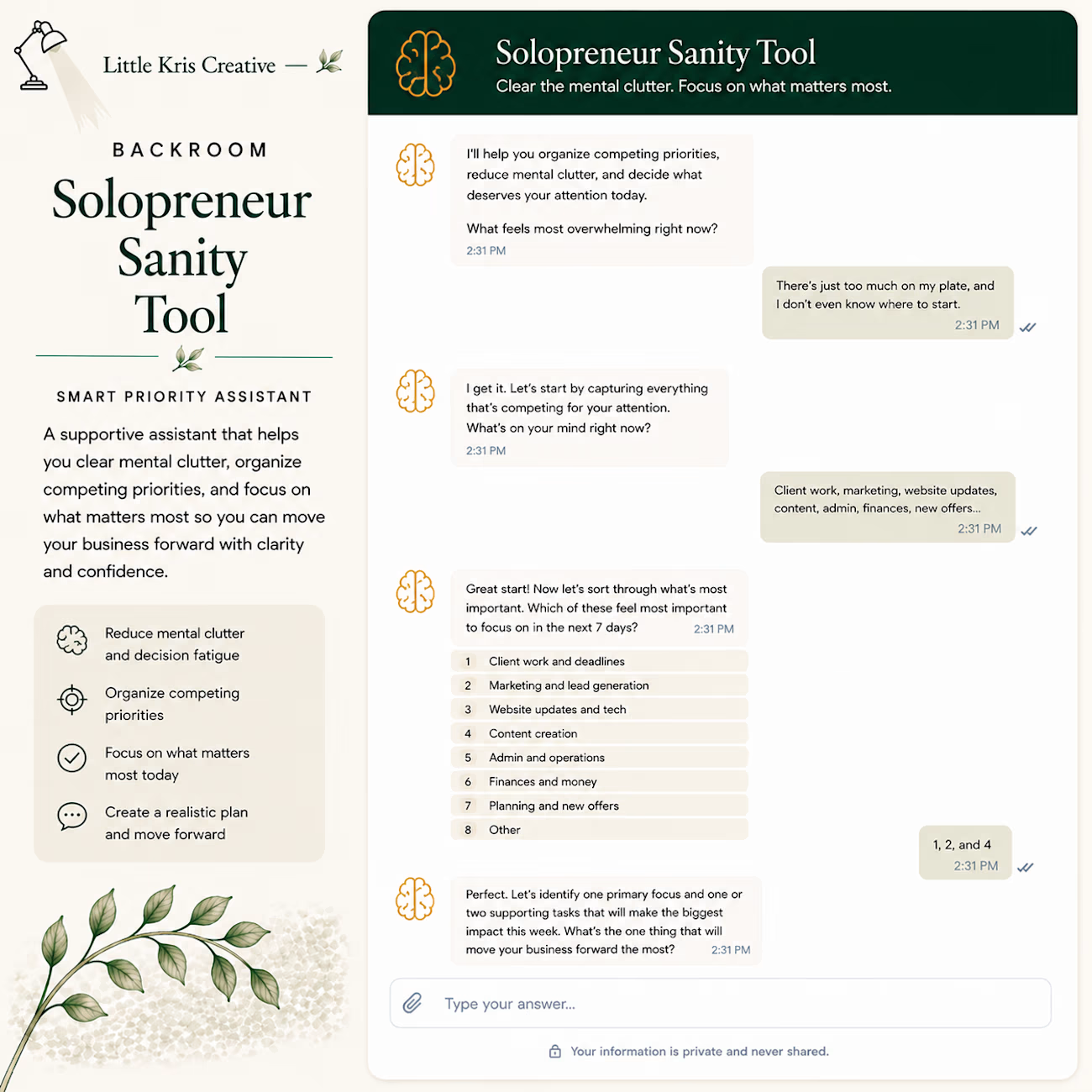
Solopreneur Sanity Tool
I designed Solopreneur Sanity Tool as a human-led AI system for small business owners who are dealing with competing priorities, mental clutter, and too many things demanding attention at once.
The challenge wasn't simply creating another AI assistant. The system needed to help users slow down the decision process, separate what feels urgent from what actually matters, and identify a realistic next focus without making decisions for them.
My Approach
I designed the underlying conversation architecture, decision logic, behavioral guardrails, user experience, and supporting materials.
The system guides users through a structured conversation that adapts to what they bring into it. Rather than generating a generic productivity plan, it helps users sort the situation, identify meaningful priorities, recognize constraints, and determine an appropriate next step.
A core design principle was keeping human judgment in control. The AI supports the thinking process rather than replacing it.
The Result
The finished system turns an open-ended AI conversation into a focused business thinking experience with a defined purpose, process, and user outcome.
It demonstrates how thoughtfully designed AI can be used as practical business infrastructure, not simply as a content generator or chatbot.


The network for creativity
Join 1.25M professional creatives like you
Connect with clients, get discovered, and run your business 100% commission-free
Creatives on Contra have earned over $150M and we are just getting started
Challenges
View all


Related posts

Niva — AI Automation Agency Website (About page)
Check it live: https://niva.framer.website/
Niva is a premium Framer template built for AI automation agencies, AI consultants, and automation-focused teams who want to attract serious B2B and enterprise clients. It helps you showcase your services, present real outcomes, and build trust with decision-makers through a warm, considered design that stands apart from the typical AI-agency aesthetic.
📌 This Template Is For You If You Want To
Build a professional website for your AI automation agency or AI consultancy
Attract B2B and enterprise clients who need to trust you before they call
Showcase services like workflow automation, custom AI agents, lead generation, and AI strategy
Present real case studies with measurable outcomes, not vague claims
Launch fast with a fully built CMS for case studies and blog content
Offer a clear, tiered pricing structure (Pilot, Scale, Enterprise) without a custom quote for every visitor
Stand out visually from the dozens of cyan-and-glow AI templates already on the market
📌 What's Included
13+ fully designed pages, covering the entire buyer journey:
Home — hero, problem/solution framing, services, industries served, integrations, process, stats, case study previews, testimonials, pricing, FAQ, and final CTA
About — origin story, mission, values, team, and company stats
Services — a full breakdown of each service line with outcomes and use cases
Case Studies — a CMS-powered index plus a detailed single-case-study template (problem → approach → solution → results)
Blog — a CMS-powered index and article template, ready for SEO content
Contact — a conversion-focused form paired with direct calendar booking
404, and legal pages — Privacy Policy, Terms of Service, and Cookie Policy included
📌 Ideal For
AI automation agencies and consultancies
Workflow automation specialists and system integrators
Custom AI agent developers
AI strategy and operations consultants
Freelance automation experts positioning as a boutique agency
SaaS companies offering AI-powered services to B2B clients
Interested in a custom version for your agency? Let's talk — DMs open.
Low-Code/No-Code DevelopmentAdobe PhotoshopFigmaFramerFramer Website DesignFramer Website Development


wow, this is a true premium website


𝗜’𝘃𝗲 𝗹𝗲𝗮𝗿𝗻𝗲𝗱 𝘀𝗼𝗺𝗲𝘁𝗵𝗶𝗻𝗴 𝘄𝗼𝗿𝗸𝗶𝗻𝗴 𝘄𝗶𝘁𝗵 𝗦𝗵𝗼𝗽𝗶𝗳𝘆 𝘀𝘁𝗼𝗿𝗲𝘀: 𝗺𝗼𝗿𝗲 𝘁𝗿𝗮𝗳𝗳𝗶𝗰 𝗱𝗼𝗲𝘀𝗻’𝘁 𝗮𝗹𝘄𝗮𝘆𝘀 𝗺𝗲𝗮𝗻 𝗺𝗼𝗿𝗲 𝘀𝗮𝗹𝗲𝘀.
Your Shopify store may NOT need more traffic.
It might need a better reason for visitors to buy.
I see this all the time:
A store is getting visitors.
People are viewing products.
Some are even adding to cart.
But sales? Still low.
So the first thought is:
“We need more ads.”
Not always.
Before spending more money on traffic, check these 6 things:
→ Is your offer clear within 5 seconds?
→ Does your product page answer the buyer’s biggest questions?
→ Are reviews and trust signals easy to find?
→ Is the Add to Cart button obvious on mobile?
→ Are shipping and returns explained clearly?
→ Is there a strong reason to buy NOW instead of “maybe later”?
More traffic sent to a weak buying experience can simply mean paying for more people to leave.
Fix the leaks first. Then scale the traffic.
I’m curious:
What’s the biggest challenge with your Shopify store right now?
A) Traffic
B) Add to carts
C) Checkout abandonment
D) Low conversion rate
E) Not sure yet
Drop the letter below 👇
I’ll reply with one thing I’d check first.



AI is slowly removing the “interface” from software.
Think about how we use software today.Open the app.
Find the right screen.
Fill in the fields.
Click a button.
Repeat.
Now imagine telling the product what you want and letting it figure out the steps. That’s what makes agentic AI interesting. The product doesn't just show information anymore. It understands the goal, works through the task, and takes action.
But this creates a completely different UX problem: If AI is doing the work, what does the user actually need to see?
Do we still need dashboards with 20 filters?
Do we still need 5-step workflows?
Do we even need traditional navigation for every task?
I think Product Designers will spend less time asking:
“Where should this button go?”
And more time asking:
“What should the product do for the user?”
This is much bigger than adding an AI chatbot.
Are we designing the next generation of interfaces, or slowly designing them away?