The network for creativity
Join 1.25M professional creatives like you
Connect with clients, get discovered, and run your business 100% commission-free
Creatives on Contra have earned over $150M and we are just getting started
Back to feedPost

Hello Ai entusiast. Jev is here 🙌 It isn’t just another classifier—it’s a paradigm shift in how AI makes decisions. While BERT and XGBoost excel at structured tasks, they demand labeled data, training cycles, and ongoing maintenance. Jev, by contrast, delivers calibrated, structured decisions in seconds—no training, no dataset, no hallucination. It’s not about reinventing classification; it’s about making it fast, reliable, and production-ready from day one. If you want to deep dive you can read my summary about what make this so groundbreaking [ https://medium.com/@mariavlahova.92/jev-in-ai-the-paradigm-shift-in-structured-decision-making-beyond-bert-beyond-xgboost-d9f963965209?postPublishedType=initial ]
medium.com
Jev in AI: The Paradigm Shift in Structured Decision-Making — Beyond BERT, Beyond XGBoost
In the rapidly evolving landscape of artificial intelligence, one name has sparked both excitement and controversy: Jev, TypeSafe AI’s…
The network for creativity
Join 1.25M professional creatives like you
Connect with clients, get discovered, and run your business 100% commission-free
Creatives on Contra have earned over $150M and we are just getting started


Related posts

A full-stack RAG application that answers questions from a team's own documents, with every answer cited to the source document and page. I designed, built, tested and deployed it end to end:
document ingestion with content-based file validation;
semantic search with PostgreSQL + pgvector;
streaming answers over Server-Sent Events, with server-side citation verification;
multi-tenant workspaces with role-based access;
usage metering with quotas and a cost dashboard;
a crash-safe PostgreSQL job queue.
Deployed as a public demo on free tiers (Vercel, Render, Supabase) with hard caps on AI spend.
Citations verified against the retrieved passages; unsupported answers return "not found"
Tenant isolation in every query; Supabase Data API locked down (verified on production)
Durable ingestion queue (SKIP LOCKED, leases, retries): kill -9 under load lost nothing
Costs reserved before every AI call; per-user, per-workspace and deployment-wide caps
Data-driven model migration (5 configurations evaluated; about 74% cheaper per answer)
1,099 backend + 393 frontend tests; load-tested; encrypted, restore-verified backups
https://knowledgepilot-ai-olive.vercel.app/


The reservation before the AI call is the detail most teams miss: you can add cost metering later, but you cannot un-spend the money after a runaway loop. On the crash-safe queue, with SKIP LOCKED plus leases, what happens to a lease held by a worker that is alive but stuck, do...

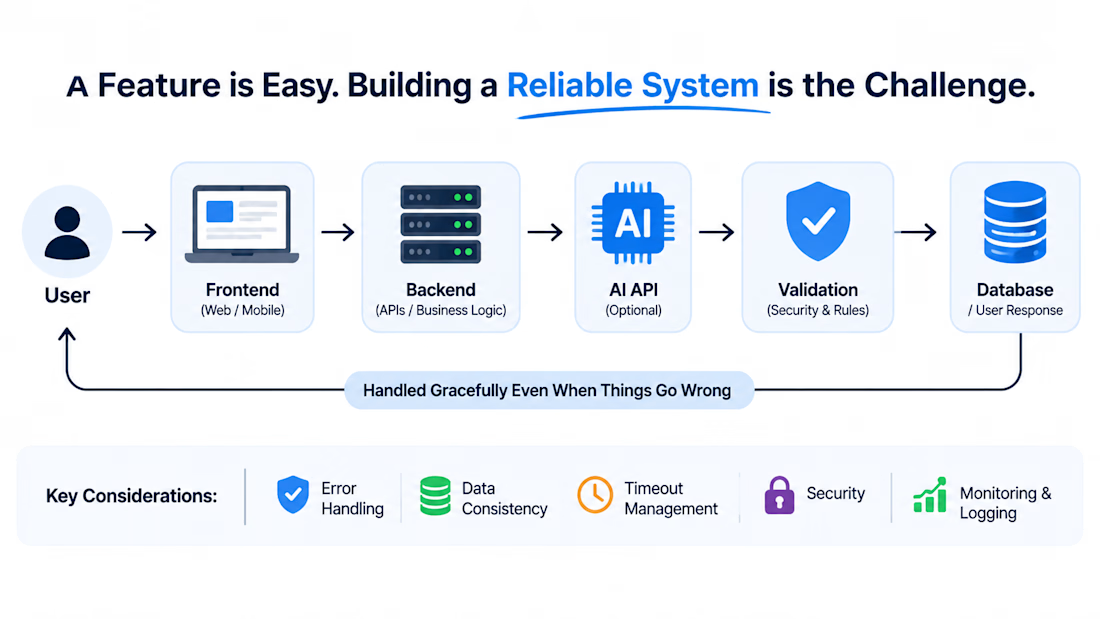
Adding AI to an application is relatively easy.
Making that AI feature reliable enough for real users is a different challenge.
When integrating AI into a web application, I think developers need to consider more than just the API call.
There are several important questions:
→ What happens when the model returns an unexpected response?
→ How do we handle timeouts and failed requests?
→ How do we protect sensitive user information?
→ Can users review or correct AI-generated results?
→ How do we monitor usage, cost and response quality?
An AI feature should fit naturally into the existing application architecture.
It needs proper backend validation, error handling, security and a clear fallback when something goes wrong.
I've worked across web applications, APIs and AI integrations, and I believe the real engineering challenge is making these pieces work together reliably.
AI should improve the product, not make the application unpredictable.
Validating model output as untrusted input is the right frame, and it catches shape and rule violations. The gap is the plausible-but-wrong answer: it passes schema and business rules and still misleads, because the rule set only knows what someone already thought to encode....

Most businesses want to use AI—but hold back because they worry about data leaks and generic, inaccurate answers.