The network for creativity
Join 1.25M professional creatives like you
Connect with clients, get discovered, and run your business 100% commission-free
Creatives on Contra have earned over $150M and we are just getting started
Back to feedPost

The URL Shortening API exemplifies the move toward Clean Architecture by separating business logic into a dedicated services directory.
Technical Breakdown
Structured Routing: The API is versioned (/api/v1) and utilizes a clean directory structure with separate folders for config, controllers, middleware, models, routes, and services.
Service Layer Pattern: Business logic is decoupled from the controller (e.g., urlService.js), allowing for more testable and maintainable code.
Comprehensive Documentation: The project includes a detailed README.md featuring a full API Reference, health check endpoints, and a structured table for CRUD operations (GET, POST, PUT, DELETE).
Data Integrity: Includes dedicated models and validators to ensure that every URL shortened meets strict data standards before entering the database.


The network for creativity
Join 1.25M professional creatives like you
Connect with clients, get discovered, and run your business 100% commission-free
Creatives on Contra have earned over $150M and we are just getting started



Related posts

Noise Reveal, a premium reveal component for Framer
I built a component that gives Framer sites cinematic reveals for images, video and live layouts. It has a soft, film-like edge with glow and grain, and can play on load, on view, from a variant or scrubbed by scroll.
It’s built for production: the reveal is prepared before it scrolls in, it’s accessible with reduced-motion support, it falls back when WebGL isn’t available, and pages stay plain HTML when nothing is moving.
Launched on the Framer Marketplace. Open to custom Framer and interaction work.


The WebGL fallback and reduced-motion support are the parts most reveal effects skip, so it's great to see them called out. Does the fallback keep some of the grain edge with CSS, or does it drop to a simple fade?

Design Exploration!
SHUTO - A Traditional Saree Website
Check out my new template - https://framer.link/ko3JZYj


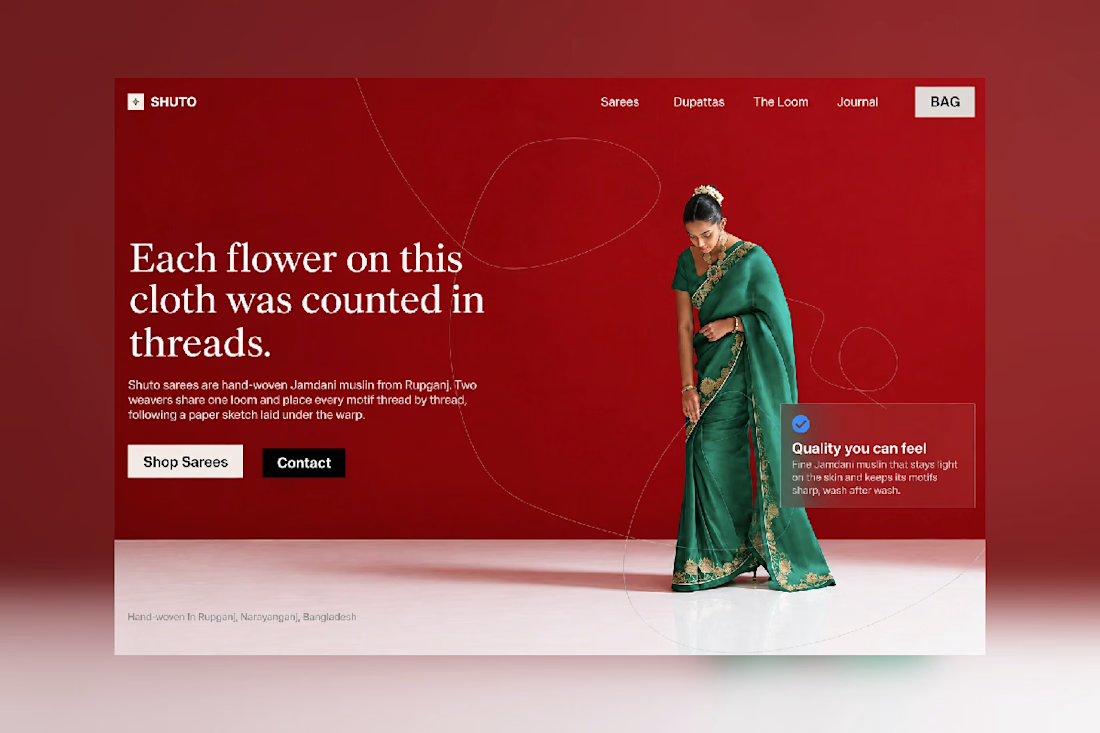

Great showcase this is very amazing

A little grain. A little distortion. A whole lot of interaction. ✳️
Introducing Grainy Carousel — an interactive Framer Code Component I've been building.
I wanted to explore how far a simple horizontal carousel could go when combined with motion, texture and optical effects.
So I brought together:
→ 7 predefined visual styles + custom mode
→ Infinite scrolling with auto-play and drag interaction
→ Procedural grain distortion
→ Adjustable blur effects
→ Concave & convex lens refraction
→ Extensive customization through the Properties panel
One component. Multiple visual directions. Endless ways to experiment.
Built for creative portfolios, digital agencies, editorial websites and immersive landing pages.
Grainy Carousel is now available on Contra.
🔗 Check it out, explore the variations and let me know which style is your favourite.
To integrate in your project, purchase it from here: https://contra.com/products/dg9gbcuK-3-d-grainy-carousel-interactive-framer-code-component
I'm also open to collaborating with teams and founders looking to bring distinctive interactions, motion and 3D experiences into their websites.
Have an interesting web experience in mind? Let's build it.
#Framer #InteractionDesign #CreativeDevelopment #MotionDesign #WebDesign
