The network for creativity
Join 1.25M professional creatives like you
Connect with clients, get discovered, and run your business 100% commission-free
Creatives on Contra have earned over $150M and we are just getting started
Back to feedPost

The most reliable AI agent is not the one that does everything on its own.
It is the one that knows when to stop.
Autonomy sounds impressive. But in a real workflow, the number of actions you can delegate to AI is not what matters most. What matters is setting the right boundaries.
Imagine an agent handling new inquiries from a website.
It can validate the data, research the company, evaluate the opportunity, and draft a personalized response.
But should it always send that response automatically?
Not necessarily.
If the information is complete, the decision is routine, and a mistake is easy to reverse, the agent can keep going.
If the data conflicts, the request is unusual, or an error could cost the company an important client, the decision should go to a person.
That is why, when designing an AI workflow, I think beyond what the agent can do and ask three additional questions:
How confident is it in the result?
Can the action be easily reversed?
What is the cost of being wrong?
The answers determine how much autonomy the agent should have.
For example:
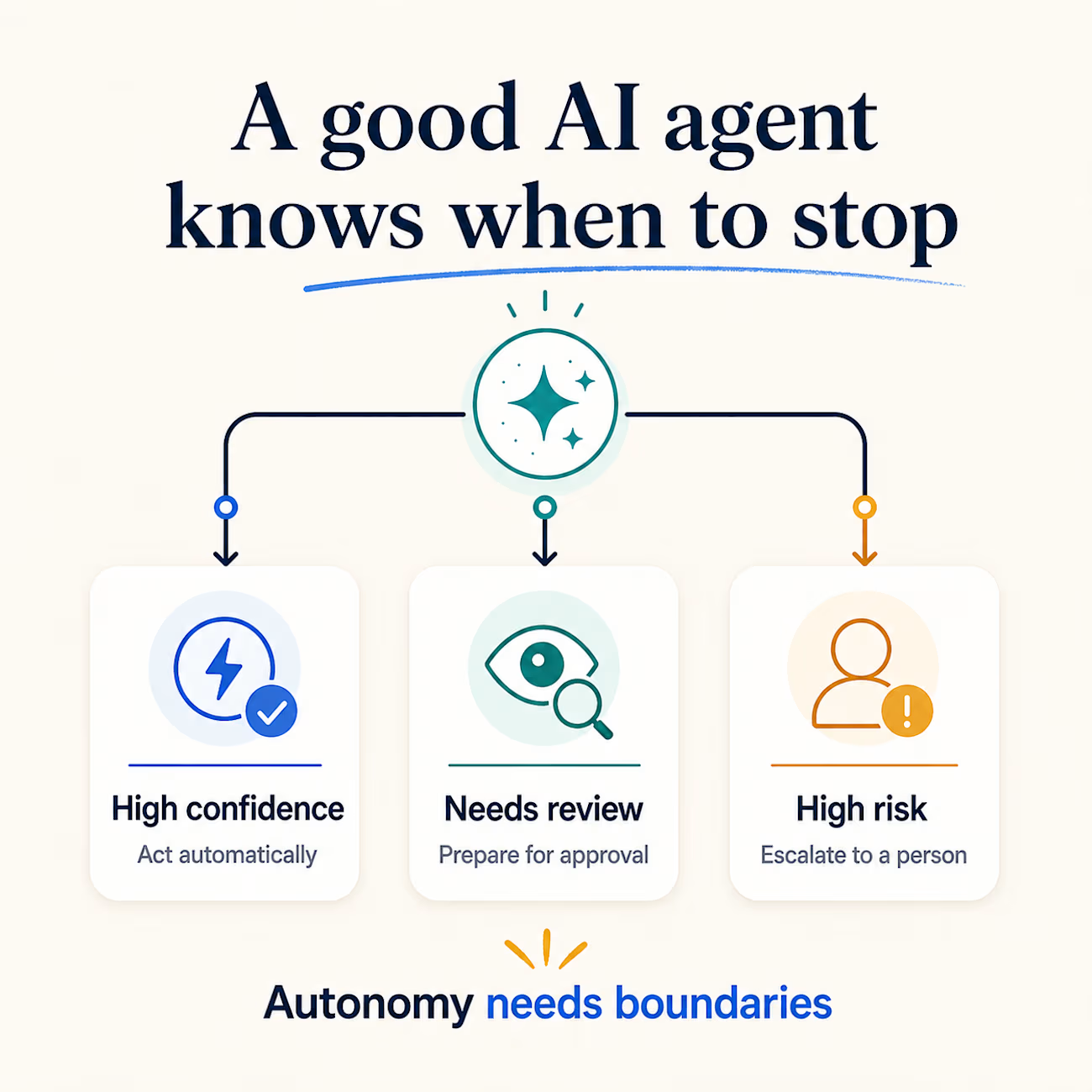
high confidence and a reversible action — execute automatically;
medium confidence — prepare the result for quick review;
low confidence or a high cost of error — stop and escalate to a person.
Human-in-the-loop is not a sign that the AI has failed.
It is part of a well-designed system.
The goal is not to remove people from every step.
The goal is to keep them out of predictable decisions and involve them exactly where judgment, accountability, and context matter.
A good AI agent saves time not because it never asks for help.
It saves time because it asks at the right moment.
Where in your workflow can AI act independently, and where should a person always make the decision?
I help founders and teams turn AI ideas into reliable full-stack products, automations, and Webflow-powered workflows.

The network for creativity
Join 1.25M professional creatives like you
Connect with clients, get discovered, and run your business 100% commission-free
Creatives on Contra have earned over $150M and we are just getting started

Challenges
View all


Related posts


New case study!
Artist portfolio website design and Webflow development for Teri Sanders, a New York-based artist.


The way the editorial grid lets Teri’s work lead while the oversized name anchors the page feels beautifully restrained. Nice balance of art direction and a usable Webflow portfolio structure.


Love this concept 🧡


At CRITER.AI, we’re building AI that helps migrants avoid expensive legal mistakes and visa bans by auditing Australian visa applications against immigration law. We’ve been getting a healthy amount of investor interest, but there was one recurring piece of feedback: our pitch deck was lackluster.
Fair enough. As a lawyer, my creativity usually goes into finding the legal issue everyone else missed, not deciding which shade of blue says “invest now.”
So we set out to change that. We chose Contra over its competitors because the caliber of people looked considerably stronger.
When I posted our request for a pitch-deck redesign, I expected a few people to reach out with quotes. As of today, we have had 303 applicants.
For a bootstrapped business, working through that volume was simply impossible. So we created a challenge:
“Here is my pitch deck. Pick the slide you think needs the most work, and show me what you can do.”
What followed was fascinating.
101 applicants (around 1/3) never replied. Of those who did, around 10% simply reiterated what they had already said. One person replied that, with 250 applicants, they were not going to bother trying. lol.
Several asked whether the test would be paid. 12 sent a quote for the work to be paid first, after which I could decide whether to go further.
Less than 25% of the applications were obviously AI-generated. We are by no means AI-phobic, but the Claude watermark was perhaps a little too much. You know who you are dude!
2 people had trouble opening the Google file we sent. I’m still not entirely sure why.
7 people were so impressed by the work they did that they watermarked it, labelled it “draft,” or otherwise made it impossible to download for further review.
12 people reached out through LinkedIn rather than the app; a further 18 emailed; and 1 person even called me.
18 people not only sent an example slide; they also signed up for our free immigration-advice beta test.
From 303 applicants, we narrowed the field to 15 people who were simply too good to ignore.
Every one of those candidates took the time to understand what we were trying to do, what CRITER.AI is about, and spoke to us as people rather than as another job listing. Two spotted mistakes in the pitch deck that we would not have noticed without them. Another created a 3-minute Loom presentation explaining the changes they made and why they mattered. Most went beyond the requested single slide. One applicant redesigned the entire pitch deck and sent it watermark-free.
It was a difficult decision, but the person we chose had just that little bit more talent than an exceptionally strong group. They not only showed that they understood what we wanted and impressed us with the slide they redesigned; they also suggested another slide we had never considered relevant, then created it using information we had not even provided.
They took our AI immigration-law business and made our pitch deck speak to investors on a human level.
Can't wait to come back to resign our website, social media and other design work.



Lovely and impressive!