The network for creativity
Join 1.25M professional creatives like you
Connect with clients, get discovered, and run your business 100% commission-free
Creatives on Contra have earned over $150M and we are just getting started
Back to feedPost


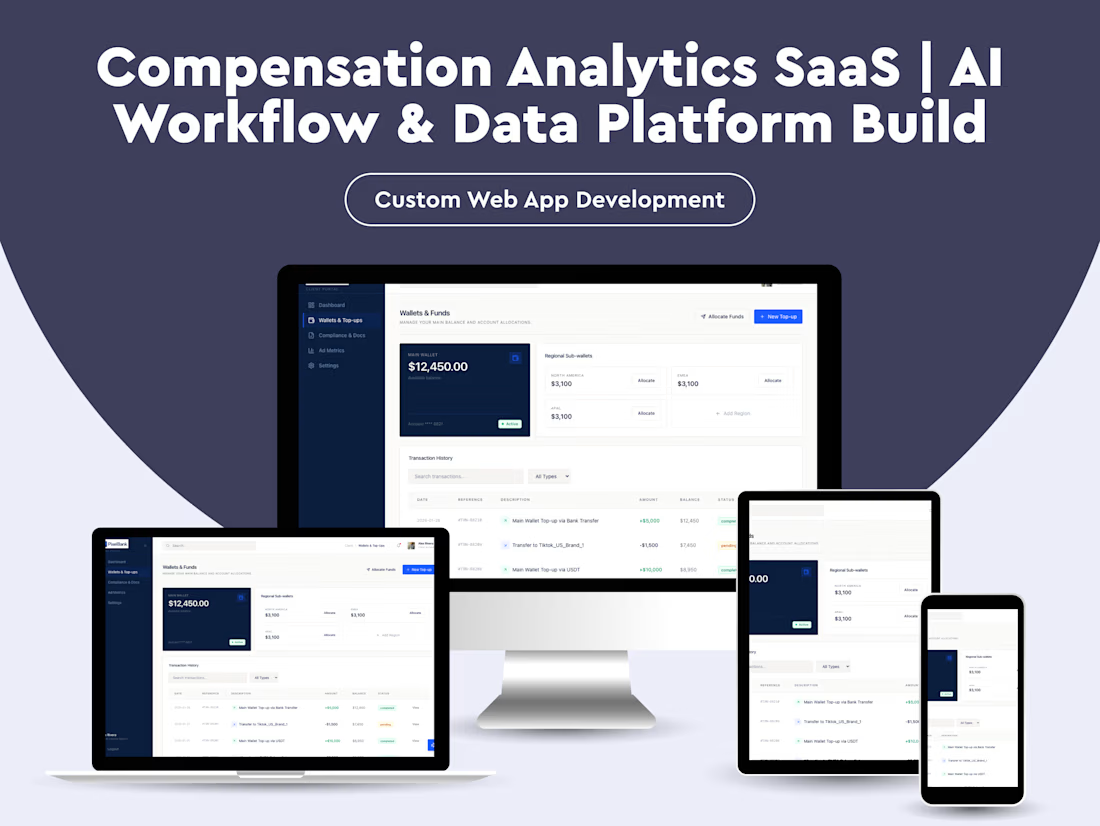
Case Study: From Prototype to Production — Building a Credit Management Platform for Ad Operations
The Starting Point
The founder wasn't guessing the problem. They had spent years inside the ad-credit ecosystem, managing wallet balances across regions, reconciling top-ups via bank wire and stablecoin, chasing compliance documents, and watching campaigns stall because a pixel stopped firing at 2am.
They knew exactly what a credit management platform needed to look like. So they built one.
Using Figma wireframes translated directly into a React frontend, they shipped a working prototype in days. Two portals were created. One for clients managing wallets and ad accounts, and one for internal operators handling treasury, compliance, and risk. It included real-time spend charts, AI-driven anomaly detection banners, a work queue for ops teams, and an embedded AI assistant that could answer questions about balances, compliance status, and pixel health.
The prototype proved the concept. Clients could see their wallet balances, request top-ups, allocate funds to ad accounts, and track campaign performance. Admins could manage treasury operations, review KYB pipelines, monitor risk scores, and process a prioritized work queue. The domain logic was sound. The UX was sharp.
But the system was never designed to survive real load.
What Started Breaking
The prototype worked on mock data. Every API call returned hardcoded arrays after a random delay. There was no backend. No database. No real authentication. The login screen accepted any email and assigned a role based on a toggle switch. Session state lived in localStorage as a raw JSON blob.
This was fine for demos. It stopped being fine the moment real money entered the picture.
The specific fractures:
1. No transactional integrity. Wallet balances, top-ups, fund transfers, and ad account allocations were all simulated. In a live system, a transfer of $25,000 from a master wallet to a regional sub-wallet is not a UI state change. It is a financial transaction that requires atomicity, audit trails, and rollback capability. The prototype had none of this.
2. Compliance was cosmetic. KYB document statuses were static labels. In production, document verification involves third-party identity providers, expiration tracking, automated re-upload reminders, and regulatory audit logs. The prototype rendered badges like "Verified", "Pending", and "Missing", but nothing enforced the state machine behind them.
3. Risk scoring was decorative. The AI risk badges showed tooltips like "Large P2P transfer detected, document expiring", but these were string literals, not outputs from a scoring model. Real risk assessment requires transaction pattern analysis, velocity checks, cross-referencing compliance status, and escalation workflows that route to the right ops agent.
4. The work queue had no backend. Urgent items like "$45,000 P2P transfer anomaly" appeared in the queue, but resolving them was just a frontend state toggle. There was no case history, no assignment logic, no SLA tracking, and no integration with the compliance or treasury systems that actually needed to act on these events.
5. Multi-tenancy was absent. The platform served one mock client and one mock admin. Scaling to dozens of clients, each with their own wallets, sub-wallets, ad accounts, compliance profiles, and credit limits, required data isolation, permissioning, and tenant-aware queries that did not exist.
6. Ad platform integration was faked. TikTok metrics like impressions, clicks, ROAS, and pixel health were all static datasets. Production requires OAuth-based API integrations, rate-limited data syncing, webhook listeners for pixel status changes, and graceful degradation when platform APIs go down. The founder understood all of this. The prototype was never meant to be the product. It was meant to prove that the product was worth building.
Why They Brought In a Team
The gap between the prototype and production was not a matter of fixing bugs. It was an architecture problem.
The founder needed:
- A real backend with transactional guarantees for financial operations
- A compliance engine that could enforce document workflows across jurisdictions
- A risk system that could ingest transaction data and surface actionable alerts, not static strings
- Multi-tenant data architecture with proper isolation and access control
- Ad platform integrations that could handle real API contracts, rate limits, and failures
- Observability including logging, monitoring, and alerting so the ops team could trust the system under load
They did not need someone to rewrite the frontend. They needed someone to build the system underneath it.
What We Delivered
Financial Operations Layer
We replaced the mock API with a transactional backend. Every wallet operation, including top-ups, transfers, allocations, and refunds, now runs through an auditable pipeline with:
- Atomic balance updates with optimistic locking
- Double-entry ledger for every fund movement
- Idempotent transaction processing to prevent duplicate charges
- Full audit trail with actor, timestamp, and before and after state
Top-up requests now flow through a verification pipeline with submission, proof-of-payment upload, approval, and balance credit. Each step is recorded and reversible.
Compliance and KYB Engine
- We built a document lifecycle system that replaces static badges with enforced state transitions:
- Documents move through missing → uploaded → under_review → verified → expired with rules governing each transition
- Expiration monitoring triggers automated client notifications
before deadlines
- Third-party identity verification integration for director ID matching
- Jurisdiction-aware requirements where different regions require different document sets
- Audit-grade logging for every status change, reviewer action, and override
The KYB pipeline now routes cases to specific compliance agents based on workload, region, and verification type.
Risk and Anomaly Detection
We replaced hardcoded risk labels with a scoring system that evaluates:
- Transaction velocity based on spend acceleration versus historical baseline
- P2P transfer patterns and threshold breaches
- Compliance status correlation, such as expired documents combined with high spend
- Account dormancy detection where inactivity triggers review
Risk scores update in near real time. High-risk events automatically generate work queue items with priority, context, and suggested actions.
Work Queue and Case Management
We transformed the frontend-only task list into an event-driven operations system:
- Events from treasury, compliance, and risk systems automatically create queue items
- Assignment logic routes items to the right agent based on type, region, and capacity
- SLA tracking with escalation rules for overdue items
- Case history that records every action, note, and resolution
- Enforced status transitions so items cannot be resolved without required actions
Multi-Tenant Architecture
We designed the data layer for tenant isolation from the ground up:
- Each client organization has isolated wallets, documents, ad accounts, and transaction histories
- Role-based access control separates client-facing and admin-facing data
- API endpoints are tenant-scoped to prevent cross-tenant data leakage
- Admin views aggregate across tenants with proper permissioning
Ad Platform Integration
We built a sync layer for TikTok Ads with an architecture that supports additional platforms:
- OAuth-based account linking with token refresh management
- Scheduled metric pulls with rate limit awareness and backoff
- Pixel health monitoring via event signal tracking instead of static labels
- Graceful degradation where stale data is clearly labeled if APIs fail
Observability
We added the infrastructure the ops team needs to trust the system:
- Structured logging for every financial operation, compliance action, and API call
- Health dashboards for backend services, integration sync status, and queue throughput
- Alerting on anomalies such as failed transactions, sync delays, and SLA breaches
- Error tracking with business context, not just stack traces
The Outcome
The system went from a prototype that could demo well to a platform that could process real money, enforce real compliance, and surface real risk under real load.
What changed:
- Financial operations now run with transactional guarantees. Wallet balances are accurate, auditable, and reconcilable.
- Compliance is enforced, not displayed. Document workflows follow regulated state machines with full audit trails.
- Risk detection is continuous and contextual. The ops team acts on scored alerts instead of static labels.
- The work queue drives operations. Events flow in automatically, route correctly, and track resolution against SLAs.
- Multi-tenancy works. New clients onboard into isolated environments without architectural changes.
- Ad integrations sync reliably. When they fail, the system clearly shows it instead of masking stale data.
The founder’s instinct was right from the start. The domain model, the UX, and the operational workflows all held up. What we built was the engineering foundation that made it dependable.
The system worked until it didn’t. Not because the idea was flawed, but because it was never designed to handle this level of complexity. The prototype proved the product. The production system proved it could scale.
Tech Stack Overview
1. Backend: Node.js (NestJS)
2. API: GraphQL
3. Auth: Auth0
4. Database: PostgreSQL
5. Cache/Queue: Redis
6. Search: Elasticsearch
7. Infrastructure: AWS
8. Containers: ECS Fargate
9. CI/CD: GitHub Actions
10. IaC: Terraform
11. Integrations: Stripe
12. Risk Engine: Python (FastAPI)
13. ML Pipeline: scikit-learn
14. AI Assistant: OpenAI GPT-4
15. Vector Store: Pinecone


The network for creativity
Join 1.25M professional creatives like you
Connect with clients, get discovered, and run your business 100% commission-free
Creatives on Contra have earned over $150M and we are just getting started











Related posts

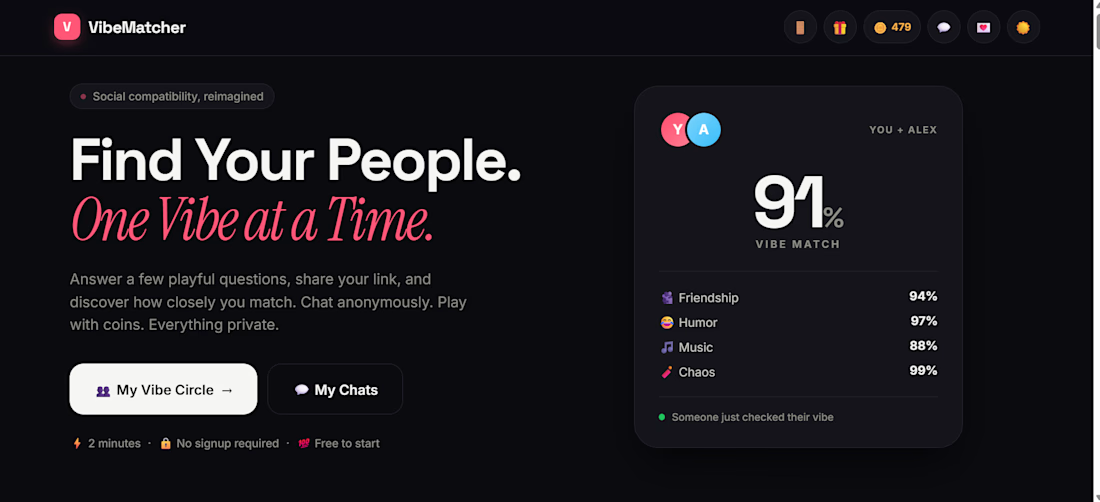
I built VibeMatcher — a fun way to discover how well your vibe matches with your friends!
What if you could compare your vibe with a friend and discover your compatibility in a fun, interactive way?
That's the idea behind VibeMatcher — a social web app I built around vibe matching and shareable results.
✨ What makes it interesting:
- Interactive vibe-matching experience
- Compatibility results and match labels
- Shareable experience designed for friends
- A modern, social-first web interface
🔗 Try it here: https://urvibematcher.vercel.app/
I'm an independent developer exploring ideas, building real products, and improving through hands-on projects.
I'm open to feedback, collaborations, and opportunities to build web apps and SaaS products for clients.
What feature would YOU add to a vibe-matching app? 👀


My Google UX Design Case Study: Boutique Coffee House
I designed a mobile ordering app to eliminate long queues, simplify custom drink orders, and enable instant promo redemptions for busy coffee lovers.
Case Study Steps & Highlights:
User Research & Personas: Identified key commuter pain points and target user needs.
User Journey & Wireframes: Mapped ordering flows and built paper-to-digital low-fi layouts.
Usability Testing: Conducted research rounds to refine navigation and checkout transparency.
Hi-Fi Prototype & Accessibility: Created an interactive Figma prototype with high-contrast UI standards.
I’d love to get your feedback! How does this design look to you, and what are your thoughts or recommendations on it? 👇
#UXDesign #GoogleUXDesign #ProductDesign #Figma #UIUX #CaseStudy #UserExperience #MobileAppDesign #RemoteWork #FreelanceUX


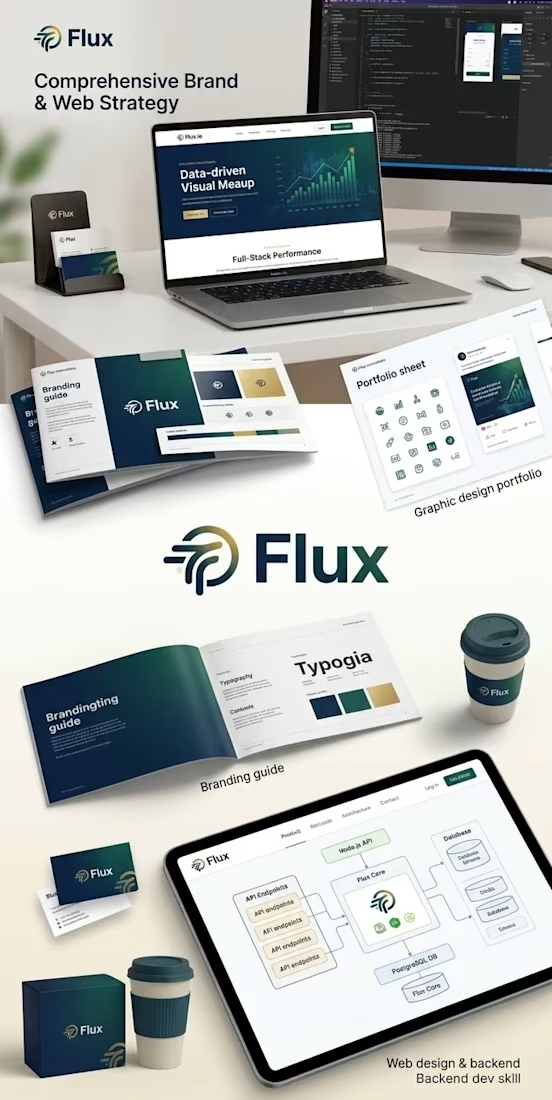
Flux Innovations: End-to-End Digital Ecosystem
A complete brand and technical execution project demonstrating my full-stack expertise:
Branding & Graphic Design: Developed the core brand identity, visual style guide, and digital assets.
Web Design (UI/UX): Designed a high-converting, responsive landing page layout focused on user engagement.
Backend Engineering: Architected secure Node.js APIs and robust PostgreSQL database schemas to power the core platform.