The network for creativity
Join 1.25M professional creatives like you
Connect with clients, get discovered, and run your business 100% commission-free
Creatives on Contra have earned over $150M and we are just getting started
Back to feedPost
Taste Test
Recently, I built an interactive voice orb for an AI voice agent, built with Three.js and custom GLSL shaders. Four real-time states: idle, listening, speaking, thinking — that react to live microphone input.
This started from a role I came across here on Contra, but didn't land. The concept stuck with me, so I built it out and added a second style: a particle orb. Two takes on the same idea — curious which one you prefer.
Here is the link to the live project - https://voice-orb.netlify.app
1 voted
14%
6 voted
86%
7 votes
Closed

Voting for the Particle ORB

Yeah, the Particle Orb looks cooler right?

Particle Orb. The granular texture gives it a lot more personality and the way particles would scatter when listening vs thinking could feel genuinely expressive. Building this after not landing the role is the right call, great portfolio piece.
Nice! Thank you for your detailed response.

Particle looks more appealing
Alright. Thank you!

Deformation ORB
Interesting choice. Thank you Esther!
You’re welcome

This is genuinely impressive the particle orb especially feels alive, not just animated. Real-time mic reactivity is such a nice touch for voice agent UX. I work in voice AI deployment myself, mostly the backend phone/call layer rather than the visual side. Would be cool to see...
This is very interesting. Thank you for your comment. You’re giving me a few ideas.

Both looks good, how about integrating a system that has both functionalities@Tomiwa Folorunso
Yeah. Would look into that. Thank you.
Wonderful, i would be in touch
The network for creativity
Join 1.25M professional creatives like you
Connect with clients, get discovered, and run your business 100% commission-free
Creatives on Contra have earned over $150M and we are just getting started





Related posts

AI Voice Agent Platform
Project description.
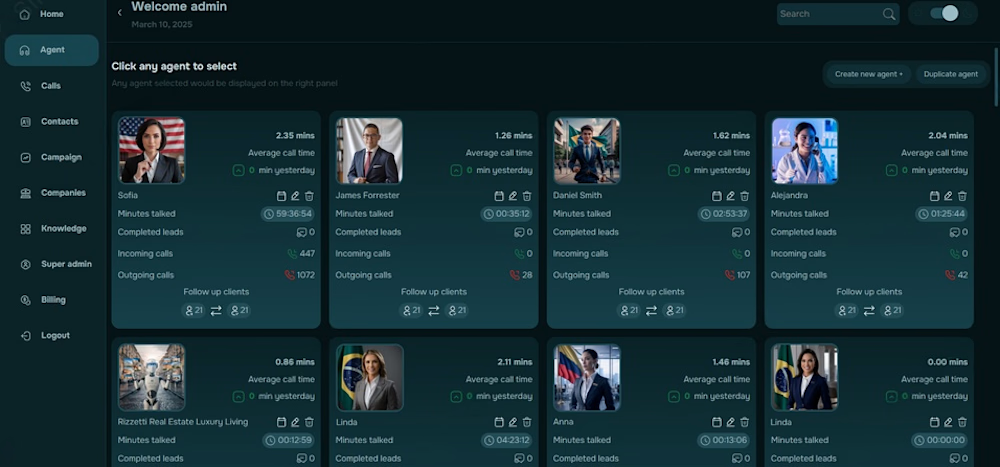
A powerful AI-driven voice agent platform that automates customer interactions using natural language, advanced speech technology, and seamless integration with business systems.
Skills and deliverables



A buyer fills in "Book a Viewing" on a real estate website.
Within 60 seconds, an AI voice agent calls them back, answers their questions and books the viewing on the live calendar.
The team starts the day with viewings booked, not a list of people to call back.
A quick check for your own business:
- open your last 20 website leads.
- For each one, compare when the form came in with when someone first called.
If the usual gap is hours rather than minutes, that's where your viewings go.
Want that gap closed?
I'd love to discuss your setup in more detail.
P.s the case study is on my profile


The 60-second callback isn't a feature — it's the entire competitive advantage. Great breakdown, Katya.

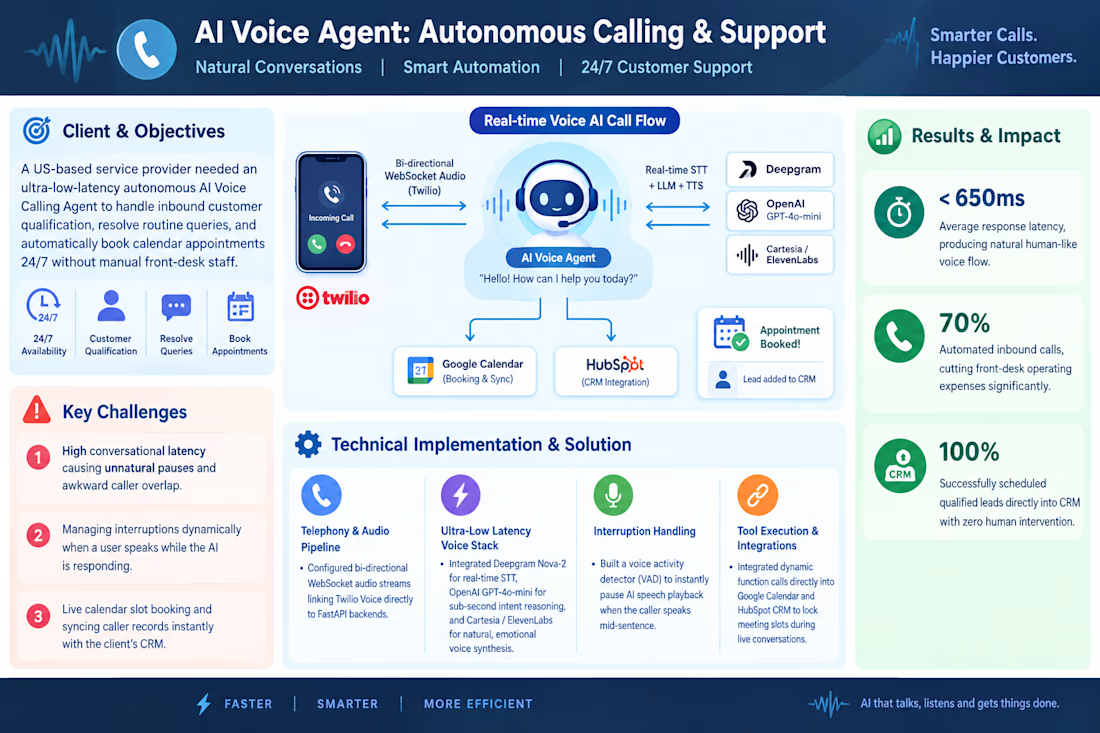
AI Voice Agent: Autonomous Calling & Support
A US-based service provider needed an ultra-low-latency autonomous AI Voice Calling Agent to handle inbound customer qualification, resolve routine queries, and automatically book calendar appointments 24/7 without manual front-desk staff.
Key Challenges:
High conversational latency causing unnatural pauses and awkward caller overlap.
Managing interruptions dynamically when a user speaks while the AI is responding.
Live calendar slot booking and syncing caller records instantly with the client's CRM.
Technical Implementation & Solution:
• Telephony & Audio Pipeline: Configured bi-directional WebSocket audio streams linking Twilio Voice directly to FastAPI backends.
• Ultra-Low Latency Voice Stack: Integrated Deepgram Nova-2 for real-time speech-to-text (STT), OpenAI GPT-4o-mini for sub-second intent reasoning, and Cartesia / ElevenLabs for natural, emotional voice synthesis.
• Interruption Handling: Built a voice activity detector (VAD) to instantly pause AI speech playback when the caller speaks mid-sentence.
• Tool Execution & Integrations: Integrated dynamic function calls directly into Google Calendar and HubSpot CRM to lock meeting slots during live conversations.
Results & Impact:
• Reached an average response latency of under 650ms, producing natural human-like voice flow.
• Automated 70% of inbound calls, cutting front-desk operating expenses significantly.
• Successfully scheduled qualified leads directly into CRM with zero human intervention.