The network for creativity
Join 1.25M professional creatives like you
Connect with clients, get discovered, and run your business 100% commission-free
Creatives on Contra have earned over $150M and we are just getting started
Back to feedPost

Here is some of my recent exploration for the footer. Here I have used my Halftone Engine in the Duotone mode with ring shape cells and enable motion in them.
Hope you like it :) ♥️ Many things are on the way see you soon.


Glad you like it, thanks :)

Such a solid footer man, I'm impressed.
@Lucas Alvarado Really happy to see that you like it, thanks for such a warm appreciation :)🤝
It's pleasure man.🤝

Looks premium.
Thanks brother!😃

Thanks bro!

Beautiful work!
Thanks :)

Thanks a lot😃 here I used my component -> Halftone Engine


Incredible work man!
Thanks brother :)🤝

Putting the motion in the footer instead of the hero is the interesting call — it rewards whoever scrolls all the way down instead of front-loading the wow moment where most visitors already bounce.
100% the footer is usually overlooked, so I thought it'd be fun to turn it into a small payoff for anyone who scrolls all the way through. well thanks Mark!🤝

Oh, I didnt realise it was a footer in the first look. This is def unique. 😍
Thanks Leena :) I really appreciate it


Well done !
Thanks bro :)
The network for creativity
Join 1.25M professional creatives like you
Connect with clients, get discovered, and run your business 100% commission-free
Creatives on Contra have earned over $150M and we are just getting started






Related posts

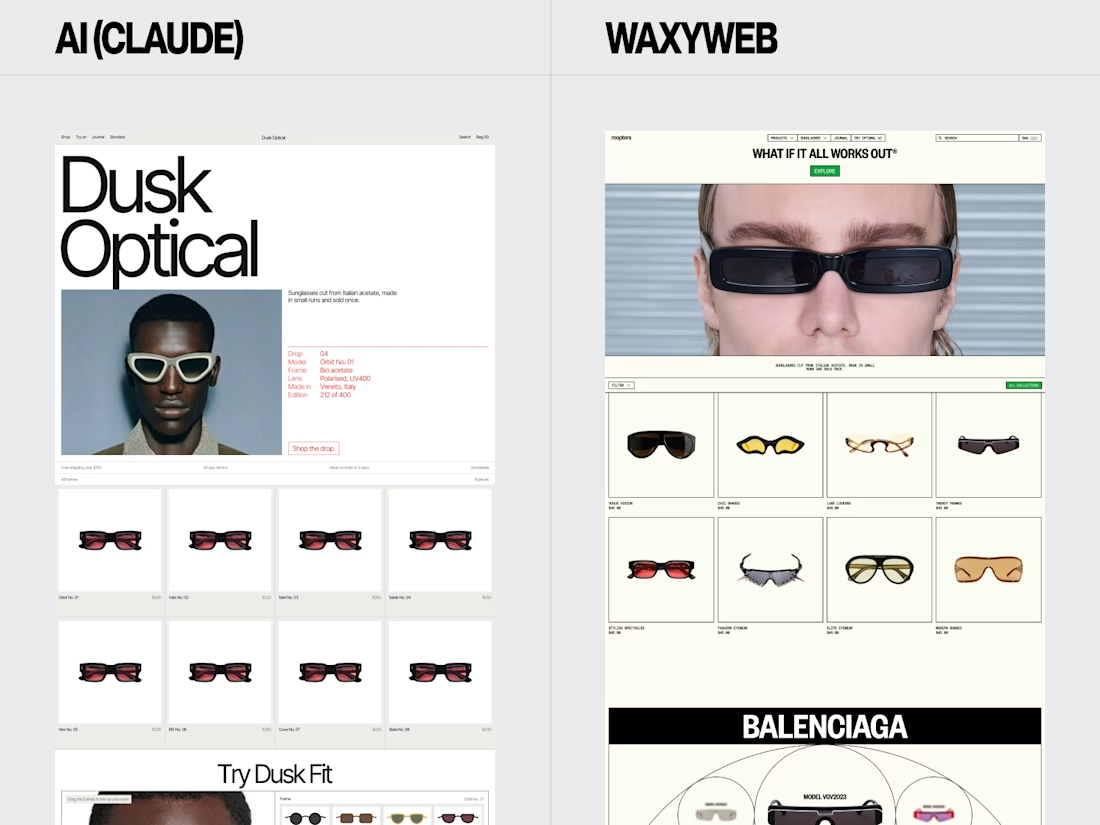
Eyewear Ecommerce Website Redesign — AI vs. WaxyWeb
A side-by-side design comparison exploring two approaches to an online eyewear store.
The WaxyWeb redesign focuses on the relationship between product presentation, collection browsing, editorial imagery, and the store’s visual identity.
Design considerations:
Eyewear product presentation
Ecommerce layout and hierarchy
Collection and product discovery
Fashion-focused visual direction
Consistent online shopping experience
For fashion, eyewear, and lifestyle brands, the goal is to create a store that presents products clearly while giving the brand a recognisable visual presence.
Website design and development: www.waxyweb.com


WaxyWeb

Steer an endless night-flight over a procedural city. NOCTURNE is a night-flight airline for insomniacs. An infinite procedural city passes beneath the wing. Steer with your mouse. Built by Samin Sami.
I built this project to test Steer an endless night-flight over a procedural city. NOCTURNE is a night-flight airline for insomniacs. An infinite procedural city passes beneath the wing. Steer with your mouse. Built by Samin Sami. The core engineering challenge was sustaining uncompromised 60 FPS rendering using Three.js (GLB 3D) while handling continuous user interaction without framework overhead.
WHAT I WAS TESTING:
I focused on two core engineering benchmarks:
Precision implementation of infinite world under continuous interactive user input
Sustained 60 FPS render performance and zero-dependency browser execution
THE TECHNICAL SIDE:
Engineered directly in the browser with Three.js (GLB 3D), Canvas2D, Infinite world. The application runs without third-party frameworks or build-step dependencies, using hardware-accelerated rendering and custom event loops to achieve zero-latency response.
Everything executes in the browser using Three.js (GLB 3D), Canvas2D, Infinite world. No third-party frameworks, no heavy runtime bundles, and zero external tracking.
WHAT I LEARNED:
Balancing the mathematical rigors of infinite world with tactile browser interaction required tuning event throttling and memory allocation to eliminate all garbage collection stutters.
Finding the sweet spot between mathematical precision and frame budget took careful profiling, but the result runs at a steady 60 FPS even on modest hardware.
TRY IT YOURSELF:
The live build is deployed on Netlify. Open it in your browser, test the controls, and observe the render response times.
If you are building high-performance 3D, physics, or creative web systems and want to collaborate, reach out here on Contra.


Anyone wants to see the source code can check it out in my JSFiddle: https://jsfiddle.net/Saminsami/n97a8xw1/1
jsfiddle.net
Nocturne - Samin Sami
Nocturne - Samin Sami - a HTML example you can edit and run in your browser on JSFiddle.
Colours that refuse to mix, combed on water in a stone trough. The Mordant Vault guards colours that refuse to blend. Float them on water. Comb them. Never, under any circumstance, stir.
I built this project to test Colours that refuse to mix, combed on water in a stone trough. The Mordant Vault guards colours that refuse to blend. Float them on water. Comb them. Never, under any circumstance, stir. The core engineering challenge was sustaining uncompromised 60 FPS rendering using WebGL / GLSL Shaders while handling continuous user interaction without framework overhead.
WHAT I WAS TESTING:
I focused on two core engineering benchmarks:
Precision implementation of shader marbling under continuous interactive user input
Sustained 60 FPS render performance and zero-dependency browser execution
THE TECHNICAL SIDE:
Engineered directly in the browser with WebGL / GLSL Shaders, Canvas2D, Shader marbling. The application runs without third-party frameworks or build-step dependencies, using hardware-accelerated rendering and custom event loops to achieve zero-latency response.
Everything executes in the browser using WebGL / GLSL Shaders, Canvas2D, Shader marbling. No third-party frameworks, no heavy runtime bundles, and zero external tracking.
WHAT I LEARNED:
Balancing the mathematical rigors of shader marbling with tactile browser interaction required tuning event throttling and memory allocation to eliminate all garbage collection stutters.
Finding the sweet spot between mathematical precision and frame budget took careful profiling, but the result runs at a steady 60 FPS even on modest hardware.
TRY IT YOURSELF:
The live build is deployed on Netlify. Open it in your browser, test the controls, and observe the render response times.
If you are building high-performance 3D, physics, or creative web systems and want to collaborate, reach out here on Contra.


Anyone who wants the source code can check this in my JSFiddle : https://jsfiddle.net/Saminsami/ezy9k74t/4
jsfiddle.net
Mordant - Samin Sami
Mordant - Samin Sami - a HTML example you can edit and run in your browser on JSFiddle.

